

Chinese Journal of Magnetic Resonance >
Study of Visual Hybrid Brain-Computer Interface Based on Wearable Magnetoencephalogram
Received date: 2024-02-02
Online published: 2024-03-11
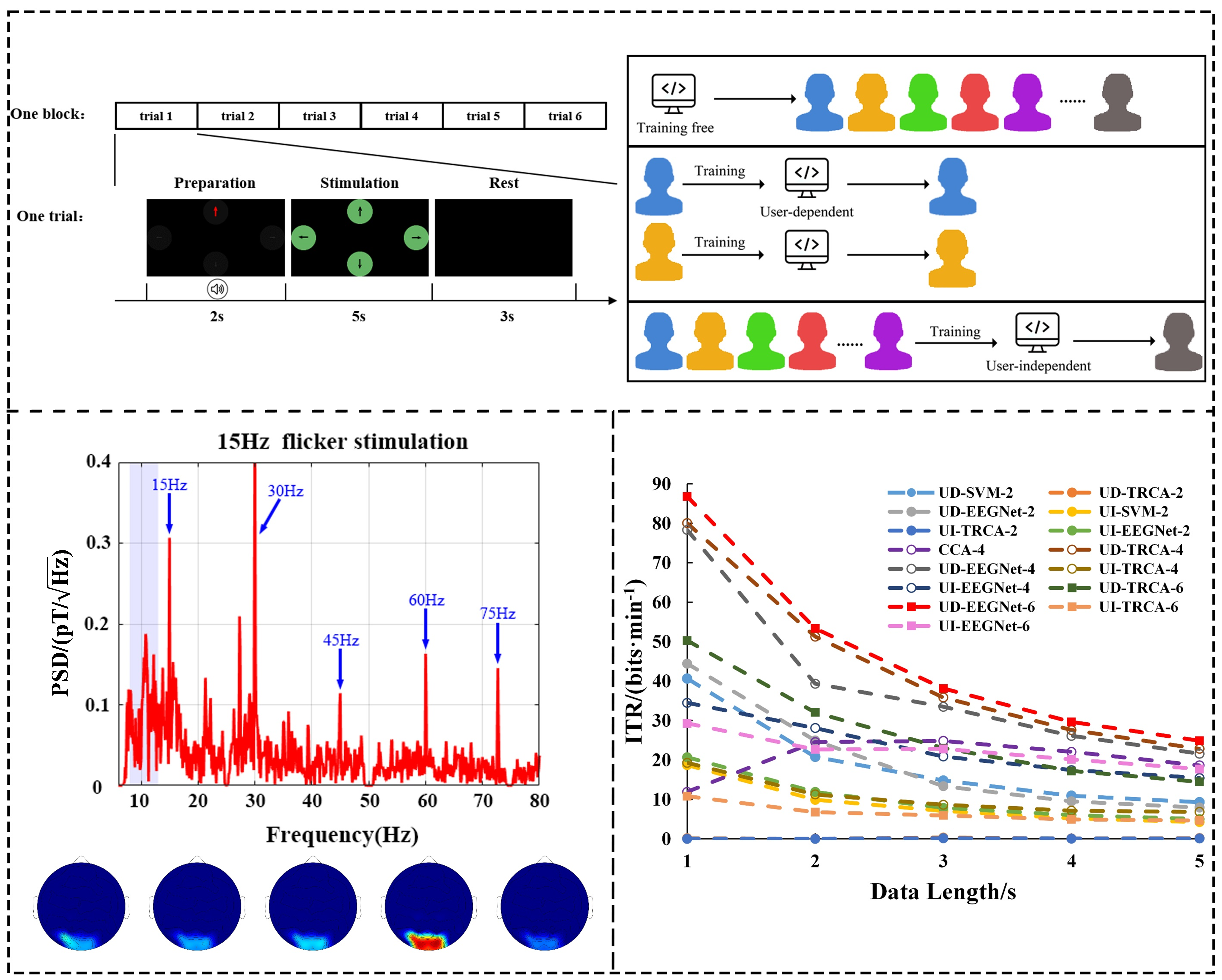
The emerging wearable magnetoencephalography technology lays the foundation for brain-computer interface to provide high-quality data. To explore the feasibility of applying wearable magnetoencephalography in visual hybrid brain-computer interface, a SSVEF-Alpha hybrid brain-computer interface is designed based on steady-state visual evoked field and Alpha wave, and the performance is compared with different classification models. The results show that based on the user-dependent training method, the average classification accuracy of hybrid brain-computer interface is (93.29±1.69)%, the information transmission rate can reach 86.81 bits/min. And the user-independent training method with short data length shows superiority over the training-free method. This study verifies the effectiveness of visual hybrid brain-computer interface and provides a reference example for further development and design of brain-computer interface products of wearable magnetoencephalography.
WANG Chenxu , GUO Xu , WANG Hui , ZHANG Xin , CHANG Yan , GUO Qingqian , HU Tao , FENG Xiaoyu , YANG Xiaodong . Study of Visual Hybrid Brain-Computer Interface Based on Wearable Magnetoencephalogram[J]. Chinese Journal of Magnetic Resonance, 2024 , 41(4) : 405 -417 . DOI: 10.11938/cjmr20243096
| [1] | BENABID A L, COSTECALDE T, ELISEYEV A, et al. An exoskeleton controlled by an epidural wireless brain-machine interface in a tetraplegic patient: a proof-of-concept demonstration[J]. Lancet Neurol, 2019, 18(12): 1112-1122. |
| [2] | ZHAI W W, YANG Y N, LU S Y, et al. Brain computer interface system research of upper limb rehabilitation training robot[J]. Journal of Biomedical Engineering Research, 2019, 38(3):269-274. |
| 翟文文, 杨玉娜, 鲁守银, 等. 上肢康复训练机器人的脑机接口系统研究[J]. 生物医学工程研究, 2019, 38(3): 269-274. | |
| [3] | ANUMANCHIPALLI G K, CHARTIER J, CHANG E F. Speech synthesis from neural decoding of spoken sentences[J]. Nature, 2019, 568(7753): 493-498. |
| [4] | LEEB R, FRIEDMAN D, MüLLER-PUTZ G R, et al. Self-paced (asynchronous) BCI control of a wheelchair in virtual environments: a case study with a tetraplegic[J]. Comput Intell Neurosci, 2007, 2007: 79642. |
| [5] | ZRENNER C, DESIDERI D, BELARDINELLI P, et al. Real-time EEG-defined excitability states determine efficacy of TMS-induced plasticity in human motor cortex[J]. Brain Stimul, 2018, 11(2): 374-389. |
| [6] | LIU H, DU Y X, PENG J, et al. A review of brain-computer interface development[J]. 2011, 24(5): 116-119. |
| 刘辉, 杜玉晓, 彭杰, 等. 脑-机接口技术发展[J]. 电子科技, 2011, 24(5): 116-119. | |
| [7] | 拉杰什P.N.拉奥. 脑机接口导论[M]. 张莉, 陈民铀, 译. 脑机接口导论, 2016. |
| [8] | VANSTEENSEL M J, PELS E G M, BLEICHNER M G, et al. Fully implanted brain-computer interface in a locked-in patient with ALS[J]. N Engl J Med, 2016, 375(21): 2060-2066. |
| [9] | PANDARINATH C, NUYUJUKIAN P, BLABE C H, et al. High performance communication by people with paralysis using an intracortical brain-computer interface[J]. Elife, 2017, 6: e18554. |
| [10] | KRUSIENSKI D J, SHIH J J. Control of a brain-computer interface using stereotactic depth electrodes in and adjacent to the hippocampus[J]. J Neural Eng, 2011, 8: 025006. |
| [11] | LOPES DA SILVA F. EEG and MEG: Relevance to neuroscience[J]. Neuron, 2013, 80(5): 1112-1128. |
| [12] | HEDRICH T, PELLEGRINO G, KOBAYASHI E, et al. Comparison of the spatial resolution of source imaging techniques in high-density EEG and MEG[J]. NeuroImage, 2017, 157: 531-544. |
| [13] | IIVANAINEN J, STENROOS M, PARKKONEN L. Measuring MEG closer to the brain: Performance of on-scalp sensor arrays[J]. NeuroImage, 2017, 147: 542-553. |
| [14] | BOTO E, HOLMES N, LEGGETT J, et al. Moving magnetoencephalography towards real-world applications with a wearable system[J]. Nature, 2018, 555(7698): 657-661. |
| [15] | ZHANG S L, CAO N. A synthetic optically pumped gradiometer for magnetocardiography measurements[J]. Chin Phys B, 2020, 29(4): 040702. |
| [16] | TIERNEY T M, HOLMES N, MELLOR S, et al. Optically pumped magnetometers: From quantum origins to multi-channel magnetoencephalography[J]. NeuroImage, 2019, 199: 598-608. |
| [17] | CHEN C Q, ZHANG X, GUO Q Q, et al. Moving wearable magnetoencephalography measurement study based on optically-pumped magnetometer[J]. Chinese J Magn Reson, 2022, 39(3): 337-344. |
| 陈春巧, 张欣, 郭清乾, 等. 基于原子磁力计的穿戴式脑磁图动态测量研究[J]. 波谱学杂志, 2022, 39(3): 337-344. | |
| [18] | SUN W, WANG H, ZHANG Y, et al. Optimal design for quantification of gas concentration based olfactory stimulator[J]. Chinese J Magn Reson, 2021, 38(1):12-21. |
| 孙韦, 王慧, 张寅, 等. 基于气体浓度定量的嗅觉刺激器优化设计[J]. 波谱学杂志, 2021, 38(1): 12-21. | |
| [19] | REGAN D. Steady-state evoked potentials[J]. J Opt Soc Am, 1977, 67(11): 1475-1489. |
| [20] | ZHIGALOV A, HERRING J D, HERPERS J, et al. Probing cortical excitability using rapid frequency tagging[J]. NeuroImage, 2019, 195: 59-66. |
| [21] | BRICKWEDDE M, SCHMIDT M D, KRüGER M C, et al. 20 Hz steady-state response in somatosensory cortex during induction of tactile perceptual learning through LTP-like sensory stimulation[J]. Front Hum Neurosci, 2020, 14: 257. |
| [22] | DEWAN E M. Occipital Alpha rhythm eye position and lens accommodation[J]. Nature, 1967, 214(5092): 975-977. |
| [23] | LI L, ZHANG J X. Study of the alpha wave differences between eyes-closed and eyes-open resting states[J]. Journal of University of Electronic Science and Technology of China, 2010, 39(3): 450-453. |
| 李凌, 张金香. 闭眼与开眼静息状态下脑电α波的差异研究[J]. 电子科技大学学报, 2010, 39(3): 450-453. | |
| [24] | KIRKUP L, SEARLE A, CRAIG A, et al. EEG-based system for rapid on-off switching without prior learning[J]. Med Biol Eng Comput, 1997, 35(5): 504-509. |
| [25] | WITTEVRONGEL B, HOLMES N, BOTO E, et al. Practical real-time MEG-based neural interfacing with optically pumped magnetometers[J]. BMC Biol, 2021, 19(1): 158. |
| [26] | LI X, CHEN J, SHI N, et al. A hybrid steady-state visual evoked response-based brain-computer interface with MEG and EEG[J]. Expert Syst Appl, 2023, 223: 119736. |
| [27] | RAVI A, BENI N H, MANUEL J, et al. Comparing user-dependent and user-independent training of CNN for SSVEP BCI[J]. J Neural Eng, 2020, 17(2): 026028. |
| [28] | ZHAO D, WANG T, TIAN Y, et al. Filter bank convolutional neural network for SSVEP classification[J]. IEEE Access, 2021, 9: 147129-147141. |
| [29] | BRAINARD D H. The psychophysics toolbox[J]. Spat Vis, 1997, 10(4): 433-436. |
| [30] | VAPNIK V. Statistical learning theory[M]. New York: Wiley, 1998. |
| [31] | NAKANISHI M, WANG Y, WANG Y T, et al. A comparison study of canonical correlation analysis based methods for detecting steady-state visual evoked potentials[J]. PLoS One, 2015, 10(10): e0140703. |
| [32] | TANAKA H, KATURA T, SATO H. Task-related component analysis for functional neuroimaging and application to near-infrared spectroscopy data[J]. NeuroImage, 2013, 64: 308-327. |
| [33] | LAWHERN V J, SOLON A J, WAYTOWICH N R, et al. EEGNet: a compact convolutional neural network for EEG-based brain-computer interfaces[J]. J Neural Eng, 2018, 15(5): 056013. |
| [34] | WOLPAW J R, RAMOSER H, MCFARLAND D J, et al. EEG-based communication: improved accuracy by response verification[J]. IEEE Trans Rehabil Eng, 1998, 6(3): 326-333. |
| [35] | ZHANG Y, VALSECCHI M, GEGENFURTNER K R, et al. The time course of chromatic adaptation in human early visual cortex revealed by SSVEPs[J]. J Vis, 2023, 23(5): 17. |
/
| 〈 |
|
〉 |