

Chinese Journal of Magnetic Resonance >
Time-varying Analysis of Brain Networks Based on High-order Dynamic Functional Connections in Mild Cognitive Impairment
Received date: 2024-03-22
Online published: 2024-05-08
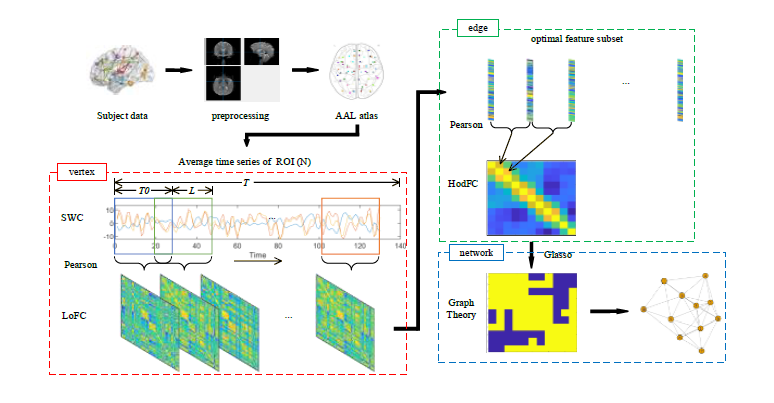
Existing research commonly uses functional connectivity (FC) combined with graph theory analysis to accomplish the auxiliary diagnosis of mild cognitive impairment (MCI). Traditional FC analysis methods usually target low-order FC networks, while high-order FC networks can reveal higher-level interactions in brain networks. However, there are few studies involving graph theory in high-order FC networks, and traditional graph theory indicators have limitations in high-order FC networks. This paper constructs a high-order FC network through high-order dynamic functional connections, combines graph theory to analyze the brain network status of MCI and normal cognition (NC), and defines two new graph theory indicators, blocking coefficient and average transition time, to characterize temporal variability in brain networks. The results show that the application of graph theory in high-order FC network can effectively extract the differential information between MCI group and NC group. The proposed blocking coefficient and average conversion time index can both show significant differences, providing a new analysis method for the study of high-order brain network.
WANG Xia , WANG Yong , LAN Qing . Time-varying Analysis of Brain Networks Based on High-order Dynamic Functional Connections in Mild Cognitive Impairment[J]. Chinese Journal of Magnetic Resonance, 2024 , 41(3) : 286 -303 . DOI: 10.11938/cjmr20243102
| [1] | PETERSEN R C. Mild cognitive impairment: transition between aging and Alzheimer’s disease[J]. Neurologia, 2000, 15(3): 93-101. |
| [2] | GAUTHIER S, REISBERG B, ZAUDIG M, et al. Mild cognitive impairment[J]. The Lancet, 2006, 367(9518): 1262-1270. |
| [3] | MAHMOUDI A, TAKERKART S, REGRAGUI F, et al. Multivoxel pattern analysis for FMRI data: a review[J]. Comput Math Methods Med, 2012, 2012: 961257. |
| [4] | BINNEWIJZEND M A A, SCHOONHEIM M M, SANZ-ARIGITA E, et al. Resting-state fMRI changes in Alzheimer’s disease and mild cognitive impairment[J]. Neurobiol Aging, 2012, 33(9): 2018-2028. |
| [5] | HUTCHISON R M, WOMELSDORF T, ALLEN E A, et al. Dynamic functional connectivity: Promise, issues, and interpretations[J]. NeuroImage, 2013, 80: 360-378. |
| [6] | KUDELA M, HAREZLAK J, LINDQUIST M A. Assessing uncertainty in dynamic functional connectivity[J]. NeuroImage, 2017, 149: 165-177. |
| [7] | THOMPSON G J, MAGNUSON M E, MERRITT M D. et al. Short-time windows of correlation between large-scale functional brain networks predict vigilance intraindividually and interindividually[J]. Hum Brain Mapp, 2013, 34(12): 3280-3298. |
| [8] | WEE C Y, YANG S, YAP P T, et al. Sparse temporally dynamic resting-state functional connectivity networks for early MCI identification[J]. Brain Imaging Behav, 2016, 10(2): 342-356. |
| [9] | DAMARAJU E, ALLEN A E, BELGER A, et al. Dynamic functional connectivity analysis reveals transient states of dysconnectivity in schizophrenia[J]. NeuroImage: Clin, 2014, 5: 298-308. |
| [10] | LEONARDI N, RICHIARDI J, GSCHWIND M, et al. Principal components of functional connectivity: A new approach to study dynamic brain connectivity during rest[J]. NeuroImage, 2013, 83: 937-950. |
| [11] | SAVVA A D, MATSOPOULOS G K, MITSIS G D. A wavelet-based approach for estimating time-varying connectivity in resting-state fMRI[J]. Brain Connect, 2021, 12(3): 285-298. |
| [12] | ZHANG Y F, SIMON V L, CABALLERO M á A, et al. Enhanced resting-state functional connectivity between core memory-task activation peaks is associated with memory impairment in MCI[J]. Neurobiol Aging, 2016, 45: 43-49. |
| [13] | CHEN X B, ZHANG H, GAO Y, et al. High-order resting-state functional connectivity network for MCI classification[J]. Hum Brain Mapp, 2016, 37(9): 3282-3296. |
| [14] | ZHANG Y, ZHANG H, CHEN X B, et al. Hybrid high-order functional connectivity networks using resting-state functional MRI for mild cognitive impairment diagnosis[J]. Sci Rep, 2017, 7(1): 6530. |
| [15] | WANG Z, SHU H, LIU D, et al. Research progress of brain structure and functional network based on graph theory analysis in Alzheimer’s disease and Mild cognitive impairment[J]. Journal of Southeast University (Medical Science Edition), 2015, 34 (1): 135-138. |
| 王赞, 束昊, 刘端, 等. 阿尔茨海默病和轻度认知障碍中基于图论分析的脑结构和脑功能网络研究进展[J]. 东南大学学报(医学版), 2015, 34(1): 135-138. | |
| [16] | SALVADOR R, SUCKLING J, COLEMAN M R, et al. Neurophysiological architecture of functional magnetic resonance images of human brain[J]. Cereb Cortex, 2005, 15: 1332-1342. |
| [17] | STAM C J, JONES B F, NOLTE G, et al. Small-world networks and functional connectivity in Alzheimer’s disease[J]. Cereb Cortex, 2007, 17: 92-99. |
| [18] | WANG X, WANG Y, WU H F, et al. Graph theory network construction method and classification of high-order dynamic functional connectivity in MCI patients[J]. Application Research of Computers, 2024, 41(4): 1094-1103. |
| 王霞, 王勇, 吴海锋, 等. MCI患者高阶动态功能连接的图论网络构建方法及分类[J]. 计算机应用研究, 2024, 41(4): 1094-1103. | |
| [19] | HOJJATI S H, EBRAHIMZADEH A, KHAZAEE A. Predicting conversion from MCI to AD using resting-state fMRI, graph theoretical approach and SVM[J]. J Neurosci Methods, 2017, 282: 69-80. |
| [20] | YAN C G, WANG X D, ZUO X N, et al. DPABI: Data processing & analysis for (resting-state) brain imaging[J]. Neuroinf, 2016, 14(3): 339-351. |
| [21] | ANDERSON A, COHEN M S. Decreased small-world functional network connectivity and clustering across resting state networks in schizophrenia: An fMRI classification tutorial[J]. Front Hum Neurosci, 2013, 7: 520. |
| [22] | WANG K, LIANG M, WANG L, et al. Altered functional connectivity in early Alzheimer’s disease: a resting-state fMRI study[J]. Hum Brain Mapp, 2007, 28 (10): 967-78. |
| [23] | LIU Z Y, ZHANG Y M, BAI L J, et al. Investigation of the effective connectivity of resting state networks in Alzheimer’s disease: a functional MRI study combining independent components analysis and multivariate Granger causality analysis[J]. NMR in Biomed, 2012, 25 (12): 1311-1320. |
| [24] | FATEMEH M, MARYAM N, ZARE A S, et al. Effective connectivity evaluation of resting-state brain networks in Alzheimer’s disease, amnestic mild cognitive impairment, and normal aging: An exploratory study[J]. Brain Sci, 2023, 13(2): 265-265. |
| [25] | LI W, WEN W, CHEN X, et al. Functional evolving patterns of cortical networks in progression of Alzheimer's disease: a graph-based resting-state fMRI Study[J]. Neural plastic, 2020, 2020: 7839536. |
| [26] | FRIEDMAN J, HASTIE T, TIBSHIRANI R. Sparse inverse covariance estimation with the graphical lasso[J]. Biostat, 2008, 9(3): 432-441. |
| [27] | WILSON R S, MAYHEW S D, ROLLINGS D T, et al. Influence of epoch length on measurement of dynamic functional connectivity in wakefulness and behavioural validation in sleep[J]. NeuroImage, 2015, 112: 169-179. |
| [28] | SEN B, CHU S, PARHI K K. Ranking regions, edges and classifying tasks in functional brain graphs by sub-graph entropy[J]. Sci Rep, 2019, 9(1): 1-20. |
| [29] | WANG H, ZHU R X, DAI Z P, et al. The altered temporal properties of dynamic functional connectivity associated with suicide attempt in bipolar disorders[J]. Pro Neuropsychopharmacol Biol Psychiatry, 2023, 129: 110898. |
| [30] | VAN J H H D, LING M J, WICK V T, et al. Dynamic functional connectivity in pediatric mild traumatic brain injury[J]. NeuroImage, 2023, 285: 120470. |
| [31] | WEI C B, GONG S T, ZOU Q, et al. A comparative study of structural and metabolic brain networks in patients with mild cognitive impairment[J]. Front Aging Neurosci, 2021, 13: 774607. |
| [32] | GAO X, XU X W, HUA X Y, et al. Group similarity constraint functional brain network estimation for mild cognitive impairment classification[J]. Front Neurosci, 2020, 14: 165. |
| [33] | LI Y J, AN S, ZHANG T L, et al. Triple-network analysis of Alzheimer’s disease based on the energy landscape[J]. Front Neurosci, 2023, 17: 1171549. |
| [34] | CHEN Z H, CHEN K L, LI Y X, et al. Structural, static, and dynamic functional MRI predictors for conversion from mild cognitive impairment to Alzheimer’s disease: Inter-cohort validation of Shanghai memory study and ADNI[J]. Hum Brain Mapp, 2023, 45(1): e26529. |
/
| 〈 |
|
〉 |