

Chinese Journal of Magnetic Resonance >
The Impact of K-Space Filling Strategy on Fat Artifacts in APT Imaging Based on FLASH Sequence
Received date: 2024-04-26
Online published: 2024-05-29
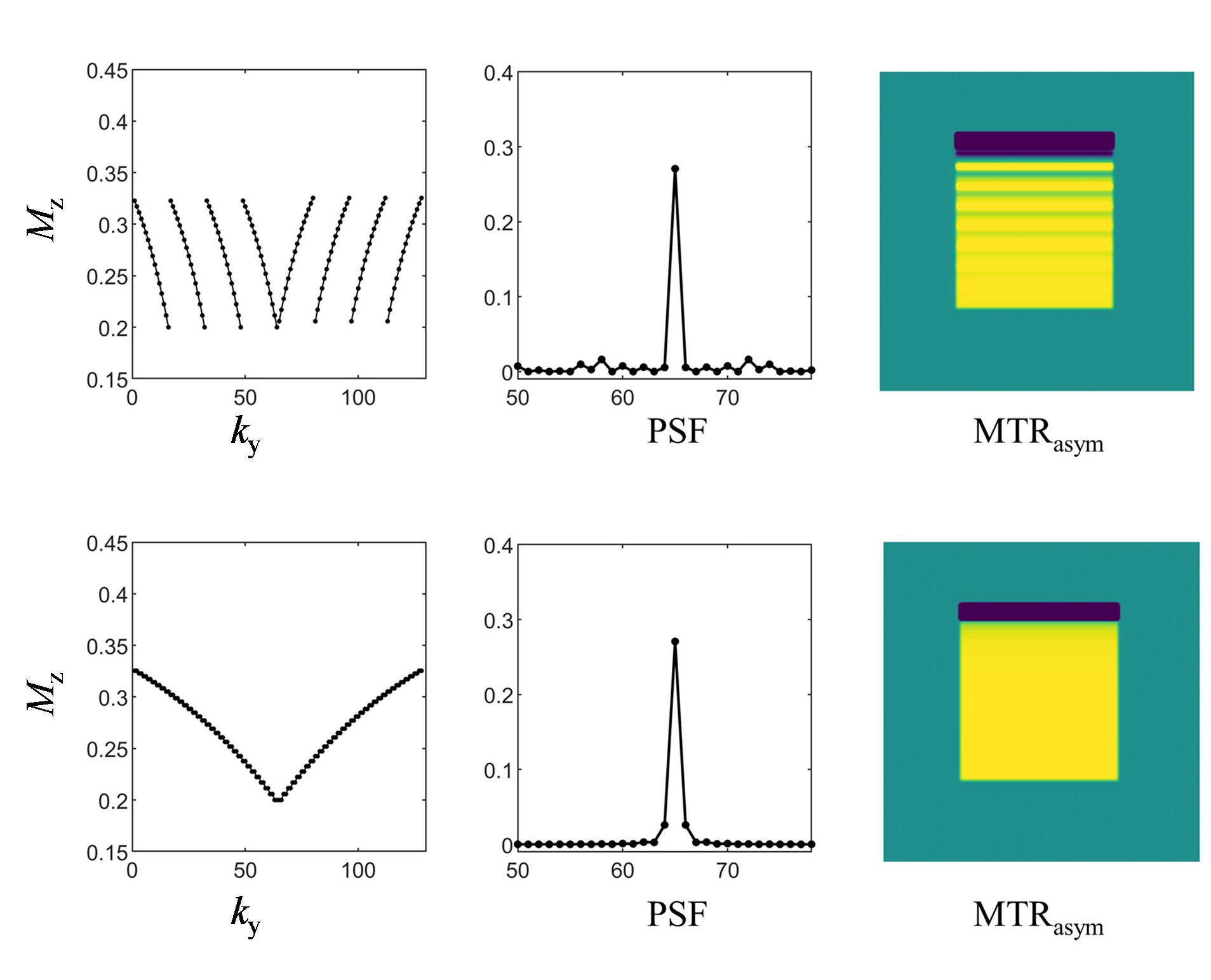
In chemical exchange saturation transfer (CEST) imaging, the relaxation recovery of longitudinal magnetization during the signal acquisition process results in a decrease in CEST contrast. Consequently, the CEST saturation mode and the corresponding K-space filling method significantly influence both the image quality and quantitative results of CEST. In this paper, simulations and human experiments were conducted to examine the impact of various K-space filling strategies within the fast low angle shot (FLASH) sequence on the quality of brain amide proton transfer (APT) images and on the quantitative analysis of magnetization transfer ratio asymmetry (MTRasym). The result indicates that employing segmented saturation techniques with optimized reordered center-out K-space filling technology can effectively mitigate artifacts caused by scalp fat and enhance the accuracy of MTRasym values.
PANG Qifan , WANG Zhichao , WU Yupeng , LI Jianqi . The Impact of K-Space Filling Strategy on Fat Artifacts in APT Imaging Based on FLASH Sequence[J]. Chinese Journal of Magnetic Resonance, 2024 , 41(4) : 443 -453 . DOI: 10.11938/cjmr20243113
| [1] | WARD K M, ALETRAS A H, BALABAN R S. A new class of contrast agents for MRI based on proton chemical exchange dependent saturation transfer (CEST)[J]. J Magn Reson, 2000, 143(1): 79-87. |
| [2] | ZHANG Y, LOU F Y, FANG K, et al. Review of a new molecular imaging method——deuterium metabolic spectroscopy and imaging[J]. Chinese J Magn Reson, 2022, 39(3): 356-365. |
| 张怡, 楼飞洋, 方可, 等. 分子影像新技术——氘代谢波谱及成像的综述与展望[J]. 波谱学杂志, 2022, 39(3): 356-365. | |
| [3] | WARD K M, BALABAN R S. Determination of pH using water protons and chemical exchange dependent saturation transfer (CEST)[J]. Magn Reson Med, 2000, 44(5): 799-802. |
| [4] | ZHOU J Y, PAYEN J F, WILSON D A, et al. Using the amide proton signals of intracellular proteins and peptides to detect pH effects in MRI[J]. Nat Med, 2003, 9(8): 1085-1090. |
| [5] | TAO Q, YI P W, WEI G J, et al. pH Imaging based on chemical exchange saturation transfer: Principles, methods, applications and recent progresses[J]. Chinese J Magn Reson, 2018, 35(4): 505-519. |
| 陶泉, 易佩伟, 魏国境, 等. 基于CEST机制的pH成像方法、原理和应用[J]. 波谱学杂志, 2018, 35(4): 505-519. | |
| [6] | TERRENO E, CASTELLI D D, CRAVOTTO G, et al. Ln(iii)-dotamgly complexes: A versatile series to assess the determinants of the efficacy of paramagnetic chemical exchange saturation transfer agents for magnetic resonance imaging applications[J]. Invest Radiol, 2004, 39(4): 235-243. |
| [7] | ZHAO X, WEN Z, HUANG F, et al. Saturation power dependence of amide proton transfer image contrasts in human brain tumors and strokes at 3 T[J]. Magn Reson Med, 2011, 66(4): 1033-1041. |
| [8] | HEO H Y, JONES C K, HUA J, et al. Whole-brain amide proton transfer (APT) and nuclear overhauser enhancement (NOE) imaging in glioma patients using low-power steady-state pulsed chemical exchange saturation transfer (CEST) imaging at 7T[J]. J Magn Reson Imaging, 2016, 44(1): 41-50. |
| [9] | SUN C, ZHAO Y, ZU Z. Validation of the presence of fast exchanging amine CEST effect at low saturation powers and its influence on the quantification of APT[J]. Magn Reson Med, 2023, 90(4): 1502-1517. |
| [10] | FOO L S, HARSTON G, MEHNDIRATTA A, et al. Clinical translation of amide proton transfer (APT) MRI for ischemic stroke: A systematic review (2003-2020)[J]. Quant Imaging Med Surg, 2021, 11(8): 3797-3811. |
| [11] | ZAISS M, EHSES P, SCHEFFLER K. Snapshot-CEST: Optimizing spiral-centric-reordered gradient echo acquisition for fast and robust 3D CEST MRI at 9.4 T[J]. NMR Biomed, 2018, 31(4): e3879. |
| [12] | ZHOU J, BLAKELEY J O, HUA J, et al. Practical data acquisition method for human brain tumor amide proton transfer (APT) imaging[J]. Magn Reson Med, 2008, 60(4): 842-849. |
| [13] | DESHMANE A, ZAISS M, LINDIG T, et al. 3D gradient echo snapshot CEST MRI with low power saturation for human studies at 3T[J]. Magn Reson Med, 2019, 81(4): 2412-2423. |
| [14] | KRISHNAMOORTHY G, NANGA R P R, BAGGA P, et al. High quality three-dimensional gagCEST imaging of in vivo human knee cartilage at 7 Tesla[J]. Magn Reson Med, 2017, 77(5): 1866-1873. |
| [15] | HAN P, CHEEMA K, LEE H L, et al. Whole-brain steady-state CEST at 3 T using MR multitasking[J]. Magn Reson Med, 2022, 87(5): 2363-2371. |
| [16] | JONES C K, POLDERS D, HUA J, et al. In vivo three-dimensional whole-brain pulsed steady-state chemical exchange saturation transfer at 7 T[J]. Magn Reson Med, 2012, 67(6): 1579-1589. |
| [17] | SCHMITT B, ZAISS M, ZHOU J, et al. Optimization of pulse train presaturation for CEST imaging in clinical scanners[J]. Magn Reson Med, 2011, 65(6): 1620-1629. |
| [18] | ZAID ALKILANI A, CUKUR T, SARITAS E U. Fd-Net: An unsupervised deep forward-distortion model for susceptibility artifact correction in EPI[J]. Magn Reson Med, 2024, 91(1): 280-296. |
| [19] | LI H, FOX-NEFF K, VAUGHAN B, et al. Parallel EPI artifact correction (PEAC) for N/2 ghost suppression in neuroimaging applications[J]. Magn Reson Imaging, 2013, 31(6): 1022-1028. |
| [20] | HAASE A, FRAHM J, MATTHAEI D, et al. FLASH imaging: Rapid NMR imaging using low flip-angle pulses. 1986[J]. J Magn Reson, 2011, 213(2): 533-541. |
| [21] | SUN P Z, CHEUNG J S, WANG E, et al. Fast multislice pH-weighted chemical exchange saturation transfer (CEST) MRI with unevenly segmented RF irradiation[J]. Magn Reson Med, 2011, 65(2): 588-594. |
| [22] | KIM H, PARK S, HU R, et al. 3D CEST MRI with an unevenly segmented RF irradiation scheme: A feasibility study in brain tumor imaging[J]. Magn Reson Med, 2023, 90(6): 2400-2410. |
| [23] | 李建奇, 林江. 现代体部磁共振诊断学原理及技术分册[M]. 上海: 复旦大学出版社, 2022. |
| [24] | HELD C, JUNKER D, WU M, et al. Intraindividual difference between supraclavicular and subcutaneous proton density fat fraction is associated with cold-induced thermogenesis[J]. Quant Imaging Med Surg, 2022, 12(5): 2877-2890. |
| [25] | ZHAO Y, YAN X, ZHANG Z, et al. Self-adapting multi-peak water-fat reconstruction for the removal of lipid artifacts in chemical exchange saturation transfer (CEST) imaging[J]. Magn Reson Med, 2019, 82(5): 1700-1712. |
| [26] | HUANG J, LAI J H C, TSE K H, et al. Deep neural network based CEST and AREX processing: Application in imaging a model of alzheimer's disease at 3 T[J]. Magn Reson Med, 2022, 87(3): 1529-1545. |
| [27] | 王志超. 化学交换饱和转移成像对比度优化及信号提取方法的研究[D]. 上海: 华东师范大学, 2021. |
| [28] | HAACKE E M. Magnetic resonance imaging : Physical principles and sequence design[M]. New York: Wiley, 1999. |
| [29] | YUSHKEVICH P A, PIVEN J, HAZLETT H C, et al. User-guided 3D active contour segmentation of anatomical structures: Significantly improved efficiency and reliability[J]. Neuroimage, 2006, 31(3): 1116-1128. |
| [30] | KIM M, GILLEN J, LANDMAN B A, et al. Water saturation shift referencing (WASSR) for chemical exchange saturation transfer (CEST) experiments[J]. Magn Reson Med, 2009, 61(6): 1441-1450. |
| [31] | ZHANG J, ZHU W, TAIN R, et al. Improved differentiation of low-grade and high-grade gliomas and detection of tumor proliferation using APT contrast fitted from Z-Spectrum[J]. Mol Imaging Biol, 2018, 20(4): 623-631. |
| [32] | TIETZE A, BLICHER J, MIKKELSEN I K, et al. Assessment of ischemic penumbra in patients with hyperacute stroke using amide proton transfer (APT) chemical exchange saturation transfer (CEST) MRI[J]. NMR Biomed, 2014, 27(2): 163-174. |
| [33] | ZHU H, JONES C K, VAN ZIJL P C, et al. Fast 3D chemical exchange saturation transfer (CEST) imaging of the human brain[J]. Magn Reson Med, 2010, 64(3): 638-644. |
| [34] | MCMAHON M T, GILAD A A, ZHOU J, et al. Quantifying exchange rates in chemical exchange saturation transfer agents using the saturation time and saturation power dependencies of the magnetization transfer effect on the magnetic resonance imaging signal (QUEST and QUESP): pH calibration for poly-L-lysine and a starburst dendrimer[J]. Magn Reson Med, 2006, 55(4): 836-847. |
| [35] | ZAISS M, ANGELOVSKI G, DEMETRIOU E, et al. QUESP and QUEST revisited-fast and accurate quantitative CEST experiments[J]. Magn Reson Med, 2018, 79(3): 1708-1721. |
| [36] | DESMOND K L, STANISZ G J. Understanding quantitative pulsed CEST in the presence of MT[J]. Magn Reson Med, 2012, 67(4): 979-990. |
| [37] | SUN P Z, WANG Y, DAI Z, et al. Quantitative chemical exchange saturation transfer (qCEST) MRI-RF spillover effect-corrected omega plot for simultaneous determination of labile proton fraction ratio and exchange rate[J]. Contrast Media Mol Imaging, 2014, 9(4): 268-275. |
| [38] | MCVICAR N, LI A X, GONCALVES D F, et al. Quantitative tissue pH measurement during cerebral ischemia using amine and amide concentration-independent detection (AACID) with MRI[J]. J Cereb Blood Flow Metab, 2014, 34(4): 690-698. |
| [39] | JONES C K, HUANG A, XU J, et al. Nuclear overhauser enhancement (NOE) imaging in the human brain at 7 T[J]. NeuroImage, 2013, 77: 114-124. |
| [40] | HEO H Y, ZHANG Y, LEE D H, et al. Quantitative assessment of amide proton transfer (APT) and nuclear overhauser enhancement (NOE) imaging with extrapolated semi-solid magnetization transfer reference (EMR) signals: Application to a rat glioma model at 4.7 Tesla[J]. Magn Reson Med, 2016, 75(1): 137-149. |
| [41] | ZHOU J Y, ZAISS M, KNUTSSON L, et al. Review and consensus recommendations on clinical APT-weighted imaging approaches at 3T: Application to brain tumors[J]. Magn Reson Med, 2022, 88(2): 546-574. |
| [42] | GLANG F, DESHMANE A, PROKUDIN S, et al. DeepCEST 3T: Robust MRI parameter determination and uncertainty quantification with neural networks-application to CEST imaging of the human brain at 3T[J]. Magn Reson Med, 2020, 84(1): 450-466. |
| [43] | WANG Z C, ZHANG J L, ZHAO Y, et al. CEST imaging of the abdomen with neural network fitting[J]. Chinese J Magn Reson, 2022, 39(1): 33-42. |
| 王志超, 张记磊, 赵羽, 等. 基于神经网络拟合的腹部化学交换饱和转移成像[J]. 波谱学杂志, 2022, 39(1): 33-42. | |
| [44] | SHI W C, JIN Z Y, YE Z. Fast multi-channel magnetic resonance imaging based on PCAU-Net[J]. Chinese J Magn Reson, 2023, 40(1): 39-51. |
| 施伟成, 金朝阳, 叶铮. 基于PCAU-Net的快速多通道磁共振成像方法[J]. 波谱学杂志, 2023, 40(1): 39-51. | |
| [45] | LI Y J, YANG X Y, YANG X M. Magnetic resonance image reconstruction of multi-scale residual Unet fused with attention mechanism[J]. Chinese J Magn Reson, 2023, 40(3): 307-319. |
| 李奕洁, 杨馨雨, 杨晓梅. 融合注意力机制的多尺度残差Unet的磁共振图像重建[J]. 波谱学杂志, 2023, 40(3): 307-319. | |
| [46] | WINDSCHUH J, ZAISS M, EHSES P, et al. Assessment of frequency drift on CEST MRI and dynamic correction: Application to gagCEST at 7 T[J]. Magn Reson Med, 2019, 81(1): 573-582. |
| [47] | KASAHARA S, MIKI Y, MORI N, et al. Spin-echo T1-weighted imaging of the brain with interleaved acquisition and presaturation pulse at 3 T: A feasibility study before clinical use[J]. Acad Radiol, 2009, 16(7): 852-857. |
| [48] | DONOHO D L. Compressed sensing[J]. IEEE T Inform Theory, 2006, 52(4): 1289-1306. |
| [49] | ZHAO Y, SUN C S, ZU Z L. Assignment of molecular origins of NOE signal at -3.5 ppm in the brain[J]. Magn Reson Med, 2023, 90(2): 673-685. |
| [50] | HUA J, JONES C K, BLAKELEY J, et al. Quantitative description of the asymmetry in magnetization transfer effects around the water resonance in the human brain[J]. Magn Reson Med, 2007, 58(4): 786-793. |
/
| 〈 |
|
〉 |