

Chinese Journal of Magnetic Resonance >
Identification and Structural Characterization of an Unknown Trace Degradation Impurity in Cabazitaxel Injection by LC-DAD-SPE-NMR/MS
Received date: 2024-07-09
Online published: 2024-11-13
In this work, the hyphenated liquid chromatography-diode array detector-solid phase extraction-nuclear magnetic resonance/mass spectrometry (LC-DAD-SPE-NMR/MS) technique is employed to characterize a novel degradation impurity with an approximate content of 0.3%~0.4% in cabazitaxel injection. In LC analysis, the impurity is co-eluted with tween-80, an important excipient contained in cabazitaxel injection, which poses a great challenge for high-purity degradation impurity isolation and further structure elucidation. Based on LC-DAD-SPE-NMR/MS hyphenation, automatic SPE is performed to trap and concentrate the impurity, and extensive NMR analysis was performed to characterize the structure of the impurity. In the 1H NMR spectrum, partial peaks of the impurity are overlaid with co-eluted tween-80. To navigate the complexity, 1H-1H, 1H-13C correlations, 1H and 13C chemical shifts are extracted from the interfering peaks of tween-80 based on extensive analysis of 2D NMR spectra. Finally, the structure of the impurity is elucidated to be a cabazitaxel isomer with a rearranged taxane skeleton. The elucidation is completed in less than 48 h, showcasing a successful application of LC-DAD-SPE-NMR/MS hyphenation in determining the structure of an unknown trace impurity in pharmaceutical drugs, which evidences its capability and application prospects in the pharmaceutical industry.
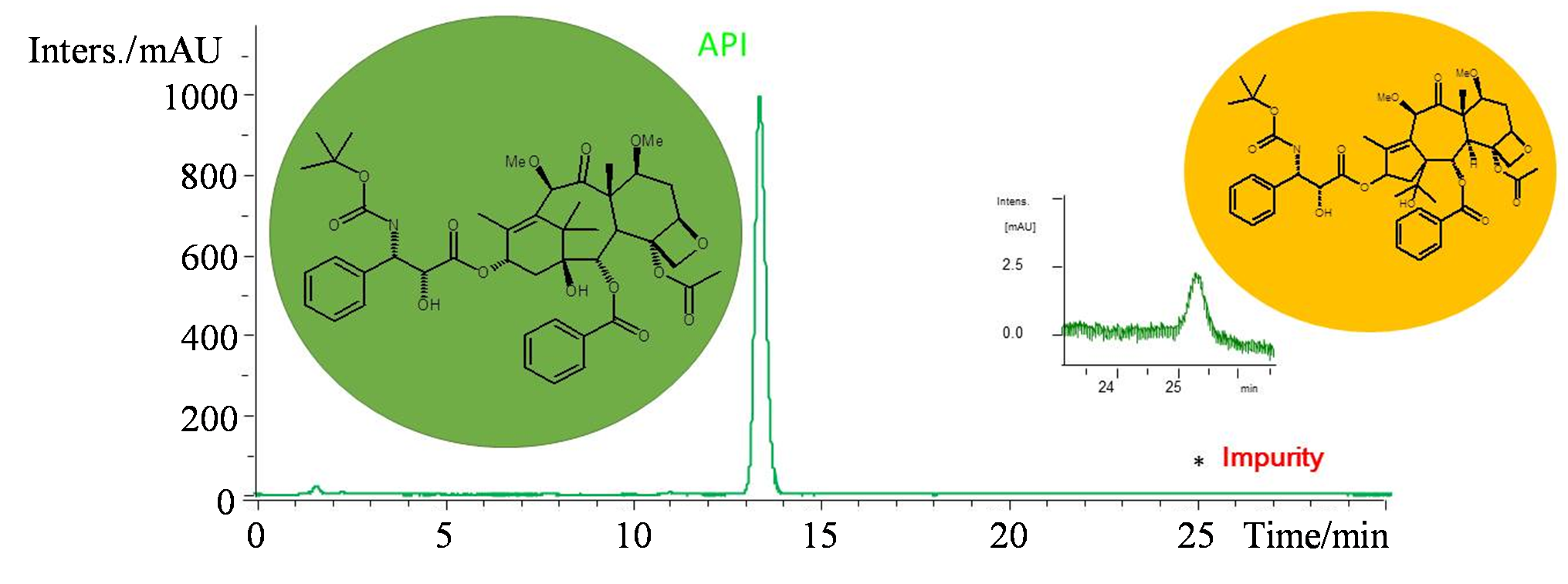
LIU Hongbing , LIU Huili , LUO Liting , SUN Lijuan , CHEN Lei . Identification and Structural Characterization of an Unknown Trace Degradation Impurity in Cabazitaxel Injection by LC-DAD-SPE-NMR/MS[J]. Chinese Journal of Magnetic Resonance, 2025 , 42(1) : 34 -46 . DOI: 10.11938/cjmr20243122
| [1] | The International Council for Harmonisation of Technical Requirements for Pharmaceuticals for Human Use. Impurities in New Drug Substances Q3A(R2)[R], 2006. https://database.ich.org/sites/default/files/Q3A_R2__Guideline.pdf |
| [2] | The International Council for Harmonisation of Technical Requirements for Pharmaceuticals for Human Use Impurities in New Drug Products Q3B(R2)[R], 2006. https://database.ich.org/sites/default/files/Q3B_R2__Guideline.pdf |
| [3] | PRAMANIK B, LEE M S, CHEN G D. Characterization of impurities and degradants using mass spectrometry[M]. Hoboken: Wiley, 2011. |
| [4] | WANG J, XU Y, WEN C M, et al. Application of a trap-free two-dimensional liquid chromatography combined with ion trap/time-of-flight mass spectrometry for separation and characterization of impurities and isomers in cefpiramide[J]. Anal Chim Acta, 2019, 992: 42-54. |
| [5] | GILLESPIE T A, WINGER B E. Mass spectrometry for small molecule pharmaceutical product development: A review[J]. Mass Spectrom Rev, 2011, 30(3): 479-490. |
| [6] | LIU Y Z, NOMIJN E P, VERNIEST G, et al. Mass spectrometry-based structure elucidation of small molecule impurities and degradation products in pharmaceutical development[J]. Trends Analyt Chem, 2019, 121: 115670. |
| [7] | QIU F H, NORWOOD D L. Identification of pharmaceutical impurities[J]. J Liq Chromatogr R T, 2007, 30(5-7): 877-935. |
| [8] | CORCORAN O, SPRAUL M. LC-NMR-MS in drug discovery[J]. Drug Discov Today, 2003, 8(14): 624-631. |
| [9] | SHARMAN G J, JONES I C. Critical investigation of coupled liquid chromatography-NMR spectroscopy in pharmaceutical impurity identification[J]. Magn Reson Chem, 2003, 41: 448-454. |
| [10] | EXARCHOU V, GODEJOHANN M, BEEK T A, et al. LC-UV-Solid-Phase Extraction-NMR-MS combined with a cryogenic flow probe and its application to the identification of com-pounds present in greek oregano[J]. Anal Chem, 2003, 75(22): 6288-6294. |
| [11] | CLARKSON C, HANSEN S H, JAROSZEWSKI J W. Hyphenation of solid-phase extraction with liquid chro-matography and nuclear magnetic resonance: Application of HPLC-DAD-SPE-NMR to identification of constituents of Kanahia laniflora[J]. Anal Chem, 2005, 77(11): 3547-3553. |
| [12] | LIU H B, ZHENG A M, YU H Y, et al. Identification of three novel polyphenolic compounds, origanine A-C, with unique skeleton from Origanum vulgare L. using the hyphenated LC-DAD-SPE-NMR/MS methods[J]. J Agric Food Chem, 2012, 60: 129-135. |
| [13] | SANDVOSS M, BARDSLEY B, BECK T L, et al. HPLC-SPE-NMR in pharmaceutical development: capabilities and applications[J]. Magn Reson Chem, 2005, 43(9): 762-770. |
| [14] | JAROSZEWSKI J W. Hyphenated NMR methods in natural products research, part 2: HPLC-SPE-NMR and other new trends in NMR hyphenation[J]. Planta Med, 2005, 71(9): 795-802. |
| [15] | WANG Y L, TANG H R, XIAO C N. Important roles of the hyphenated HPLC-DAD-MS-SPE-NMR technique in metabonomics[J]. Magn Reson Chem, 2009, 47(S1): 157-162. |
| [16] | SEGER C, GODEJOHANN M, TSENG LH, et al. LC-DAD-MS/SPE-NMR hyphenation. A tool for the analysis of pharmaceutically used plant extracts: Identification of iso-baric iridoid glycoside regioisomers from Harpagophytum procumbens[J] Anal Chem, 2005, 77(3): 878-885. |
| [17] | LIU F, WANG Y N, LI Y, et al. Minor nortriterpenoids from the twigs and leaves of Rhododendron latoucheae[J]. J Nat Prod, 2018, 81(8): 1721-1733. |
| [18] | PAN C K, LIU F, JI Q, et al. The use of LC/MS, GC/MS, and LC/NMR hyphenated techniques to identify a drug degradation product in pharmaceutical development[J]. J Pharm Biomed Anal, 2006, 40(3): 581-590. |
| [19] | RINALDI F, FAN J Y, PATHIRANA C, et al. Semi-preparative LC-SPE-cryoflow NMR for impurity identifications: use of mother liquor as a better source of impurities[J]. Magn Reson Chem, 2013, 51(9): 517-522. |
| [20] | HAR?A M, HABINOVEC I, MESTROVIC E, et al. Rapid identification of unknown impurities in 3-Bromo-5-(trifluoromethyl) aniline by LC-SPE/NMR[J]. Croat Chem Acta, 2016, 89(4): 543-547. |
| [21] | PALLER C J, ANTONARAKIS E S. Cabazitaxel: a novel second-line treatment for metastatic castration-resistant prostate cancer[J]. Drug Des Dev Ther, 2011, 5: 117-124. |
| [22] | WANG Y Y, FENG F, CHEN L, et al. Isolation, identification and characterization of potential impurities in cabazitaxel and their formation[J]. Magn Reson Chem, 2014, 52(12): 783-788. |
| [23] | LI C Y, LAN G J, JIANG J Y, et al. Development and validation of a stability-indicating HPLC Method for the determination of the impurities in cabazitaxel[J]. J Chromatographia, 2015, 78(11-12): 825-831. |
| [24] | RAJAN N, BASHA K A. A validated stability indicating UPLC method for simultaneous determination of related substances, and degradation products of cabazitaxel drug substance and its pharmaceutical injection forms[J]. J Pharm Sci Res, 2014, 6(12): 411-419. |
| [25] | FUJI K, TANAK K, Li B, et al. Taxchinin a: A diterpenoid from Taxus chinensis[J]. Tetra Lett, 1992, 33(51): 7915-7916. |
| [26] | CHATTOPADHYAY SK, SAHA G C, SHARMA R P, et al. A rearranged taxane from the himalayan yew Taxus wallichiana[J]. Phytochemistry, 1996, 42(3): 787-788. |
| [27] | SHEN Y C, CHEN Y J, CHEN C Y. Taxane diterpenoids from the seeds of Chinese yew Taxus chinensis[J]. Phytochemistry, 1999, 52(8): 1565-1569. |
| [28] | DAS B, SRINIVAS K V N S, RAVINDRANATH N, et al. Acid catalyzed conversions of toxoids[J]. J Ind Chem Soc, 2001, 78: 667-670. |
| [29] | YU D H, KANG W, HAO F, et al. Spectroscopic studies and structural elucidation of cabazitaxel[J]. Chinese J Magn Reson, 2017, 34(2): 191-199. |
| 余大海, 康旺, 郝福, 等. 卡巴他赛结构确证的波谱学研究[J]. 波谱学杂志, 2017, 34(2): 191-199. |
/
| 〈 |
|
〉 |