

Chinese Journal of Magnetic Resonance >
Experimental Study on Accurate Determination of Shale Porosity by Nuclear Magnetic Resonance
Received date: 2024-11-21
Online published: 2025-02-10
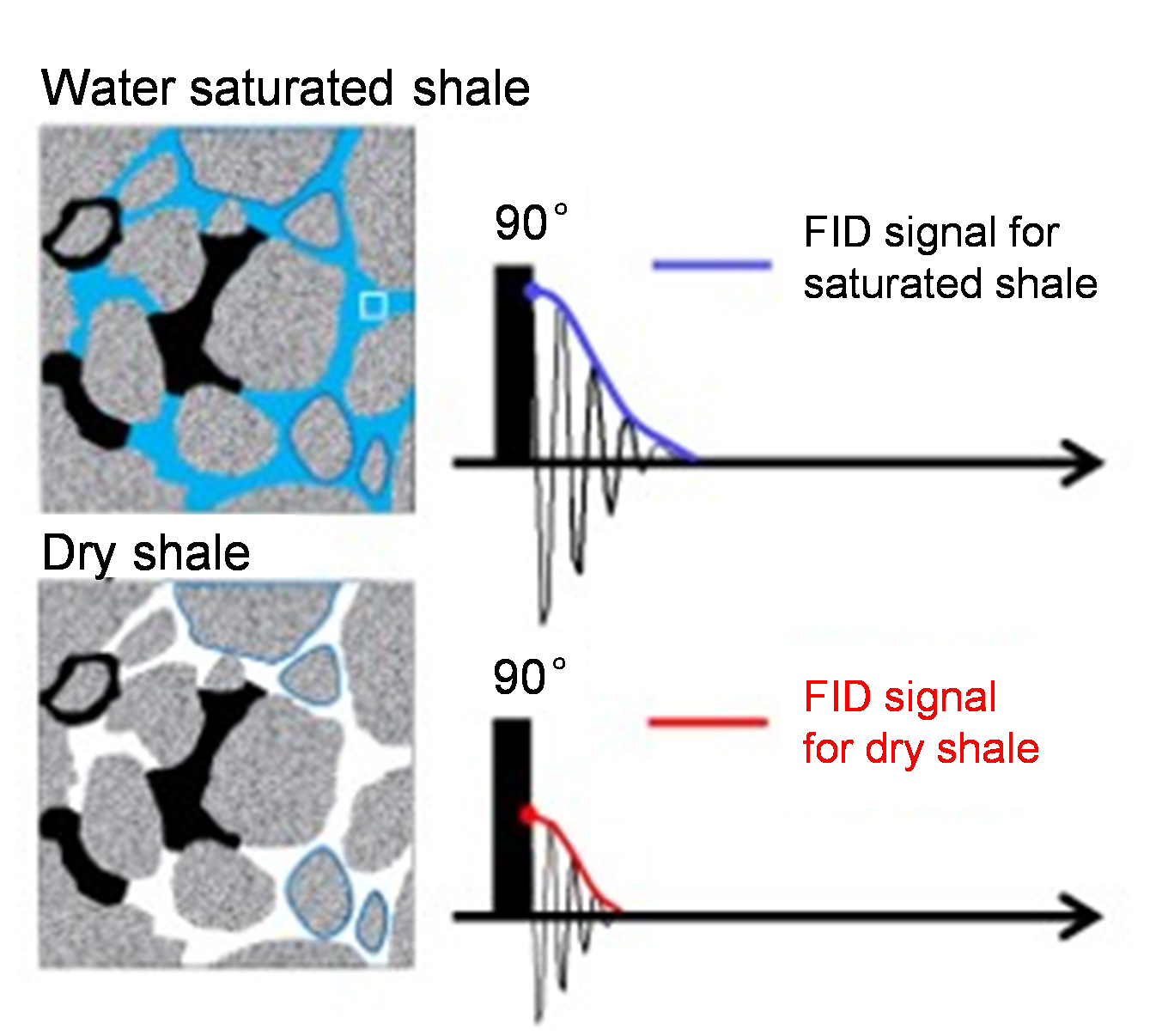
In recent years, the exploration and development of shale oil and gas have expanded significantly, accompanied by numerous challenges. Porosity is a fundamental parameter for shale reservoir evaluation and reserve estimation, providing essential data for determining sweet spots and formulating development plans. Low-field nuclear magnetic resonance (LF-NMR) technology has unique non-invasive, non-destructive characteristics and has become a crucial method for shale porosity measurement. However, shale has substantially different nuclear magnetic resonance (NMR) response mechanisms from that of conventional sandstone and carbonate reservoir rocks. Furthermore, improper experimental parameters or inversion process can lead to errors or even faults in the measurement of shale porosity by NMR. In this paper, T1-T2 correlation is adopted to qualitatively identify hydrogen-containing components in dry and saturated shale. Based on the principle that NMR signal is proportional to the number of spin protons under uniform static magnetic field and constant temperature field, an experimental method is proposed to directly measure the shale porosity. This method calibrates with standard water sample, then compares the first amplitude of the NMR free induction decay (FID) signal between water-saturated and dry shale. The experimental results show that the NMR porosity obtained through this method is in good agreement with the weight porosity, and the influence of background signal from hydrogen-containing matrix components in shale is eliminated.
DU Qunjie . Experimental Study on Accurate Determination of Shale Porosity by Nuclear Magnetic Resonance[J]. Chinese Journal of Magnetic Resonance, 2025 , 42(3) : 275 -284 . DOI: 10.11938/cjmr20243138
| [1] | COATES G, 肖立志, PRAMMER M. 核磁共振测井原理与应用[M]. 北京: 石油工业出版社, 2007. |
| [2] | 邓克俊. 核磁共振测井理论及应用[M]. 谢然红, 编. 东营: 中国石油大学出版社, 2010. |
| [3] | WASHBURN K E, BIRDWELL J E. A new laboratory approach to shale analysis using NMR relaxometry[C]// Unconventional Resources Technology Conference, Denver, Colorado. 2013: 1775-1782. |
| [4] | WASHBURN K E, ANDERSSEN E, VOGT S J, et al. Simultaneous Gaussian and exponential inversion for improved analysis of shales by NMR relaxometry[J]. J Magn Reson, 2015, 250: 7-16. |
| [5] | GUO J, MACMILLAN B, ZAMIRI M S, et al. Magnetic resonance T1-T2* and T1ρ-T2* relaxation correlation measurements in solid-like materials with non-exponential decays[J]. J Magn Reson, 2021, 328: 107005. |
| [6] | DAIGLE H, JOHNSON A, GIPS J P, et al. Porosity evaluation of shales using NMR secular relaxation[C]// Unconventional Resources Technology Conference, Denver, Colorado. 2014: 1205-1216. |
| [7] | XU H, TANG D, ZHAO J, et al. A precise measurement method for shale porosity with low-field nuclear magnetic resonance: A case study of the Carboniferous-Permian strata in the Linxing area, eastern Ordos Basin, China[J]. Fuel, 2015, 143: 47-54. |
| [8] | ZHANG P, LI J, LU S, et al. A precise porosity measurement method for oil-bearing micro/nano porous shales using low-field nuclear magnetic resonance (LF-NMR)[J]. J Nanosci Nanotechnol, 2017, 17: 6827-6835. |
| [9] | TAN M, MAO K, SONG X, et al. NMR petrophysical interpretation method of gas shale based on core NMR experiment[J]. Pet Sci Eng, 2015, 136: 100-111. |
| [10] | GUO J F, XIE R H, ZOU Y L. Simulation of NMR responses in sandstone and restricted diffusion[J]. Chinese Journal of Geophysics, 2016, 59(7): 2703-2712. (in Chinese) |
| 郭江峰, 谢然红, 邹友龙. 砂岩核磁共振响应模拟及受限扩散[J]. 地球物理学报, 2016, 59(7): 2703-2712. | |
| [11] | LI J, LU S, CHEN G, et al. A new method for measuring shale porosity with low-field nuclear magnetic resonance considering non-fluid signals[J]. Mar Pet Geol, 2019, 102: 535-543. |
| [12] | LI X, LIU P, LUO Y Y, et al. Analysis of influencing factors on porosity measurement of shale gas reservoir core[J]. Progress in Geophysics, 2015, 30(5): 2181-2187. |
| 李新, 刘鹏, 罗燕颖, 等. 页岩气储层岩心孔隙度测量影响因素分析[J]. 地球物理学进展, 2015, 30(5): 2181-2187. | |
| [13] | SUN J M, ZONG C L, DONG X, et al. Porosity measurement of crushed shales using NMR[J]. Well Logging Technology, 2017, 41(5): 512-516. |
| 孙建孟, 宗成林, 董旭. 基于核磁共振的页岩粉碎样品孔隙度研究[J]. 测井技术, 2017, 41(5): 512-516. | |
| [14] | ZHOU S W, DONG D Z, ZHANG J H, et al. Optimization of key parameters for porosity measurement of shale gas reservoirs[J]. Natural Gas Industry, 2021, 41(5): 20-29. |
| 周尚文, 董大忠, 张介辉, 等. 页岩气储层孔隙度测试方法关键参数优化[J]. 天然气工业, 2021, 41(5): 20-29. | |
| [15] | ZHANG G, HE Z B, CAO W Q, et al. Effects of echo time on NMR apparent porosity and correction methods[J]. Chinese J Magn Reson, 2020, 37(2): 172-181. |
| 张宫, 何宗斌, 曹文倩, 等. 回波间隔对核磁共振表观孔隙度的影响及矫正方法[J]. 波谱学杂志, 2020, 37(2): 172-181. | |
| [16] | DU Q, XIAO L, ZHANG Y, et al. A novel two-dimensional NMR relaxometry pulse sequence for petrophysical characterization of shale at low field[J]. J Magn Reson, 2020, 310: 106643. |
| [17] | 岩心分析方法[S]. 行业标准, 2019. |
| [18] | 岩样核磁共振参数实验室测量规范[S]. 行业标准, 2014. |
/
| 〈 |
|
〉 |