

Chinese Journal of Magnetic Resonance >
Research on Pressure Compensation for the Rubidium Atomic Clock Working in Atmospheric Environment
Received date: 2024-04-22
Online published: 2025-03-05
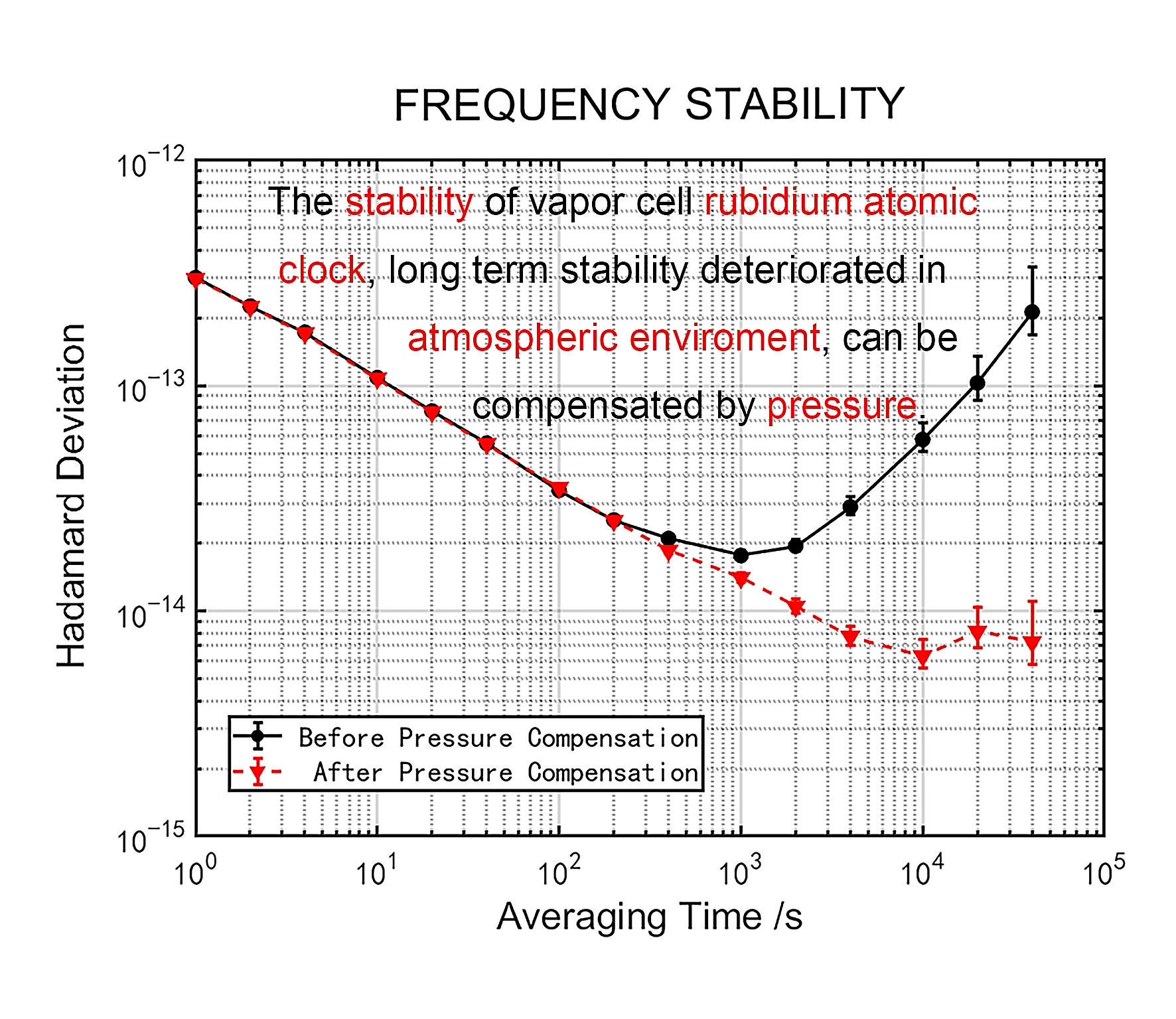
Vapor cell rubidium atomic clock is widely used in the fields of satellite navigation and communication with advantages including small size, light weight, low power and maintenance cost. The high-performance vapor cell rubidium atomic clocks in BDS-3 (Beidou-3 Navigation Satellite System) demonstrate exceptional stability, achieving 5E-13/
LI Junyao , LI Chengkang , ZHAO Feng , WANG Chen , WANG Fang , KANG Songbai , WANG Pengfei , MEI Ganghua , MING Gang . Research on Pressure Compensation for the Rubidium Atomic Clock Working in Atmospheric Environment[J]. Chinese Journal of Magnetic Resonance, 2025 , 42(1) : 96 -102 . DOI: 10.11938/cjmr20243112
| [1] | XU F, HAO Q, HE S G, et al. Spectrum characteristics and filtering effect of 87Rb-Ar spectrum lamp[J]. Chinese J Magn Reson, 2016, 33(1): 125-132. |
| 许风, 郝强, 何胜国, 等. 87Rb-Ar光谱灯光谱特性和滤光效果研究[J]. 波谱学杂志, 2016, 33(1): 125-132. | |
| [2] | MEI G H, ZHAO F, QI F, et al. Characteristics of the space-borne rubidium atomic clocks for the BeiDou III navigation satellite system[J]. Sci Sin-Phys Mech As, 2021, 51(1): 118-124. |
| [3] | LI J Y, MING G, ZHAO F, et al. A rubidium atomic frequency standard with stability at 10-15 level operated under atmospheric condition[C]// 2021 Proceedings of China satellite navigation conference (CSNC), Springer LNEE, 774: 62-73. |
| [4] | ALMAT N, GHARAVIPOUR M, MORENO W, et al. Long-term stability analysis toward <10-14 level for a highly compact POP Rb cell atomic clock[J]. IEEE T Ultrason Ferr, 2020, 67(1): 207-216. |
| [5] | VANIER J, KUNSKI R, CYR N, et al. On hyperfine frequency shifts caused by buffer gases: Application to the optically pumped passive rubidium frequency standard[J]. J Appl Phys, 1982, 53(8): 5387-5391. |
| [6] | XU J Q, LI J Y, ZHAO F, et al. High-precision frequency drift compensation study of high-performance rubidium atomic clock[J]. Chinese J Magn Reson, 2024, 41(2): 184-190. |
| 徐俊秋, 李俊瑶, 赵峰, 等. 高性能铷原子钟的高精度漂移补偿研究[J]. 波谱学杂志. 2024, 41(2): 184-190. | |
| [7] | TIMOSHENKO S, WOINOWSKY-KRIEGER S. Theory of plates & shells[M]. 2nd ed. New York, NY, USA: McGraw-Hill, 1959. |
| [8] | 邵军. 数理统计[M]. 北京: 高等教育出版社, 2018. |
/
| 〈 |
|
〉 |