

Chinese Journal of Magnetic Resonance >
19F NMR Chemical Shift-encoded cRGD-targeted Dual-modal Probe for Multicolor Imaging
Received date: 2025-11-05
Online published: 2026-08-11
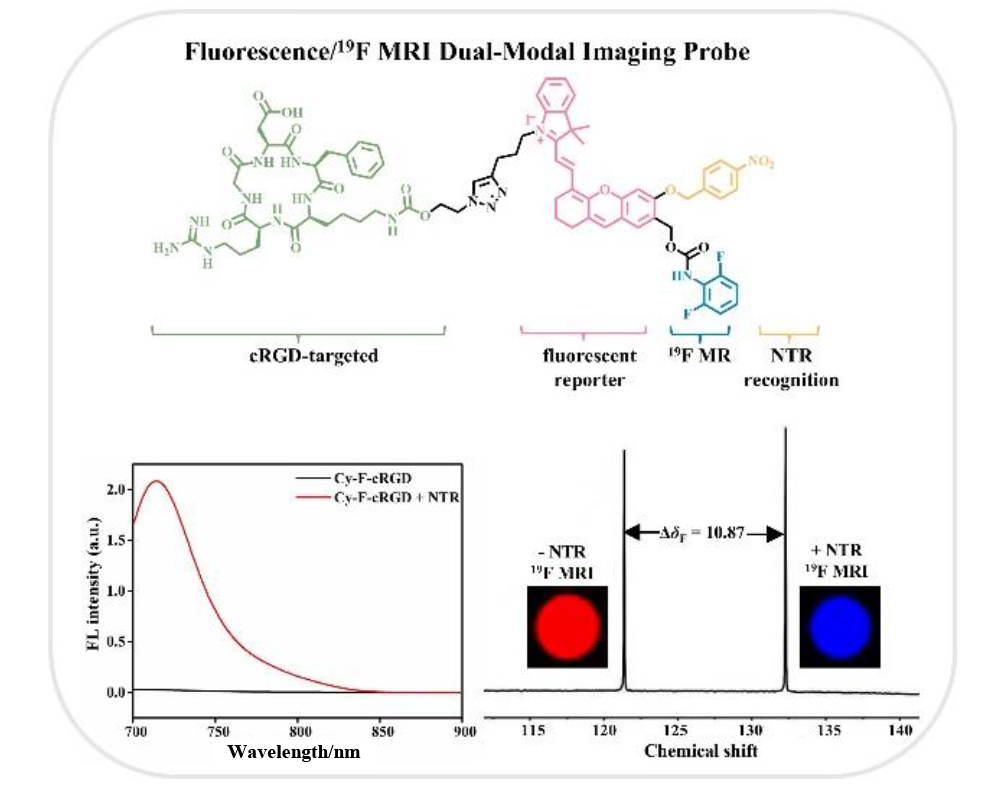
Specific imaging of the tumor microenvironment is critical for precise cancer diagnosis, yet conventional single-modal imaging techniques struggle to combine high sensitivity with high spatial resolution. This study designed and synthesized a cRGD peptide-targeted, nitroreductase (NTR)-responsive hemicyanine-19F dual-modal probe, Cy-F-cRGD. Through systematic screening of different fluorine-containing groups, we found that an ortho-difluoro structure induced a remarkable 19F chemical shift change (ΔδF = 10.87). Concurrently, the hemicyanine unit exhibited an 80 nm red shift in absorption and a 90-fold fluorescence enhancement, achieving an optical “off-on” signal switch. This work offers a new design strategy for developing smart responsive multimodal probes.
LI Na , XIAO Long , LI Sha , LIU Yudun , JIA Yushu , ZHANG Lei , CHEN Shizhen . 19F NMR Chemical Shift-encoded cRGD-targeted Dual-modal Probe for Multicolor Imaging[J]. Chinese Journal of Magnetic Resonance, 2026 , 43(3) : 279 -290 . DOI: 10.11938/cjmr20253189
| [1] | CHEN L L, LYU Y F, ZHANG X, et al. Molecular imaging: design mechanism and bioapplications[J]. Sci China Chem, 2023, 66(5): 1336-1383. |
| [2] | LIU Y R, LI Y, SUN W, et al. pH-Activatable NIR hemicyanine for mitochondria-targeted cancer phototheranostics[J]. Anal Chem, 2025, 97(6): 3310-3318. |
| [3] | TAMEZ-FERNáNDEZ J F, STEVEN C F, NGUYEN J, et al. Potent inducers of paraptosis through electronic tuning of hemicyanine electrophiles[J]. J Am Chem Soc, 2025, 147(36): 32571-32579. |
| [4] | QIU Y, LIU Z H, SUN C C, et al. Fluorescence visualization of helix inversion in biomimic polymeric foldamer[J]. Angew Chem Int Ed, 2025, 64: e12834. |
| [5] | GAO J H, LEI H, CHEN Q, et al. Magnetic resonance imaging: progresses and perspective[J]. Sci China Life Sci, 2020, 50(11): 1285-1295. |
| 高家红, 雷皓, 陈群, 等. 磁共振成像发展综述[J]. 中国科学: 生命科学, 2020, 50(11): 1285-1295. | |
| [6] | JANASIK D, KRAWCZYK T. 19F MRI probes for multimodal imaging[J]. Chem Eur J, 2022, 28(5): e202102556. |
| [7] | YANG J, LI Y B, WU L N, et al. The application of 19F-MR molecular imaging in targeted drugdelivery[J]. Chin J Magn Reson Imaging, 2020, 11(10): 954-956. |
| 杨洁, 李迎波, 吴丽娜, 等. 19F-MR分子成像在靶向药物递送中的应用[J]. 磁共振成像, 2020, 11(10): 954-956. | |
| [8] | TEMME S, KLEIMANN P, TIREN Z B, et al. Imaging of thromboinflammation by multispectral 19F MRI[J]. Int J Mol Sci, 2025, 26(6): 2462. |
| [9] | ARIN T A T, SEDLACEK O. Stimuli-responsive polymers for advanced 19F magnetic resonance imaging: from chemical design to biomedical applications[J]. Biomacromolecules, 2024, 25(9): 5630-5649. |
| [10] | FU C K, HERBST S, ZHANG C, et al. Polymeric 19F MRI agents responsive to reactive oxygen species[J]. Polym Chem, 2017, 8(31): 4585-4595. |
| [11] | LI L X, LI A, LIN Y Y, et al. An activatable 19F MRI molecular probe for sensing and imaging of norepinephrine[J]. ChemistryOpen, 2022, 11(7): e202200110. |
| [12] | REN L L, CHEN S Z, JIANG W P, et al. Efficient temperature-feedback liposome for 19F MRI signal enhancement[J]. Chem Commun, 2020, 56(92): 14427-14430. |
| [13] | CHEN S Z, XIAO L, LI Y, et al. In vivo nitroreductase imaging via fluorescence and chemical shift dependent 19F NMR[J]. Angew Chem Int Ed, 2022, 61(50): e202213495. |
| [14] | CHEN S Z, CHEN W J, GU Y W, et al. Engineering spiropyran-based ratiometric 19F MRI probes with ultralarge chemical shift variations[J]. ACS Sensors, 2025, 10(9): 6533-6541. |
| [15] | DIETSCHREIT J C B, WAGNER A, LE T A, et al. Predicting 19F NMR chemical shifts: a combined computational and experimental study of a trypanosomal oxidoreductase-inhibitor complex[J]. Angew Chem Int Ed, 2020, 59(31): 12669-12673. |
| [16] | WAN Q Q, LI Z, MA H M. Progress in fluorescent probes for nitroreductase[J]. J Anal Sci, 2014, 30(5): 755-760. |
| 万琼琼, 李照, 马会民. 硝基还原酶荧光探针的研究进展[J]. 分析科学学报, 2014, 30(5): 755-760. | |
| [17] | CAO J, CAMPBELL J, LIU L, et al. In vivo chemiluminescent imaging agents for nitroreductase and tissue oxygenation[J]. Anal Chem, 2016, 88(9): 4995-5002. |
| [18] | SARKAR S, SHIL A, JUN Y W, et al. Real-time detection of reduced nitroreductase with a reversible fluorescent probe[J]. Adv Sci, 2025, 12: e08689. |
| [19] | QIN W J, XU C C, ZHAO Y F, et al. Recent progress in small molecule fluorescent probes for nitroreductase[J]. Chin Chem Lett, 2018, 29(10): 1451-1455. |
| [20] | THIEL Z, RIVERA-FUENTES P. Single-molecule imaging of active mitochondrial nitroreductases using a photo-crosslinking fluorescent sensor[J]. Angew Chem Int Ed, 2019, 58(33): 11474-11478. |
| [21] | FU Q F, GU Z, SHEN S Y, et al. Radiotherapy activates picolinium prodrugs in tumours[J]. Nat Chem, 2024, 16(8): 1348-1356. |
| [22] | KOLAKOWSKI R V, HAELSIG K T, EMMERTON K K, et al. The methylene alkoxy carbamate self-immolative unit: utilization for the targeted delivery of alcohol-containing payloads with antibody-drug conjugates[J]. Angew Chem Int Ed, 2016, 55(28): 7948-7951. |
| [23] | MARVIN C C, HOBSON A D, MCPHERSON M, et al. Self-immolative carbamate linkers for CD19-budesonide antibody-drug conjugates[J]. Bioconjugate Chem, 2023, 34(10): 1835-1850. |
| [24] | YU Q, ZHANG L, JIANG M, et al. An NIR fluorescence turn-on and MRI bimodal probe for concurrent real-time in vivo sensing and labeling of β-galactosidase[J]. Angew Chem Int Ed, 2023, 62(46): e202313137. |
| [25] | LIU Z Q, ZHANG L, LI S, et al. Highly selective dual-modal probe for photoacoustic and magnetic resonance imaging of the labile Cu2+ pool in the liver[J]. Anal Chem, 2025, 97(34): 18707-18715. |
/
| 〈 |
|
〉 |