

Chinese Journal of Magnetic Resonance >
A Deep Learning-based Method for LF-NMR Relaxation Time Spectrum Inversion
Received date: 2026-01-26
Online published: 2026-08-11
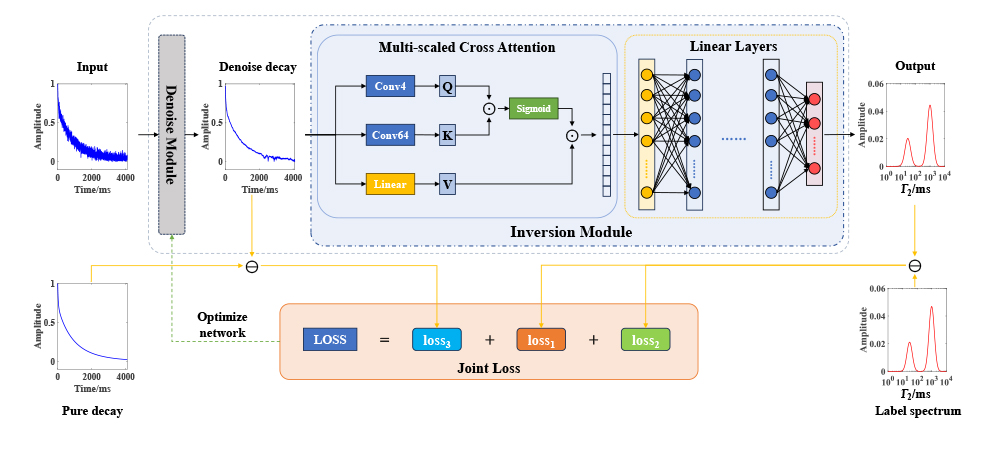
Low-field nuclear magnetic resonance (LF-NMR) relaxation time spectrum analysis has been widely applied in petroleum engineering and geological exploration. However, conventional NMR relaxation time spectrum inversion algorithms require time-domain signals with high signal-to-noise ratios (SNRs), which are often difficult to obtain in practical scenarios such as on-site core analysis. To achieve accurate and stable inversion of low-SNR NMR signals, this paper proposes a deep learning-based inversion network named UDMCA (U-Net Denoising and Multi-scale Cross Attention Inversion Network), which incorporates a multi-scale cross-attention mechanism to extract and fuse relaxation features at multiple scales according to the decay characteristics of NMR signals, thereby improving inversion accuracy for low-SNR multi-component signals. In addition, a U-Net denoising module is introduced to further enhance noise robustness. Experimental results show that the proposed method achieves accurate and stable inversion for low-SNR signals and demonstrates good applicability in core NMR signal inversion, providing an effective solution for low-SNR LF-NMR data processing and inversion.
LIU Kewen , JIANG Yukang , CHEN Fang , CHEN Junfei , LU Yuan , CHEN Li , LIU Chaoyang . A Deep Learning-based Method for LF-NMR Relaxation Time Spectrum Inversion[J]. Chinese Journal of Magnetic Resonance, 2026 , 43(3) : 307 -320 . DOI: 10.11938/cjmr20263201
| [1] | GUO J C, ZHOU H Y, ZENG J, et al. Advances in low-field nuclear magnetic resonance (NMR) technologies applied for characterization of pore space inside rocks: a critical review[J]. Pet Sci, 2020, 17(5): 1281-1297. |
| [2] | FAJT M, MAZUR-ROSMUS W, STEFA?SKA A, et al. Chert outcrops differentiation by means of low-field NMR relaxometry[J]. Sci Rep, 2024, 14(1): 25280. |
| [3] | LU Y, LIU K, WANG Y. Applying NMR T2 spectral parameters in pore structure evaluation—an example from an Eocene low-permeability sandstone reservoir[J]. Appl Sci, 2021, 11(17): 8027. |
| [4] | MITCHELL J, HOWE A M, CLARKE A. Real-time oil-saturation monitoring in rock cores with low-field NMR[J]. J Magn Reson, 2015, 256: 34-42. |
| [5] | PRANGE M, SONG Y Q. Understanding NMR spectral uncertainty[J]. J Magn Reson, 2010, 204(1): 118-123. |
| [6] | 高汉宾, 张振芳. 核磁共振原理与实验方法[M]. 武汉: 武汉大学出版社, 2008. |
| [7] | TIKHONOV A N. On the solution of ill-posed problems and the method of regularization[J]. Dokl Akad Nauk SSSR, 1963, 151(3): 501-504. |
| [8] | BUTLER J P, REEDS J A, DAWSON S V. Estimating solutions of first kind integral equations with nonnegative constraints and optimal smoothing[J]. SIAM J Numer Anal, 1981, 18(3): 381-397. |
| [9] | DAY I J. On the inversion of diffusion NMR data: Tikhonov regularization and optimal choice of the regularization parameter[J]. J Magn Reson, 2011, 211(2): 178-185. |
| [10] | BECK A, TEBOULLE M. A fast iterative shrinkage-thresholding algorithm for linear inverse problems[J]. SIAM J Imaging Sci, 2009, 2(1): 183-202. |
| [11] | BERMAN P, LEVI O, PARMET Y, et al. Laplace inversion of low-resolution NMR relaxometry data using sparse representation methods[J]. Concepts Magn Reson Part A, 2013, 42(3): 72-88. |
| [12] | ZOU Y, XIE R, LIU M, et al. Nuclear magnetic resonance spectrum inversion based on the residual hybrid L1/L2 norm[J]. IEEE Geosci Remote Sens Lett, 2018, 15(8): 1194-1198. |
| [13] | LUO S H, XIAO L Z, JIN Y, et al. Low-field NMR inversion based on low-rank and sparsity restraint of relaxation spectra[J]. Pet Sci, 2022, 19(6): 2741-2756. |
| [14] | PARASRAM T, DAOUD R, XIAO D. T2 analysis using artificial neural networks[J]. J Magn Reson, 2021, 325: 106930. |
| [15] | LUO G, XIAO L Z, LUO S H, et al. A study on multi-exponential inversion of nuclear magnetic resonance relaxation data using deep learning[J]. J Magn Reson, 2023, 346: 107358. |
| [16] | CHEN B, WU L, CUI X, et al. High-quality reconstruction for Laplace NMR based on deep learning[J]. Anal Chem, 2023, 95(31): 11596-11602. |
| [17] | DEY K K, ASH J T, TREASE N M, et al. Trading sensitivity for information: Carr-Purcell-Meiboom-Gill acquisition in solid-state NMR[J]. J Chem Phys, 2010, 133(5): 054501. |
| [18] | WHITTALL K P, MACKAY A L. Quantitative interpretation of NMR relaxation data[J]. J Magn Reson, 1989, 84(1): 134-152. |
| [19] | RONNEBERGER O, FISCHER P, BROX T. U-Net: Convolutional networks for biomedical image segmentation[C]// Medical Image Computing and Computer-Assisted Intervention-MICCAI 2015. Cham: Springer, 2015: 234-241. |
| [20] | KOMATSU R, GONSALVES T. Comparing U-Net based models for denoising color images[J]. AI, 2020, 1(4): 465-486. |
/
| 〈 |
|
〉 |