


引言
纵向多自旋阶(Longitudinal Multi-spin Orders,LMOs)是一类特殊的非平衡态磁化模式,为NMR研究偶合体系提供独特途径.这类磁化模式产生于存在标量偶合、偶极偶合或四极相互作用的多自旋体系中,表现为沿纵向(z轴)方向的多自旋相干[3].从量子力学角度分析,LMOs对应于多自旋系统密度矩阵的特定非对角元,例如双自旋阶(IkzIlz)和三自旋阶(IkzIlzImz)分别表征二自旋和三自旋体系中的高阶极化分布.
频率循环法通过改变跃迁脉冲的激发频率,可选择性产生特定偶合体系的LMO信号,从而实现不同化合物信号的谱图分离.然而,传统FC方法存在固有缺陷:180°翻转脉冲受射频场不均匀及脉冲长度误差等影响,导致后续小角度翻转脉冲将LMO信号转换为可检测信号时,会引入与目标LMO无关的强干扰信号,显著降低谱图解析可靠性.
针对DQF-LMO方法的信号损失问题,目前研究从信号增强、脉冲序列优化和信号采集三个维度提出改进方案.在信号增强方面,动态核极化(DNP)等技术可大幅提升初始信号强度[15];脉冲序列设计方面通过重聚焦脉冲和相位循环方案优化能够提高信号接收效率[14,16];而多次扫描累加的方法则有效抑制随机噪声的干扰.基于这些研究基础,本研究将Hadamard编码技术与DQF-LMO相结合提出改进序列.该方法通过多色跃迁脉冲同时产生不同偶合体系的LMOs,同时引入Hadamard编码方案显著优化信号采集效率.为验证方法的普适性,我们选取橙汁中具有环状结构的糖类化合物和混合氨基酸中的链式化合物作为测试体系.实验结果表明,改进后的序列能够有效利用双峰和四重峰的偶合裂分特征实现重叠谱峰分离,同时将信噪比(SNR)提升至DQF-LMO方法的2倍左右,为复杂混合物的NMR分析提供了新的解决方案.
1 理论部分
1.1 脉冲序列
图1是Hadamard编码的纵向多自旋阶二量子滤波一维谱(Hadamard Encoded Double-Quantum-Filtered Longitudinal Multi-spin Orders,Hadamard-DQF-LMO)方法的脉冲序列.该方法的核心在于将Hadamard编码与产生纵向多自旋阶的频率循环法相结合.脉冲序列由以下几个部分组成:预饱和压水模块WS,多色180°跃迁脉冲p1,Hadamard编码的多色180°脉冲p2,奇偶阶筛选非选择性180°脉冲,由两个非选择性90°脉冲和强度比为1:2的梯度场组成的二量子滤波模块以及采样期组成.N阶Hadamard-DQF-LMO实验由N个子实验构成.在每次子实验中,信号经压水模块后,由多色180°跃迁脉冲p1作用于N个偶合体系中主动自旋k的裂峰谱线,设计频率循环获得纵向二自旋阶信号
其中
图1

图1
Hadamard-DQF-LMO脉冲序列. 射频部分(RF)中,白色矩形表示预饱和压水模块(WS),多重波形p1和p2分别代表多色180°跃迁脉冲和Hadamard编码的多色180°脉冲,虚线矩形和黑色矩形分别代表180°和90°的非选择性脉冲. 梯度场部分(Gz)的矩形G1和G2表示散相梯度场,其强度比为1:2
Fig. 1
The Hadamard-DQF-LMO pulse sequence. The white rectangle represents the water suppression (WS) presaturation module, while the composite waveforms p1 and p2 correspond to the polychromatic 180° transition pulse and Hadamard-encoded polychromatic 180° pulse, respectively. The dashed and solid black rectangles denote non-selective 180° and 90° pulses, respectively. The rectangles G1 and G2 indicate the dephasing gradient fields with an intensity ratio of 1:2
1.2 Hadamard编解码
图2
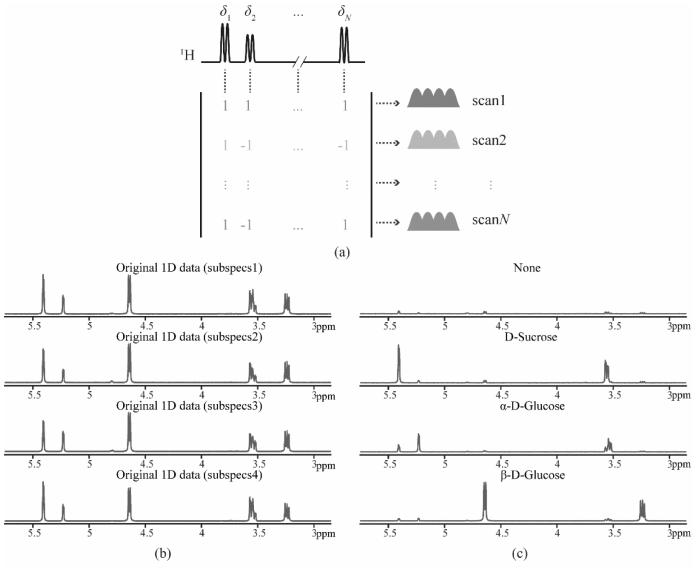
图2
(a) N阶Hadamard-DQF-LMO谱编码示意图;(b)四阶Hadamard-DQF-LMO采集谱;(c)图(b) Hadamard解码后获得的LMO谱. 图为绝对值谱
Fig. 2
(a) The encoding procedure of the order-N Hadamard-DQF-LMO spectrum; (b) The acquisition spectra of the order-4 Hadamard-DQF-LMO; (c) Resulting LMO spectra after Hadamard decoding of (b). The spectra are shown in absolute mode
在Hadamard-DQF-LMO实验中,Hadamard矩阵的作用并非调制多色脉冲中不同激发频率的相位,而是通过其元素(“1”或“-1”)选择控制不同频率翻转脉冲的施加与否.N阶Hadamard矩阵的每一行对应一次子实验,矩阵元素“1”表示施加该频率的翻转脉冲,“−1”则表示不施加.
2 实验方法与材料
2.1 样品
实验用到的试剂如下:重水(青岛腾龙微波,氘代率为99.9%),含0.05%的四甲基硅烷(TMSP,Tetramethylsilane);D-脯氨酸(D-Proline,Pro,Aladdin,99%),D-天冬酰胺(D-Asparagine,Asn,Aladdin,99%),L-谷氨酸(L-Glutamic acid,Glu,Aladdin,99%),D-谷氨酰胺(D-Glutamine,Gln,Aladdin,98%),L-异亮氨酸(L-Isoleucine,Ile,Aladdin,99%),L-亮氨酸(L-Leucine,Leu,Aladdin,99%)和L-缬氨酸(L-Valine,Val,Aladdin,99%),实验中所用氨基酸均采购自阿拉丁公司.
样品1:橙汁.水果市场购买的新鲜脐橙挤出橙汁,橙汁经过滤后静置12 h,取橙汁的上层清液与含有TMSP的D2O按2 : 1的体积混合,将600 μL样品转移至外径5 mm的NMR样品管中.
样品2:多种氨基酸的混合物水溶液.将D-脯氨酸、D-天冬酰胺、L-谷氨酸、D-谷氨酰胺、L-异亮氨酸、L-亮氨酸和L-缬氨酸溶于含有TMSP的D2O中,D-脯氨酸的浓度为0.14 mol/L,D-天冬酰胺的浓度为0.31 mol/L,L-谷氨酸的浓度为0.17 mol/L,D-谷氨酰胺的浓度为0.19 mol/L,L-异亮氨酸的浓度为0.04 mol/L,L-亮氨酸的浓度为0.12 mol/L,L-缬氨酸的浓度为0.14 mol/L,将600 μL样品转移至外径5 mm的NMR样品管中.
2.2 NMR实验
实验所用仪器为Varian Unity Plus 500 MHz NMR谱仪,使用5 mm 1H[15N-31P]间接检测探头.工作频率为499.80 MHz,实验温度为25 ℃,所有实验使用TMSP为内标(δH 0.00).
1H NMR单脉冲实验参数如下:射频中心(Ο1)定为δ 3.80,谱宽为5 814 Hz,采样点数为8 720.
Hadamard-DQF-LMO实验参数如下:弛豫延迟时间为8 s.使用预饱和压水序列作为压水模块,压水时长2 s.多色180°跃迁脉冲使用MATLAB工具包生成225 ms的多色选择性脉冲,功率为-2 dB.Hadamard编码的多色180°翻转脉冲由MATLAB工具包生成18 ms多色选择性脉冲,功率为14 dB.双量子筛选模块的梯度场作用时间为1 ms,强度G1=71.2 mT/m,G2=142.4 mT/m.双量子筛选的演化时间τ为5 ms.实验采用八步频率循环(具体方案见附录材料S2和S3),采样时间1.5 s,每张子实验谱所需时间为1 min 48 s. 四阶Hadamard-DQF-LMO实验总时长为7 min 12 s.Hadamard-DQF-LMO四次子实验以及每个实验八步循环中的多色180°跃迁脉冲、Hadamard编码的多色180°翻转脉冲、非选择性180°脉冲以及接收机的相位参数具体见附件材料S2和S3.表中空频率对应谱图的δ -0.20处,此处在1H谱中无谱峰存在.
对比实验DQF-LMO序列的单180°跃迁脉冲使用225 ms的高斯形状脉冲,功率为-14 dB,其余参数与Hadamard-DQF-LMO实验保持一致.
本实验使用MATLAB程序进行Hadamard解码,其中部分函数源于FID-A函数工具包[23].解码程序提供了包含标准化输入、输出,Hadamard解码,数据可视化和SNR(Signal-to-Noise Ratio)计算在内的功能.其中SNR的计算函数需要输入目标信号区和噪声区以确定待计算谱峰强度和噪声强度.使用二次多项式拟合噪声区域基线,经基线校正后的噪声谱noise的标准差为噪声强度noised;信号谱峰消除直流偏置之后的最大值为信号强度signal.SNR的计算公式为
3 结果与讨论
3.1 橙汁
橙汁中含有丰富的糖类化合物,包括蔗糖、α-葡萄糖、β-葡萄糖等.如图3所示,在常规1H NMR谱图中(δ 3.00~4.50区域),糖环质子信号因高度重叠形成复杂的谱峰.研究采用Hadamard-DQF-LMO序列,利用多色180°跃迁脉冲选择性作用于蔗糖异头质子(Suc-H-1, δ 5.40)、α-葡萄糖异头质子(α-Gluc-H-1, δ 5.22)和β-葡萄糖异头质子(β-Gluc-H-1, δ 4.63)的双重峰,并通过偶合网络追踪提取重叠区域的关联信号(Suc-H-2、α-Gluc-H-2和β-Gluc-H-2),成功实现了糖类化合物在谱峰密集区的谱图提取与增强(图4). 其中,DQF-LMO能从谱图拥挤的区域选择出特定的谱峰,被选出的谱峰所对应的核(被动核)与被激发的核(主动核)之间存在偶合关系;而Hadamard模块则提高谱图的信噪比.
图3
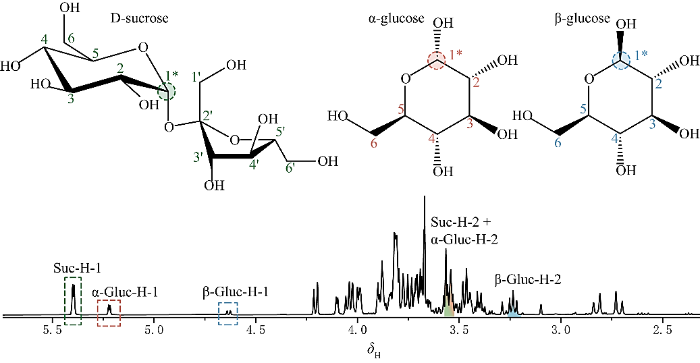
图3
橙汁样品(样品1)的一维1H NMR谱图. 图中上方为检测目标物质蔗糖、α-葡萄糖和β-葡萄糖的化学结构
Fig. 3
1D 1H NMR spectrum of orange juice (Sample 1), with chemical structures of the target analytes (sucrose, α-glucose and β-glucose) shown above the spectrum
图4
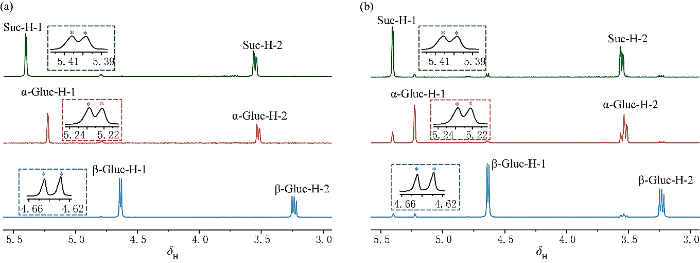
图4
橙汁样品的一维LMO谱(绝对值显示). (a) DQF-LMO序列获得;(b) Hadamard-DQF-LMO序列获得
Fig. 4
1D LMO spectra of the orange-juice (absolute value display) acquired with (a) the DQF-LMO sequence and (b) the Hadamard-DQF-LMO sequence
图4(a)显示,DQF-LMO序列成功提取了橙汁样品中蔗糖和α-葡萄糖在混叠区域的谱峰Suc-H-2和α-Gluc-H-2信号.与未加入Hadamard编码的DQF-LMO相比,Hadamard-DQF-LMO序列显著提升了谱图的SNR(图4(b)).根据1.2节所述理论,四阶Hadamard编码(N=4)可提供
表1 橙汁样品的DQF-LMO与Hadamard-DQF-LMO谱图SNR对比
Table 1
| 偶合峰 | DQF-LMO | Hadamard-DQF-LMO | 提升效率 |
|---|---|---|---|
| Suc-H-2 | 227.85 | 426.29 | 187% |
| α-Gluc-H-2 | 123.40 | 252.54 | 204% |
| β-Gluc-H-2 | 213.29 | 386.36 | 181% |
注:SNR计算使用的信号峰是被动自旋谱峰,Suc-H-2、α-Gluc-H-2和β-Gluc-H-2对应区域分别为δ 3.40 ~ 3.60、δ 3.40 ~ 3.60和δ 3.00 ~ 3.35;噪声基准区域为δ -0.50 ~ 0.00.
在实验耗时方面,Hadamard-DQF-LMO实验的时间优势体现在采集多个频点的应用场景下.Hadamard-DQF-LMO实验可通过编码多个频点实现一次性采集多个频点LMO谱图,以大幅节省实验时间.具体而言,单次子实验所需的扫描时间t与DQF-LMO实验时间相同,N阶Hadamard-DQF-LMO实验时间为Nt,可同时采集N-1个频点,获得N-1张LMO谱图,且每张谱图相比于单次DQF-LMO实验信噪比提升
Hadamard-DQF-LMO技术作为一种信号增强策略,其信噪比提升效果可应用于各类复杂样品的高通量分析中.本课题组之前提出的DQF-LMO检测方法[13],已用于复杂体系如功能饮料,可提取饮料中叠加在高浓度糖类信号中的微量酒精信号. 将Hadamard编码技术和DQF-LMO检测方法相结合的Hadamard-DQF-LMO技术提升检测灵敏度,为揭示微量成分提供一种快速检测工具.
3.2 混合氨基酸
为了验证Hadamard-DQF-LMO序列在三自旋系统中的选择性检测和信号增强能力.本研究采用7种氨基酸的混合样品(含天冬酰胺Asn、谷氨酸Glu、谷氨酰胺Gln和缬氨酸Val等)进行实验.实验聚焦于选择主动核Asn-H-1(δ 4.03)、Glu-H-1(δ 3.79)和Val-H-1(δ 3.63),并通过追踪其偶合网络提取相关信息.
如图5所示,Asn-H-1表现为特征性的四重峰,其偶合体系中的Asn-H-2a和Asn-H-2b显示出典型的强偶合特征.Glu-H-1与Gln-H-1化学位移严重重叠,由于信号重叠,这两组三重峰共同形成了表观四重峰. 此外,它们的偶合核Glu-H-2和Gln-H-2在常规¹H NMR谱中严重重叠.除上述重叠信号外,图5中Val-H-1显示出清晰的双峰特征,可用于验证该方法对非重叠信号的选择性增强能力.序列中使用多色180°跃迁脉冲分别激发不同偶合体系中的单根谱线,具有良好的选择性.但是当磁场均匀性下降或多个谱峰重叠时,常常需要在一定范围内寻找阶跃脉冲的合适激发位置,如果选择的激发位置不准确会影响信号的强度,严重时无法选中单根谱线导致伪峰引入.
图5
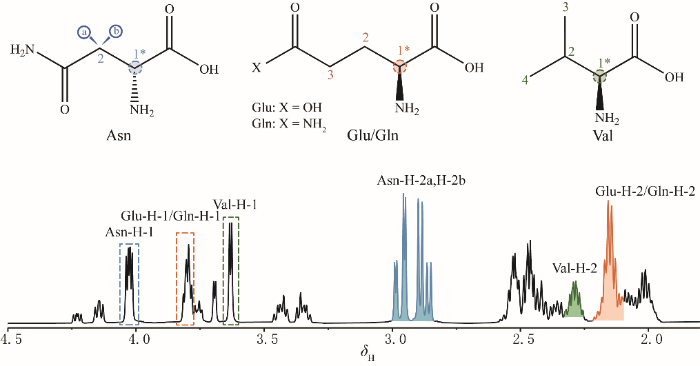
图5
混合氨基酸样品(样品2)的一维1H NMR谱. 图中上方为检测目标物质天冬酰胺、谷氨酸、谷氨酰胺和缬氨酸的化学结构
Fig. 5
1D 1H NMR spectrum of mixed amino acids (Sample 2), with chemical structures of the target analytes (asparagine, glutamic acid, glutamine and valine) shown above the spectrum
图6
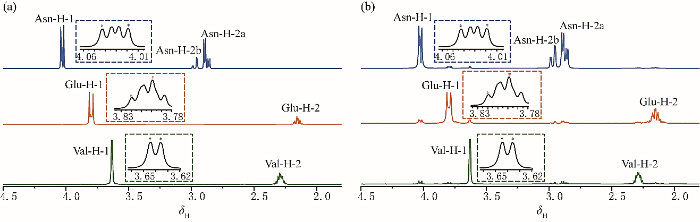
图6
混合氨基酸样品的一维LMO谱. (a) DQF-LMO序列获得;(b) Hadamard-DQF-LMO序列获得
Fig. 6
1D LMO spectra of mixed amino acids acquired with (a) the DQF-LMO sequence and (b) the Hadamard-DQF-LMO sequence
表2 混合氨基酸的DQF-LMO与Hadamard-DQF-LMO谱SNR对比
Table 2
| 偶合峰 | DQF-LMO | Hadamard-DQF-LMO | 提升效率 |
|---|---|---|---|
| Asn-H-2a | 428.04 | 724.93 | 169% |
| Glu-H-2 | 76.24 | 135.22 | 177% |
| Val-H-2 | 123.62 | 227.68 | 184% |
注:SNR计算使用的信号峰是被动自旋谱峰,Asn-H-2a、Glu-H-2和Val-H-2对应区域分别为δ 2.80 ~ 3.20、δ 2.00 ~ 2.24和δ 2.20 ~ 2.50;噪声基准区域为δ -0.50 ~ 0.00.
这些实验结果不仅验证了Hadamard-DQF-LMO序列在复杂体系中的适用性,更展示了其在保持信号特异性的同时显著提升检测灵敏度的独特优势.该方法为复杂生物样品中特定核团的检测提供了一种高效可靠的技术手段.
4 总结
本研究成功开发了一种新型Hadamard-DQF-LMO脉冲序列技术,该技术通过将DQF-LMO的单频激发模式创新性地改进为多频并行激发,并巧妙结合Hadamard编码策略,实现了NMR检测灵敏度的显著提升.该方法的创新性主要体现在:(1)构建了高效的多频选择性激发模块,可同时作用于多个主动核;(2)设计了优化的Hadamard编码采集方案,在不增加实验时间的前提下大幅提升信噪比;(3)建立了完整的信号解码处理方法,确保获取高保真度的谱图信息.通过橙汁和混合氨基酸样品的系统验证,研究证实该方法能有效解析二重、三重乃至四重偶合体系,成功实现了复杂生物样品中严重重叠信号的选择性检测与增强,信噪比提升幅度达到169%~204%.
从复杂混合物中解析严重重叠的信号是一项挑战. 现有方法如CSSF(Chemical Shift Selective Filter)虽选择性高,但基于多步增量扫描导致实验耗时过长[24];GEMSTONE(Gradient-Enhanced Multiplet-Selective Targeted-Observation NMR Experiment)技术虽实现了单次扫描,但其依赖的空间编码机制对分子扩散敏感,在高选择性条件下易造成显著的信号衰减与灵敏度损失[25]. 本工作所采用的Hadamard编码采集LMO信号策略有效地规避了上述局限:它巧妙融合跃迁选择性脉冲、频率循环和多色脉冲使用,无需空间编码或多次扫描,即可快速、高选择性地提取目标谱峰,极大提高了分析效率. Huang等人提出一种用于混合物分析的一维双选择性全相关谱NMR方法,在强背景信号下得到干净的低浓度硫二甘醇谱图[26]. 在我们前期的DQF-LMO序列研究中,DQF-LMO和1D TOCSY具有相当的检测灵敏度[13],因此Hadamard-DQF-LMO可以用于复杂样品中更少量化合物NMR谱的采集和浓度测量.这一技术突破为食品科学、代谢组学等领域的复杂基质分析提供了强有力的新型研究工具,特别是在微量成分检测和复杂谱图解析方面展现出独特优势,具有重要的应用前景.当然,本研究方法也存在一定局限性,例如其性能在谱峰严重重叠至无法选择性激发特定成分时受限;序列中多量子滤波模块的延迟时间和J偶合常数乘积的正弦值决定偶合体系的信号强度,导致不同偶合体系信号强度非线性变化,影响化合物浓度的比较.
附件材料
附件材料(可在《波谱学杂志》期刊官网
S1 Hadamard-DQF-LMO演化信号的理论推导
S2 Hadamard-DQF-LMO橙汁实验的频率循环方案参数表
S3 Hadamard-DQF-LMO混合氨基酸实验的频率循环方案参数表
S4 橙汁样品的DQF-LMO不同实验时间的SNR对比表
利益冲突
无
参考文献
Study on the enantiomeric recognition of chiral ureas containing amino acid units
[J].
含氨基酸单元手性脲的对映体识别性能研究
[J].
In vivo glutathione molecular MRS signal selection based on nuclear spin singlet states
[J].
基于核自旋单重态的活体谷胱甘肽分子MRS信号选择
[J].
DOI:10.11938/cjmr20243105
[本文引用: 1]

谷胱甘肽(GSH)是一种由谷氨酸、半胱氨酸和甘氨酸聚合而成的三肽,是人体还原驱动力的主要来源,能维持人体内部氧化还原平衡.谷胱甘肽还与生物体内自由基淬灭、肿瘤治疗密切相关.利用活体磁共振波谱(MRS)监测生物体中谷胱甘肽的含量变化对于理解其生物学作用具有重要意义.由于生物体内环境复杂,活体组织的磁共振信号往往重叠严重,难以实现特定分子的选择性检测及定量.本文介绍了一种利用核自旋单重态选择性检测活体谷胱甘肽分子的方法,通过在谷胱甘肽中选择合适的自旋体系,将其制备为单重态,借助梯度脉冲消除其它分子的信号,进而实现谷胱甘肽信号的选择性检测.该方法在健康人体大脑中得到了实验验证,理论和实验结果表明,与文献中报道的其它方法相比,本文的方法具有检测效率高、选择性强的特点.
Magnetic resonance spectroscopy with longitudinal multispin orders
[J].
DOI:10.2174/157341108783339106
URL
[本文引用: 1]
Longitudinal multispin orders can be created in spin systems that exhibit scalar, dipolar or quadrupolar couplings. They provide an effective way for measurement of scalar couplings and also to probe molecular interactions and dynamics. They cannot be separated by phase cycling or gradient selection methods which are the only known modes of separating different coherences. In this review we describe the frequency cycling procedure for separating various orders in weakly and strongly coupled spin systems. We provide the analytical solutions that permit determination of the frequency cycle for different spin systems. We also discuss the creation of longitudinal orders through relaxation. Finally we highlight the potential applications including spectral editing, measurement of relative signs of scalar couplings and structural properties of molecules.
Proton chemical-shift anisotropy-Detection of cross-correlation with dipole-dipole interactions by double-quantum filtered two-dimensional NMR exchange spectroscopy
[J].DOI:10.1016/0009-2614(89)87037-X URL [本文引用: 1]
Observation of cross correlations in a weakly coupled F-19-H-1 4-spin system
[J].DOI:10.1006/jmra.1995.1151 URL [本文引用: 1]
Separation of longitudinal multispin order by frequency cycling
[J].DOI:10.1006/jmra.1993.1237 URL [本文引用: 1]
Analysis of longitudinal multispin orders in strongly coupled spin systems
[J].Longitudinal multispin orders provide an effective way for measurement of scalar couplings and also to probe molecular interactions and dynamics. Analysis of longitudinal orders has been made in strongly coupled AB and ABX spin systems to determine the dependence of strong coupling parameter on these orders. Experimental and simulated spectra of various longitudinal orders are illustrated for these spin systems. This general procedure can be extended to broad range of spin systems to understand the influence of strong coupling on longitudinal orders.
Slow relaxation of longitudinal multispin orders in weakly and strongly coupled two-spin systems
[J].DOI:10.1002/mrc.v50.6 URL [本文引用: 1]
Selective excitation of long-lived nuclear spin states
[J].
DOI:10.1021/acs.jpclett.2c01749
PMID:35849533
[本文引用: 1]
Nuclear magnetization storage, once limited by longitudinal and transverse relaxation lifetimes, and, can be prolonged by symmetry-adapted nuclear spin order, i.e. long-lived states (LLS) and long-lived coherences (LLC), which have significantly extended relaxation time constants compared to and, respectively. Excitation and/or detection of LLS currently involves pulses covering wide frequency ranges in high-magnetic-field spectrometers. This leads to excitation of unwanted signals that may overlap and interfere with the resonances of interest. Herein, we present a new pulse sequence that converts longitudinal magnetization to LLS and further to detectable magnetization using only frequency-selective pulses. We demonstrate the suitability of this sequence for different -coupled spin pairs in dipeptide AlaGly and protein Ubiquitin. The newly developed method is adapted for investigations of LLS in complex systems such as proteins and mixtures of metabolites where selected molecular groups are to be investigated separately.
Multiquantum chemical exchange saturation transfer NMR to quantify symmetrical exchange: Application to rotational dynamics of the guanidinium group in arginine side chains
[J].
DOI:10.1021/acs.jpclett.0c01322
PMID:32543198
[本文引用: 1]
Chemical exchange saturation transfer (CEST) NMR experiments have emerged as a powerful tool for characterizing dynamics in proteins. We show here that the CEST approach can be extended to systems with symmetrical exchange, where the NMR signals of all exchanging species are severely broadened. To achieve this, multiquantum CEST (MQ-CEST) is introduced, where the CEST pulse is applied to a longitudinal multispin order density element and the CEST profiles are encoded onto nonbroadened nuclei. The MQ-CEST approach is demonstrated on the restricted rotation of guanidinium groups in arginine residues within proteins. These groups and their dynamics are essential for many enzymes and for noncovalent interactions through the formation of hydrogen bonds, salt-bridges, and π-stacking interactions, and their rate of rotation is highly indicative of the extent of interactions formed. The MQ-CEST method is successfully applied to guanidinium groups in the 19 kDa L99A mutant of T4 lysozyme.
Longitudinal exchange: an alternative strategy towards quantification of dynamics parameters in ZZ exchange spectroscopy
[J].
DOI:10.1007/s10858-011-9547-8
PMID:21947921
Longitudinal exchange experiments facilitate the quantification of the rates of interconversion between the exchanging species, along with their longitudinal relaxation rates, by analyzing the time-dependence of direct correlation and exchange cross peaks. Here we present a simple and robust alternative to this strategy, which is based on the combination of two complementary experiments, one with and one without resolving exchange cross peaks. We show that by combining the two data sets systematic errors that are caused by differential line-broadening of the exchanging species are avoided and reliable quantification of kinetic and relaxation parameters in the presence of additional conformational exchange on the ms-μs time scale is possible. The strategy is applied to a bistable DNA oligomer that displays different line-broadening in the two exchanging species.
Detection of γ-aminobutyric acid (GABA) by longitudinal scalar order difference editing
[J].DOI:10.1006/jmre.2001.2371 URL [本文引用: 1]
Enhanced detection of crowded NMR peaks using longitudinal multi-spin order for chemical analysis
[J].DOI:10.1016/j.aca.2025.344429 URL [本文引用: 3]
Refocused double-quantum editing for lactate detection at 7 T
[J].
DOI:10.1002/mrm.24227
PMID:22374843
[本文引用: 2]
Lactate is an important marker for anaerobic glucose metabolism, and it is therefore of particular interest in, for example, cerebral ischemia, skeletal muscle disorders, and in the monitoring of oncology treatments. However, the in vivo detection of lactate with magnetic resonance spectroscopy is complicated by the overlap of the low-intensity lactate methyl resonance with lipid signal. Therefore, double-quantum filters have been employed to dephase the overlapping lipid signal, as they allow for a very high lipid suppression efficiency. For reliable lactate detection in lipid-rich environment, very large crushing gradients have to be employed to dephase the lipid signal under the noise level. Double-quantum filters are generally associated with signal loss of the metabolite of interest. For lactate, half of the signal is lost by selecting either the double- or the zero-quantum coherences. Moreover, owing to incomplete refocusing, traditional double-quantum filters with very large crusher gradients exhibit additional loss of the already low-lactate signal. In this study, a refocused double-quantum filter is described, which does not suffer from this source of additional signal loss. Therefore, it becomes possible to detect lactate at lower concentrations, or in lipid-rich environments. Lactate measurements are shown in the human calf muscle at 7 T.Copyright © 2012 Wiley Periodicals, Inc.
Dynamic nuclear polarization at high magnetic fields
[J].
DOI:10.1063/1.2833582
URL
[本文引用: 1]
Dynamic nuclear polarization (DNP) is a method that permits NMR signal intensities of solids and liquids to be enhanced significantly, and is therefore potentially an important tool in structural and mechanistic studies of biologically relevant molecules. During a DNP experiment, the large polarization of an exogeneous or endogeneous unpaired electron is transferred to the nuclei of interest (I) by microwave (μw) irradiation of the sample. The maximum theoretical enhancement achievable is given by the gyromagnetic ratios (γe∕γl), being ∼660 for protons. In the early 1950s, the DNP phenomenon was demonstrated experimentally, and intensively investigated in the following four decades, primarily at low magnetic fields. This review focuses on recent developments in the field of DNP with a special emphasis on work done at high magnetic fields (⩾5T), the regime where contemporary NMR experiments are performed. After a brief historical survey, we present a review of the classical continuous wave (cw) DNP mechanisms—the Overhauser effect, the solid effect, the cross effect, and thermal mixing. A special section is devoted to the theory of coherent polarization transfer mechanisms, since they are potentially more efficient at high fields than classical polarization schemes. The implementation of DNP at high magnetic fields has required the development and improvement of new and existing instrumentation. Therefore, we also review some recent developments in μw and probe technology, followed by an overview of DNP applications in biological solids and liquids. Finally, we outline some possible areas for future developments.
Long-range distance determinations in biomacromolecules by EPR spectroscopy
[J].Electron paramagnetic resonance (EPR) spectroscopy provides a variety of tools to study structures and structural changes of large biomolecules or complexes thereof. In order to unravel secondary structure elements, domain arrangements or complex formation, continuous wave and pulsed EPR methods capable of measuring the magnetic dipole coupling between two unpaired electrons can be used to obtain long-range distance constraints on the nanometer scale. Such methods yield reliably and precisely distances of up to 80 A, can be applied to biomolecules in aqueous buffer solutions or membranes, and are not size limited. They can be applied either at cryogenic or physiological temperatures and down to amounts of a few nanomoles. Spin centers may be metal ions, metal clusters, cofactor radicals, amino acid radicals, or spin labels. In this review, we discuss the advantages and limitations of the different EPR spectroscopic methods, briefly describe their theoretical background, and summarize important biological applications. The main focus of this article will be on pulsed EPR methods like pulsed electron-electron double resonance (PELDOR) and their applications to spin-labeled biosystems.
Hadamard NMR spectroscopy
[J].DOI:10.1016/S0079-6565(03)00022-0 URL [本文引用: 2]
Application of the rotation approach to selective excitation of coupled spin systems by a shaped radiofrequency pulse
[J].DOI:10.1080/00268979500102651 URL [本文引用: 1]
Hadamard-encoded localized high-resolution NMR spectroscopy via intermolecular double-quantum coherences
[J].DOI:10.1016/j.cplett.2015.01.025 URL [本文引用: 1]
Frequency-domain Hadamard spectroscopy
[J].A new technique is proposed for multichannel excitation and detection of NMR signals in the frequency domain, an alternative to the widely used pulse-excited Fourier transform method. An extensive array of N radiofrequency irradiation channels covers the spectrum of interest. A selective radiofrequency pulse sequence is applied to each channel, generating a steady-state NMR response acquired one-point-at-a-time in the intervals between pulses. The excitation pattern is repeated N times, phase-encoded according to a Hadamard matrix, and the corresponding N composite responses are decoded by reference to the same matrix. This multiplex technique offers the same sensitivity advantage as conventional Fourier transform spectroscopy. The irradiation pattern may be tailored to concentrate on interesting spectral regions, to facilitate homonuclear double resonance, or to avoid exciting strong solvent peaks. As no free induction decay is involved, the new method avoids problems of pulse breakthrough or lineshape distortion by premature termination of the time-domain signal.
Fast magnetic resonance force microscopy with Hadamard encoding
[J].DOI:10.1103/PhysRevB.76.180405 URL [本文引用: 1]
High-resolution localized NMR spectroscopy based on Hadamard-encoding
[J].
基于哈德曼编码的新型高分辨定域谱
[J].
DOI:10.11938/cjmr20192780
[本文引用: 1]
核磁共振(NMR)技术作为一种非植入无损伤的检测技术,已经广泛应用于化学、生物和医学等领域.本文基于哈德曼(Hadamard)编码的分子间单量子相干(iSQC)技术提出了一种新的序列,首先从理论上对该序列进行了简要的分析并阐明其原理,然后用套管模型实验和脑模型实验验证该序列在不均匀磁场下准确定域和快速获取高分辨谱的能力.实验表明,该序列在不均匀磁场下可以快速获取高分辨定域谱,同时抑制溶剂峰信号,具备一定的应用价值.
Advanced processing and simulation of MRS data using the FID appliance (FID-A)—An open source, MATLAB-based toolkit
[J].DOI:10.1002/mrm.v77.1 URL [本文引用: 1]
Qualitative analysis of aromatic compounds via 1D TOCSY techniques
[J].
Single-scan selective excitation of individual NMR signals in overlapping multiplets
[J].DOI:10.1002/anie.v60.2 URL [本文引用: 1]
A nuclear magnetic resonance method for mixture analysis based on one-dimensional doubly selective excitation total correlation spectroscopy
[J].
一种用于混合物分析的一维双选择性全相关谱核磁共振方法
[J].


