


引言
在多级孔分子筛的制备方法中,氟化铵(NH4F)溶液刻蚀因其温和、可控的反应条件而展现出独特优势[5,6].其刻蚀作用主要依靠溶液中的双氟氢离子(HF2-),该物种对分子筛骨架中的Si−O−Si与Si−O−Al键具有无差别的反应活性,因此能够在晶体内部形成连通性良好的介孔网络,而非单一的定向孔道[7].这种多级孔结构的引入,通常不会明显改变分子筛的晶体结构与骨架硅铝比,从而在显著提升扩散性能的同时,仍能保持微孔分子筛的催化优势[8].研究表明,通过调节NH4F浓度、反应温度、反应时间等参数,可实现对分子筛中介孔体积与孔径分布的精细调控[9].此外,NH4F刻蚀还可与酸处理、碱处理等步骤结合,进一步优化孔结构,使其在大分子催化反应中表现出优异的活性、选择性与稳定性[10].
近年来,固体核磁共振(NMR)技术因其能够从原子尺度获取局部结构与化学环境的准确信息,逐渐成为表征固体材料结构与性质不可或缺的工具[13
基于此,本研究拟采用多种固体NMR技术,系统考察不同浓度NH4F刻蚀对ZSM-5分子筛结构及酸性的影响,从原子尺度揭示刻蚀过程中酸位浓度、强度、类型与空间可接近性的演变规律,并建立其与多级孔结构形成之间的内在联系,旨在为NH4F刻蚀工艺的优化与多级孔分子筛催化剂的理性设计提供理论依据与科学基础.
1 实验部分
1.1 仪器与试剂
实验所用NH4-ZSM-5分子筛(CBV 5524G)购自Zeolyst International公司.氟化铵(NH4F,AR)、2-13C-丙酮(99 atom % 13C)购自Sigma-Aldrich公司.TMPO(99%)、TBPO(99.5%)、二氯甲烷(CH2Cl2,HPLC级,≥ 99.9%)、水合硝酸铝(99.999%)、磷酸氢二铵((NH4)2PO4,99%)、金刚烷(GC标准品,≥ 99.9%)购自麦克林公司.
X射线衍射(XRD)分析在日本理学SmartLab SE型X射线粉末衍射仪上进行.形貌与微观结构观察使用日本电子JEM-F200场发射透射电子显微镜(TEM).比表面积与孔隙结构分析在Micromeritics ASAP 2460型物理吸附仪上进行.电感耦合等离子体发射光谱(ICP-OES)分析采用Agilent 5110 ICP-OES光谱仪.所有固体NMR实验均在Bruker Avance III 400 MHz谱仪上完成.催化反应在连续流动固定床石英反应管(内径6.0 mm,长度450 mm)中进行;所有气体产物均采用配备氢火焰离子化检测器及HP-PLOT/Q色谱柱(30 m×0.53 mm×40 μm)的气相色谱仪(GC-9790PLUS)进行在线分析.
1.2 样品制备
首先配置质量分数为10%、20%和40%的NH4F水溶液.称取0.5 g NH4-ZSM-5分子筛,加入25 mL相应浓度的NH4F水溶液,在80 ℃搅拌反应0.5 h.反应结束后,使用离心机将混合物分离,并用去离子水反复洗涤至滤液呈中性.所得固体在80 ℃烘箱过夜干燥,随后放置于管式炉中,在流动的干燥空气气氛下于510 ℃焙烧6 h以脱除铵根,得到NH4F刻蚀后的H-ZSM-5样品,分别标记为Z5-10%F、Z5-20%F和Z5-40%F.
XRD测试前,将待测样品置于玛瑙研钵中充分研磨,直至粒度约为320目.取适量研磨好的粉末填入样品架凹槽中,用洁净的玻璃片压实表面,并刮除多余粉末,使样品表面与样品架平面严格平齐.压片完成后,即可进行XRD测试.
TEM测试前,取少量粉末样品分散于无水乙醇中,置于超声波清洗器中振荡分散10~30 min,形成均匀的稀释悬浮液.随后用镊子夹取超薄碳膜铜网,以玻璃毛细管吸取悬浮液,滴加2~3滴至铜网上.静置干燥15 min以上,待乙醇充分挥发,使粉末颗粒均匀分散并牢固附着于支持膜上,即可用于TEM观察.
ICP-OES测试前,样品经过消解处理,转化为澄清、稳定、无固体颗粒且不含有机物的溶液,以确保待测元素完全溶解并适合雾化进入等离子体.
将约100 mg焙烧后的样品装入自制玻璃管中,连接至真空系统,以1 ℃/min的升温速率升至400 ℃,并在400 ℃及真空度< 10-3 Pa条件下脱水处理10 h,随后在真空条件下密封保存,用于后续探针分子吸附及NMR测试.
探针分子的吸附细节参照本课题组前期建立的标准化流程[19].2-13C-丙酮吸附:在真空系统上,将脱水后的样品管浸入液氮中,导入少量2-13C-丙酮蒸气,随后用火焰熔封样品管口,并于液氮中保存待测.TMPO/TBPO吸附:在氮气保护的手套箱中,将约100 mg脱水样品放置于自制的带有密封阀的样品管中,分别加入0.2 mL TMPO或0.1 mL TBPO的0.5 mol/L探针分子的CH2Cl2溶液,将样品管密封.经过0.5 h的超声处理,使溶液与分子筛混合均匀后,转移至真空系统上脱除CH2Cl2溶剂.随后,将样品管在160 ℃保持2 h,以保证探针分子均匀吸附.最后,将负载探针分子的样品在手套箱中装入4 mm氧化锆转子,并用Kel-F盖子密封,随后进行NMR实验.
开展催化实验前,称取100 mg(40~60目)催化剂装入反应管,400 ℃下活化2 h;随后,通过进料泵将甲醇输入反应器,甲醇质量空速为4.8 h-1;反应在350 ℃和常压下进行.催化实验中,通过质量流量控制器独立调控反应气体,以改变总流量和反应物分压.
1.3 固体NMR实验
固体NMR实验使用4 mm双共振魔角旋转探头,旋转速率设定为10 kHz.单脉冲1H MAS NMR实验的π/2脉冲宽度为4.1 μs,采样间隔为5 s.单脉冲27Al MAS NMR实验的π/12脉冲宽度为0.2 μs,采样间隔为1 s.单脉冲29Si MAS NMR实验的π/2脉冲宽度为4.8 μs,采样间隔为60 s.单脉冲13C MAS NMR实验的π/2脉冲宽度为4.1 μs,采样间隔为4 s.单脉冲31P MAS NMR实验的π/2脉冲宽度为4.4 μs,采样间隔为15 s.1H、27Al、29Si、13C及31P核的化学位移分别以外标物金刚烷(δH = 1.91)、1 mol/L硝酸铝溶液(δAl = 0)、高岭土(δSi = −91.5)、金刚烷(δC = 38.8)和磷酸氢二铵(δP = 1.0)为参考.
2 结果与讨论
2.1 NH4F刻蚀制备多级孔ZSM-5分子筛
为阐明NH4F刻蚀对分子筛结构及酸性的调控作用,本研究选取具有典型MFI[ZSM-5 (FIVE)]拓扑结构的ZSM-5(原粉标记为Z5-parent)作为研究对象,采用不同浓度(10%、20%与40%)的NH4F溶液对其进行水热刻蚀处理,获得系列改性样品(Z5-10%F、Z5-20%F和Z5-40%F).通过综合运用X射线衍射(XRD)、透射电子显微镜(TEM)及氮气物理吸附实验等表征手段,旨在从晶体结构、微观形貌与孔道特征三个方面,揭示NH4F浓度与分子筛多级孔结构形成之间的关系,为后续关联其酸性演变奠定基础.
2.1.1 XRD和TEM表征
为了系统研究NH4F刻蚀对ZSM-5分子筛结构的影响,首先通过XRD和TEM对刻蚀前后的样品进行了表征.如图1(a)所示,NH4-ZSM-5分子筛原粉(Z5-parent)在2θ为7.8°、8.8°、23.1°、23.9°和24.4°处呈现出典型的MFI拓扑结构特征衍射峰.经过不同浓度(10%、20%、40%)NH4F溶液处理后,所有样品均保留了这些特征峰,且未出现杂相,表明刻蚀过程基本保持了分子筛的拓扑结构.然而,随着NH4F浓度的增加,衍射峰强度逐渐下降.以Z5-parent的结晶度(100%)为基准进行计算,刻蚀后样品的相对结晶度依次降至91%、86%和80%(表1).这主要是由于当NH4F溶液浓度较低时,刻蚀程度较低,分子筛晶体结构完整性得以较好保持;而高浓度NH4F刻蚀造成骨架的局部溶解,从而导致分子筛结晶度的下降.
图1
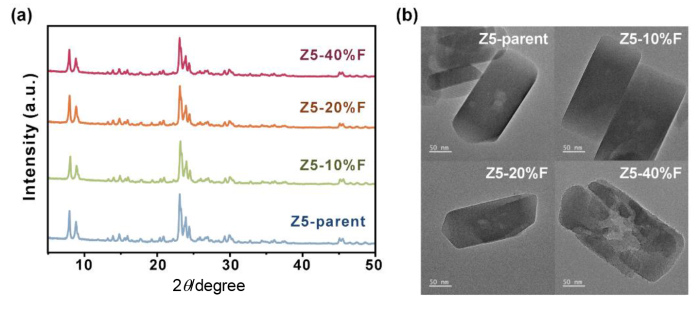
图1
ZSM-5分子筛原粉及不同浓度NH4F刻蚀样品的(a) XRD图谱与(b) TEM图像
Fig. 1
(a) XRD patterns and (b) TEM images of the parent and NH4F-etched ZSM-5 samples
表1 ZSM-5分子筛原粉及不同浓度NH4F刻蚀样品的比表面积、孔体积、相对结晶度及硅铝比
Table 1
| Sample | SBETa /m2g-1 | Smicroa /m2g-1 | Vporea /cm3g-1 | Vmicroa /cm3g-1 | Vmesoa /cm3g-1 | Crystallinityb /% | Si/Alc |
|---|---|---|---|---|---|---|---|
| Z5-parent | 431 | 406 | 0.21 | 0.17 | 0.04 | 100 | 29.8 |
| Z5-10%F | 424 | 405 | 0.21 | 0.17 | 0.04 | 91 | 31.9 |
| Z5-20%F | 407 | 386 | 0.26 | 0.16 | 0.10 | 86 | 32.6 |
| Z5-40%F | 407 | 363 | 0.30 | 0.15 | 0.15 | 80 | 34.0 |
a: 来自氮气物理吸附实验,SBET指总的比表面积,Smicro指微孔的比表面积,Vpore指总的孔体积,Vmicro指微孔的孔体积,Vmeso指介孔的孔体积;b: 来自XRD实验;c: 来自ICP-OES实验.
为了直接观察NH4F刻蚀ZSM-5分子筛晶体的过程,我们利用TEM对样品进行了分析.对于低浓度NH4F处理后的样品(Z5-10%F、Z5-20%F),其TEM图像(图1(b))显示,晶体内部出现分散的亮斑,即存在不连通的空腔或次生孔道,证实介孔已在分子筛晶体中形成.随着NH4F浓度提升至40%(Z5-40%F),晶体中进一步出现相互连通的孔道网络.这些结果表明,随着刻蚀程度加深,不连通的空腔或孔道逐渐扩展并相互连接,最终在晶体中形成发达且内外连通的多级孔道系统.
2.1.2 氮气物理吸附实验
氮气吸附等温线及孔径分布进一步从孔径大小的角度揭示了NH4F刻蚀引起的孔道演变过程(图2). Z5-parent的吸附等温线呈典型的I型特征,在相对压力较低(p/p0 < 0.1)时吸附量迅速上升,表明其主要为微孔结构,相应的BET(Brunauer-Emmett-Teller)比表面积和总孔容主要来源于微孔(表1). 10% NH4F溶液刻蚀后,Z5-10%F的等温线仍保持I型,且其微孔比表面积及微孔体积与Z5-parent相比变化不大(表1),表明该条件下微孔骨架基本保持完整,刻蚀对分子筛结构几乎没有影响.随着NH4F浓度增至20%,Z5-20%F的等温线在p/p0 = 0.45 ~ 0.95范围内出现回滞环,表明该条件下介孔已经形成;根据孔径分布曲线,此时的介孔尺寸约为10 nm.定量数据显示,Z5-20%F样品的微孔比表面积开始下降,而介孔体积同步增加(表1). 进一步提高NH4F浓度至40%,Z5-40%F的等温线回滞环显著扩大,且孔径分布曲线向介孔方向偏移,在约15 nm处出现一个宽峰,这与文献报道的NH4F刻蚀分子筛所形成的介孔尺寸范围(10~20 nm)高度吻合[20].同时,微孔比表面积进一步降低,介孔体积显著增加(表1).这一系列变化表明,NH4F刻蚀程度加剧推动了分子筛骨架从单一微孔体系向微-介孔多级孔体系的转变.
图2
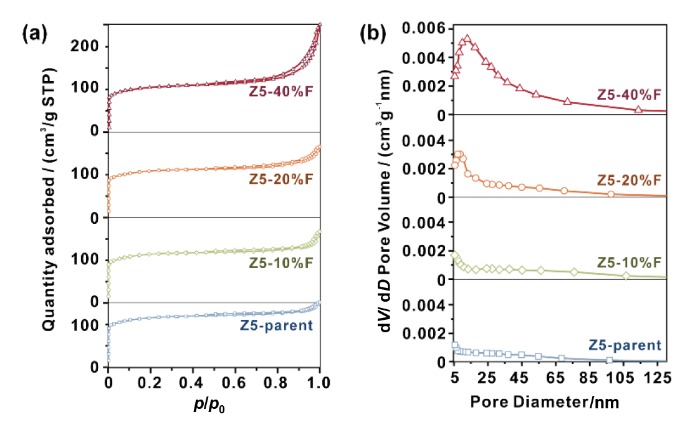
图2
ZSM-5分子筛原粉及不同浓度NH4F刻蚀样品的(a)氮气吸附等温线及(b)孔径分布
Fig. 2
(a) N2 adsorption isotherms, and (b) pore size distribution of the parent and NH4F-etched ZSM-5 samples
综合XRD、TEM及氮气物理吸附实验结果,证实可以通过调控NH4F溶液浓度实现ZSM-5分子筛从微孔向多级孔结构的可控转变,为后续深入探究NH4F刻蚀对分子筛活性位结构及酸性的影响创造了条件.
2.2 NH4F刻蚀对ZSM-5分子筛活性位结构的影响
在明确NH4F刻蚀能够可控构筑分子筛多级孔体系的基础上,本研究进一步通过固体27Al/29Si/1H MAS NMR技术,从原子尺度探究NH4F刻蚀对ZSM-5分子筛活性位局域结构的影响,以期阐明其演变机制.
图3
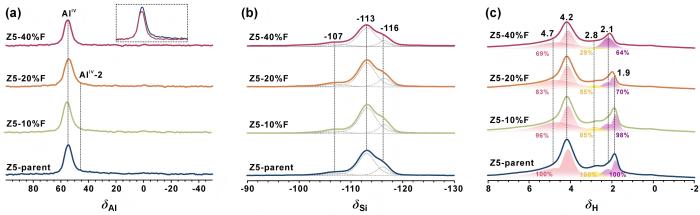
图3
ZSM-5分子筛原粉及不同浓度NH4F刻蚀样品的(a) 27Al MAS NMR、(b) 29Si MAS NMR及(c) 1H MAS NMR谱图
Fig. 3
(a) 27Al MAS NMR, (b) 29Si MAS NMR and (c) 1H MAS NMR spectra of the parent and NH4F-etched ZSM-5 samples
进一步通过29Si MAS NMR考察了骨架硅物种的变化,如图3(b)所示,所有经NH4F处理的样品,其29Si NMR谱图线型与Z5-parent高度相似,均呈现三组特征峰,未发生明显的位移或峰形变化,结合文献将δSi ‒107处的信号归属于Si(1Al)物种,δSi ‒113和‒116处的信号为不同化学环境的Si(0Al)物种[23].同时,随着NH4F溶液浓度增加,尤其在高浓度(40%)刻蚀下,三组共振峰强度均减弱,与27Al NMR谱图中铝含量的变化趋势一致.结合27Al与29Si NMR结果可知,NH4F对ZSM-5分子筛的刻蚀并未导致优先脱铝或脱硅,而是在原子尺度上相对均匀地溶解骨架,对Si‒O‒Si和Si‒O‒Al键具有近乎无差别的反应活性.
为了进一步验证刻蚀过程中骨架化学组成的演变,采用ICP-OES对所有样品的整体硅铝比(Si/Al)进行了定量分析.结果表明(表1),原粉Z5-parent的Si/Al为29.8.经10%、20%和40% NH4F溶液刻蚀后,样品的Si/Al分别为31.9、32.6和34.0,呈现轻微上升趋势.这一较小幅度的变化表明,NH4F刻蚀过程中骨架硅和铝的溶出程度基本相当,未发生明显的优先脱铝或脱硅现象.Si/Al的轻微上升可能源于刻蚀过程中部分骨架缺陷位AlIV-2物种的优先溶解,这与27Al NMR中AlIV-2信号减弱的结果一致.ICP-OES分析结果与29Si和27Al NMR谱图中峰形无明显位移、峰强度同步减弱的现象高度吻合,进一步证实了NH4F对分子筛骨架具有近乎无差别的反应活性.
随后,通过1H MAS NMR直接监测刻蚀过程中表面羟基物种的演变,如图3(c)所示,Z5-parent的谱图显示三组特征峰:δH 1.9和2.1处的硅羟基(Si‒OH)、δH 2.8处的铝羟基(Al‒OH)、以及δH 4.2和4.7处的Brønsted酸性桥羟基(Si‒O(H)‒Al)[24].结合27Al NMR结果,δH 2.8处的信号可归属为AlIV-2物种中的Al‒OH.分峰拟合结果显示,在低浓度刻蚀(Z5-10%F)阶段,Al‒OH含量降至原粉的85%,Si‒O(H)‒Al含量保持96%,而Si‒OH含量保持98%.这一结果证实了低浓度刻蚀阶段优先攻击Al‒OH缺陷位的结论,与27Al NMR中AlIV-2物种信号快速减弱的现象完全吻合.进入中等浓度刻蚀(Z5-20%F)阶段后,Al‒OH含量进一步降至55%,Si‒O(H)‒Al开始明显下降至83%,Si‒OH也显著减少至70%.这表明刻蚀已从Al‒OH扩展到Si‒OH和骨架Si‒O(H)‒Al,导致骨架溶解.Si‒O(H)‒Al的下降与后续TMPO-31P NMR中δP 76信号开始减弱的趋势(见2.3节)相一致,印证了此时酸量的减少.在高浓度刻蚀(Z5-40%F)阶段,所有羟基物种含量均显著下降,Si‒O(H)‒Al降至69%,Al‒OH降至29%,Si‒OH降至64%.这一结果表明,高浓度刻蚀进一步溶解分子筛骨架,与TEM观察到的介孔网络发育[图1(b)]以及氮气吸附测得的介孔体积大幅增加(表1)一致.
综上所述,27Al/29Si/1H NMR实验揭示了NH4F刻蚀ZSM-5分子筛的化学过程:低浓度刻蚀阶段优先攻击Al‒OH缺陷位;随着刻蚀程度加深,逐步开始攻击Si‒OH,随后无差别攻击骨架Si‒O‒Si和Si‒O‒Al键.该过程在有效构筑多级孔结构的同时,基本维持了分子筛的拓扑结构,但过度刻蚀也会造成桥羟基含量下降.这些结果从原子水平加深了对NH4F刻蚀分子筛活性位微观机制的理解与认知.
2.3 NH4F刻蚀对ZSM-5分子筛酸性的影响
在阐明NH4F刻蚀对ZSM-5分子筛活性位结构影响的基础上,本研究进一步聚焦于刻蚀过程中分子筛酸性的演变规律.采用探针分子(2-13C-丙酮、TMPO及TBPO)辅助的固体NMR技术,从酸类型、酸强度、酸位空间分布及可接近性等多个维度,对NH4F刻蚀过程中分子筛的酸性进行了系统表征.
基于2-13C-丙酮探针分子羰基碳原子的13C化学位移对酸性极为敏感这一特性,对ZSM-5分子筛中Brønsted酸位(BAS)与Lewis酸位(LAS)进行了研究.如图4(a)所示,Z5-parent样品在δC 223和233处出现两个特征共振峰,分别对应于吸附在BAS和LAS上的2-13C-丙酮分子[25].为进一步验证信号归属,我们采集了二维1H‒13C异核相关谱[图4(b)].谱图中可见(233, 2.6)和(223, 2.6) ppm两对相关信号,分别来源于吸附在不同酸位上的丙酮羰基碳和自身甲基氢之间的耦合.仅在δC 223处检测到与δH 16.4的相关信号,对应吸附于BAS的丙酮羰基碳与酸性质子之间的空间关联;而δC 233信号与酸性质子之间不存在相关峰,从而明确了BAS与LAS的信号归属.结合此前1H和27Al NMR结果,这种LAS可能来源于与骨架部分键连的四配位铝物种(AlIV-2).经NH4F刻蚀后,BAS与LAS信号强度均呈现逐渐减弱的趋势,且LAS信号变化更为明显,在较高浓度NH4F处理后几乎消失.这些结果表明,尽管NH4F刻蚀同步降低了分子筛的BAS与LAS含量,但更倾向于优先攻击LAS,从而调变BAS/LAS比例.这一现象与1H NMR中Al‒OH和27Al NMR中AlIV-2物种随NH4F浓度增加而快速消失的演变规律完全吻合.
图4
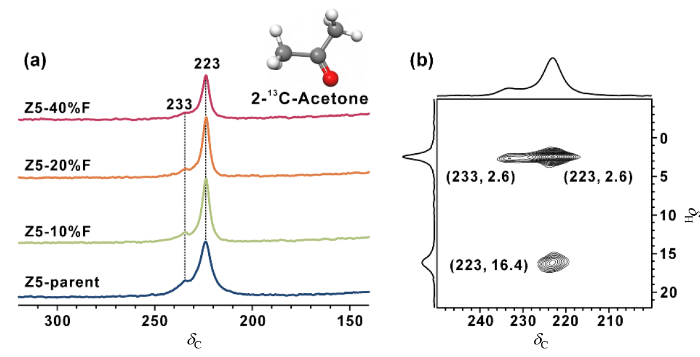
图4
ZSM-5分子筛原粉及不同浓度NH4F刻蚀样品吸附2-13C-丙酮的固体核磁共振谱:(a) 13C MAS NMR谱;(b)二维1H‒13C相关谱
Fig. 4
Probe-assisted solid-state NMR spectra of 2-13C-acetone adsorbed on the parent and NH4F-etched ZSM-5 samples: (a) 13C MAS NMR spectra and (b) two-dimensional 1H‒13C correlation spectrum
为了精准表征不同浓度NH4F刻蚀分子筛的酸强度与酸分布,本研究进一步采用不同尺寸的三烷基氧膦[TMPO(~0.55 nm)和TBPO(~0.82 nm)]探针分子技术[17,19].吸附TMPO的31P NMR谱[图5(a)]能够同时提供分子筛孔道内和外表面,特别是微孔内酸位的强度与分布信息.Z5-parent的谱图显示四个特征峰,分别归属于:邻近LAS的超强BAS(δP 86)、强BAS(δP 76)、LAS(δP 68)以及较弱BAS(δP 63)[26,27]. 经10% NH4F溶液刻蚀后,δP 68处的LAS信号显著减弱,这与1H NMR中δH 2.8处Al‒OH信号减少相符合,再次证实NH4F刻蚀初期优先攻击AlIV-2物种.同时,δP 86处超强BAS信号减弱,印证了其超强酸性来源于与邻近LAS(δP 68)的协同效应[26],该协同作用随LAS的减少而变弱.δP 76处的强BAS信号强度明显增加,可能源于两种机制的共同作用.一方面,部分δP 86信号的协同效应被削弱,进而转化为δP 76信号;另一方面,温和刻蚀作用清除了部分孔道堵塞物种,打开了受限的微孔通道,使得原本处于较难接近位置的内部BAS得以暴露,从而更容易被TMPO探针探测到.当NH4F浓度增至20%与40%时,所有酸位信号(包括δP 76)强度均有所下降,表明过度刻蚀引发分子筛内部骨架结构的降解,导致总酸密度降低.
图5
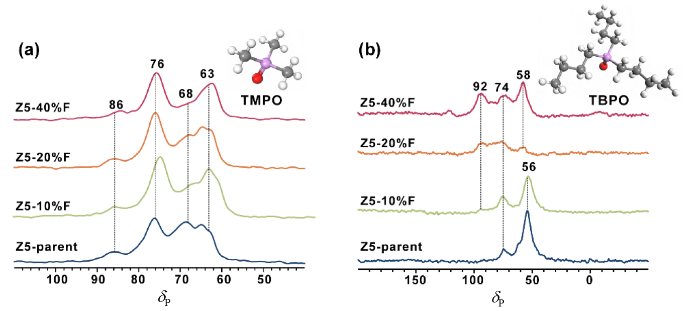
图5
ZSM-5分子筛原粉及不同浓度NH4F刻蚀样品吸附含膦探针分子的31P MAS NMR谱:(a) TMPO和(b) TBPO
Fig. 5
31P MAS NMR spectra of the parent and NH4F-etched ZSM-5 samples adsorbing phosphine-containing probe molecules: (a) TMPO and (b) TBPO
由于TBPO分子尺寸大于ZSM-5的原始微孔孔径,吸附TBPO的31P NMR谱[图5(b)]能够提供分子筛外表面及新形成介孔中酸位的信息.Z5-parent的谱图只有δP ~56(物理吸附在外表面的TBPO)和较弱的δP 74(吸附在外表面BAS上的TBPO)信号[28],证实其外表面酸位数量较少,BAS主要分布于微孔内部,且缺乏足够容纳TBPO的大尺寸孔道.经过NH4F刻蚀后,δP 74处信号增强,表明NH4F刻蚀将更多的BAS暴露于外表面.同时,在δP 92处出现了一个随NH4F浓度增加而增强的新峰,可以归属于TBPO分子进入新生成的介孔后,被其中的BAS质子化所形成的TBPOH+物种[28].由于TBPOH+物种处于介孔的限域环境中,其31P核受到更强的屏蔽作用,从而表现出比外表面BAS(δP 74)更大的化学位移.该信号的出现与增强,是NH4F刻蚀构筑分子筛介孔的最直接谱学证据.
综合多种探针分子的固体NMR结果,清晰地揭示了NH4F刻蚀对ZSM-5分子筛酸性的调变机制.在较低浓度下,NH4F优先攻击Lewis酸性的骨架铝缺陷位,调控Brønsted/Lewis酸比例,并起到“开孔”作用,提升晶体内部BAS的可接近性;随着NH4F浓度增加,刻蚀转变为“造孔”,通过构筑介孔通道将大量原本在微孔中的酸位暴露于更开放的空间;然而,过高的NH4F浓度会导致“过度刻蚀”,造成骨架溶解与总酸量下降.本研究从原子尺度阐明了NH4F刻蚀逐步调控分子筛孔道结构与酸性(浓度、强度、类型、分布及可接近性)的化学过程,为理解多级孔分子筛的催化性能提供了坚实的科学基础.
2.4 催化性能验证:甲醇转化反应
为验证NH4F刻蚀所构筑的多级孔结构对催化性能的影响,选取甲醇制烯烃(MTO)反应作为探针反应,对原粉(Z5-parent)和40% NH4F刻蚀样品(Z5-40%F)进行了催化寿命对比测试.反应在固定床反应器中进行,反应温度为350 ℃,质量空速为4.8 h-1,结果如图6所示.Z5-parent的甲醇转化率在38.5 h后开始下降,而Z5-40%F的转化率可维持至70 h,催化剂寿命显著延长.这一结果表明,NH4F刻蚀所引入的多级孔结构有效改善了传质性能,抑制了积碳的生成与沉积,从而提升了催化剂的稳定性.尽管Z5-40%F样品因过度刻蚀导致部分酸量损失,但其发达的介孔网络为反应物和产物提供了更便捷的扩散通道,延缓了活性位的覆盖和失活.催化数据与TEM、氮气吸附及固体NMR表征结果相互印证,为NH4F刻蚀策略的有效性提供了直接证据.
图6
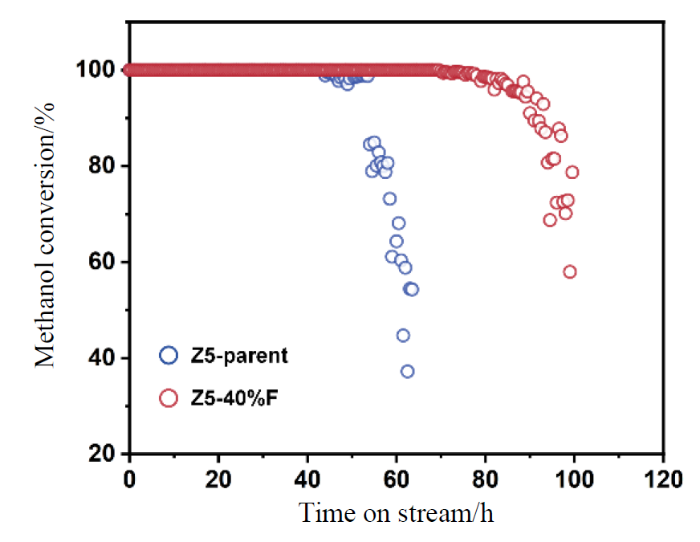
图6
ZSM-5分子筛原粉及40%NH4F刻蚀样品催化MTO反应的甲醇转化率随反应时间的变化曲线
Fig. 6
The curves of methanol conversion with reaction time in MTO reaction catalyzed by the parent and 40% NH4F-etched ZSM-5 samples
3 结论
本研究综合运用多种固体NMR技术,系统揭示了NH4F刻蚀对ZSM-5分子筛结构及酸性的调控机制.结果表明,NH4F刻蚀能够在基本保持分子筛拓扑结构的前提下,于晶体内部构建出连通性良好的多级孔体系.27Al与29Si MAS NMR证实,该过程对Si‒O‒Si和Si‒O‒Al键具有近乎无差别的反应活性,未引发明显的优先脱铝或脱硅,是一种相对温和、均匀且可控的后处理改性策略.更为重要的是,结合1H MAS NMR及探针分子(2-13C-丙酮、TMPO、TBPO)辅助的固体NMR分析,从原子尺度阐明了NH4F刻蚀对活性位结构与酸性的调变机制:低浓度(10%)刻蚀优先攻击Lewis酸性的骨架铝缺陷位,并发挥“开孔”作用,提升内部Brønsted酸位的可接近性;中等浓度(20%)刻蚀进入“造孔”阶段,通过构筑介孔通道进一步提升晶体内部酸位的可接近性;然而,过高浓度(40%)刻蚀会导致骨架过度溶解,造成总酸量下降.本研究建立了“NH4F浓度-孔结构-酸性”之间的内在关联,为利用NH4F刻蚀法实现多级孔分子筛催化剂的理性设计与优化提供了理论依据.
利益冲突
无
参考文献
Emerging applications of zeolites in catalysis, separation and host-guest assembly
[J].DOI:10.1038/s41578-021-00347-3 [本文引用: 1]
Confinement effects on molecular diffusion in zeolites: Mechanisms and perspectives
[J].
DOI:10.1039/D5CS00613A
URL
[本文引用: 1]

This review provides a comprehensive elucidation of the fundamental mechanisms and key interactions governing molecular diffusion under nanoconfinement in zeolites.
Hierarchically structured zeolites: From design to application
[J].DOI:10.1021/acs.chemrev.0c00016 URL [本文引用: 1]
Chemical engineering of zeolites: Alleviating transport limitations through hierarchical design and shaping
[J].
DOI:10.1039/d5cs00169b
PMID:40439198
[本文引用: 1]
Zeolites are indispensable catalysts in a wide range of industrial applications due to their well-defined microporous structures and exceptional shape-selective properties. However, their practical use is often constrained by diffusion limitations, which can hinder reactant accessibility, influence product selectivity, and accelerate catalyst deactivation. This review critically examines strategies to alleviate these diffusion constraints, focusing on hierarchical structuring, nanozeolite synthesis, and advanced shaping techniques. We discuss fundamental diffusion theories, experimental characterization methods, and emerging methodologies that enhance mass transport in zeolites. By bridging fundamental principles with industrial applications, this review provides a comprehensive overview of how tailored zeolite architectures can optimize catalytic performance, paving the way for more efficient and sustainable processes.
Mesoporous zeolites by fluoride etching
[J].DOI:10.1016/j.coche.2015.01.002 URL [本文引用: 1]
Modification of zeolite morphology via NH4F etching for catalytic bioalcohol conversion
[J].DOI:10.1002/cctc.v16.6 URL [本文引用: 1]
Chemical equilibrium controlled etching of MFI-type zeolite and its influence on zeolite structure, acidity, and catalytic activity
[J].DOI:10.1021/cm400719z URL [本文引用: 1]
A sponge-like small pore zeolite with great accessibility to its micropores
[J].DOI:10.1039/D0QI00261E URL [本文引用: 1]
Optimization of ammonium fluoride route to hierarchical ZSM-5 zeolites
[J].DOI:10.1016/j.micromeso.2023.112760 URL [本文引用: 1]
Enabling mesopore engineering inside Al-rich MOR zeolites via a sequential fluorination-acid leaching-alkaline treatment strategy
[J].
DOI:10.1039/D5TA02715B
URL
[本文引用: 1]
Hierarchical Al-rich MOR zeolites with an intracrystalline mesopore centered at 10–20 nm were synthesized by a tandem fluorination-acid leaching-alkaline treatment protocol.
Preparation of hierarchical SSZ-13 by NH4F etching
[J].DOI:10.1016/j.micromeso.2020.110863 URL [本文引用: 1]
Synthesis of fluorinated ZSM-5 catalysts: Fluoride effect on structure properties and coke resistance in n-hexane catalytic cracking
[J].DOI:10.1007/s10853-023-08776-x [本文引用: 1]
Recent advances on surface metal hydrides studied by solid-state nuclear magnetic resonance spectroscopy
[J].
DOI:10.1016/j.mrl.2022.09.001
PMID:40919280
[本文引用: 1]
Metal hydrides (M-H) on solid surfaces, i.e., surface M-H, are ubiquitous but critical species in heterogeneous catalysis, and their intermediate roles have been proposed in numerous reactions such as (de)hydrogenation and alkanes activation, etc., however, the detailed spectroscopic characterizations remain challenging. Solid-state nuclear magnetic resonance (ssNMR) spectroscopy has become a powerful tool in surface studies, as it provides access to local structural characterizations at atomic level from multiple views, with comprehensive information on chemical bonding and spatial structures. In this review, we summarized and discussed the latest research developments on the successful application of ssNMR to characterize surface M-H species on solid catalysts including supported single-site heterogeneous catalysts, bulk metal oxides and metal-modified zeolites. We also discussed the opportunities and challenges in this field, as well as the potential application/development of state-of-the-art ssNMR technologies to enable further exploration of metal hydrides in heterogeneous catalysis.© 2022 The Authors.
Unraveling boron-organic template interactions in [B, Al]-ZSM-5 zeolite using solid-state NMR spectroscopy
[J].
Exploring the effect of ethanol-water structuring on the transport properties of ethanol in porous silicas
[J].
Solid-state NMR investigation of the host-guest interactions in gas adsorption and chemical separation using MOFs as adsorbents
[J].
固体NMR研究MOFs吸附和分离过程中的主客体相互作用
[J].
DOI:10.11938/cjmr20223027
[本文引用: 1]
固体核磁共振(NMR)因对结构和化学环境敏感,已广泛应用于研究金属有机框架材料(MOFs)在吸附分离应用上的主客体相互作用机制.多核、多维、变温固体NMR实验可以用来研究低碳碳氢化合物、CO<sub>2</sub>在MOFs孔道内的吸附行为(包括优先吸附位点、动力学性质、扩散快慢等).固体NMR也可用来直接测定低碳烷烃/烯烃在MOFs中的分离选择性,并观测低碳烷烃/烯烃在MOFs孔道内的竞争优先吸附.此外,固体NMR还可用来揭示常见化学品与MOFs的主客体相互作用模式.这些研究的开展将有助于人们理解MOFs在吸附和分离过程中存在的内在构效关系.
31P NMR chemical shifts of phosphorus probes as reliable and practical acidity scales for solid and liquid catalysts
[J].
DOI:10.1021/acs.chemrev.7b00289
PMID:28952317
[本文引用: 2]
Acid-base catalytic reaction, either in heterogeneous or homogeneous systems, is one of the most important chemical reactions that has provoked a wide variety of industrial catalytic processes for production of chemicals and petrochemicals over the past few decades. In view of the fact that the catalytic performances (e.g., activity, selectivity, and reaction mechanism) of acid-catalyzed reactions over acidic catalysts are mostly dictated by detailed acidic features, viz. type (Brønsted vs Lewis acidity), amount (concentration), strength, and local environments (location) of acid sites, information on and manipulation of their structure-activity correlation are crucial for optimization of catalytic performances as well as innovative design of novel effective catalysts. This review aims to summarize recent developments on acidity characterization of solid and liquid catalysts by means of experimental P nuclear magnetic resonance (NMR) spectroscopy using phosphorus probe molecules such as trialkylphosphine (TMP) and trialkylphosphine oxides (RPO). In particular, correlations between the observed P chemical shifts (δP) of phosphorus (P)-containing probes and acidic strengths have been established in conjuction with density functional theory (DFT) calculations, rendering practical and reliable acidity scales for Brønsted and Lewis acidities at the atomic level. As illustrated for a variety of different solid and liquid acid systems, such as microporous zeolites, mesoporous molecular sieves, and metal oxides, the P NMR probe approaches were shown to provide important acid features of various catalysts, surpassing most conventional methods such as titration, pH measurement, Hammett acidity function, and some other commonly used physicochemical techniques, such as calorimetry, temperature-programmed desorption of ammonia (NH-TPD), Fourier transformed infrared (FT-IR), and H NMR spectroscopies.
Bridging the molecular mechanism and industrial process of zeolite-catalyzed methanol conversion to olefins and ethanol using advanced solid-state NMR spectroscopy
[J].
DOI:10.1039/d5cs00341e
PMID:40511683
Zeolite-catalyzed methanol-to-olefin (MTO) and methanol-to-ethanol (MTE) reactions have achieved significant breakthroughs in both industry and academia, proving to be mature alternative pathways for producing basic chemicals from non-oil resources. The successful transition of these catalytic processes from laboratory to industrial implementation has been propelled by fundamental breakthroughs in the comprehensive understanding of reaction mechanisms. In this context, solid-state nuclear magnetic resonance (ssNMR) spectroscopy has emerged as an indispensable tool for elucidating catalyst structures, catalytic reaction mechanisms, and the interactions and dynamics of reactant molecules in these industrially important processes. This review specifically focuses on the application of ssNMR spectroscopy in industrially mature MTO and dimethyl ether (DME) carbonylation processes, which serve as representative examples of zeolite-catalyzed industrial processes. Based on this molecular-level information from spectroscopic observations combined with theoretical methods, this review aims to bridge the fundamental understandings of reaction mechanisms with practical applications, including the rationalization of catalysts, the optimization of catalytic performance, and the improvement of industrial processes.
Solid-state 31P NMR mapping of active centers and relevant spatial correlations in solid acid catalysts
[J].DOI:10.1038/s41596-020-0385-6 [本文引用: 3]
The mosaic structure of zeolite crystals
[J].
DOI:10.1002/anie.201608417
PMID:27797136
[本文引用: 1]
Zeolites are widely used in many commercial processes, mostly as catalysts or adsorbents. Understanding their intimate structure at the nanoscale is the key to control their properties and design the best materials for their ever increasing uses. Herein, we report a new and controllable fluoride treatment for the non-discriminate extraction of zeolite framework cations. This sheds new light on the sub-structure of commercially relevant zeolite crystals: they are segmented along defect zones exposing numerous nanometer-sized crystalline domains, separated by low-angle boundaries, in what were apparent single-crystals. The concentration, morphology, and distribution of such domains analyzed by electron tomography indicate that this is a common phenomenon in zeolites, independent of their structure and chemical composition. This is a milestone to better understand their growth mechanism and rationally design superior catalysts and adsorbents.© 2016 Wiley-VCH Verlag GmbH & Co. KGaA, Weinheim.
Identity, evolution, and acidity of partially framework-coordinated Al species in zeolites probed by TMP 31P-NMR and FTIR
[J].DOI:10.1021/acscatal.3c00714 URL [本文引用: 1]
Dissolution behavior and varied mesoporosity of zeolites by NH4F etching
[J].DOI:10.1002/chem.v28.16 URL [本文引用: 1]
Aluminum distribution and active site locations in the structures of zeolite ZSM-5 catalysts
[J].
DOI:10.1126/science.ads7290
PMID:40273238
[本文引用: 1]
Zeolites have exceptional catalytic performance in oil refining and chemical synthesis that can be attributed to their well-defined porous structures that host active sites. This study pinpoints the exact locations of aluminum atoms in ZSM-5 structures-a key zeolite catalyst. Aluminum siting governs catalytic efficiency in acid and redox processes. Anomalous x-ray powder diffraction (AXRPD) at the aluminum K-edge probes the long-range order of aluminum atoms within the ZSM-5 frameworks, precisely quantifying both isolated aluminum atoms and Al(-O-Si-O-)Al sequences (aluminum pairs). Supported by nuclear magnetic resonance studies, AXRPD unambiguously determines the crystallographic organization of aluminum pairs, recognized spectroscopically as α, β, and γ sites, linking their distribution to superior catalytic activity in propene oligomerization. This combined approach provides essential insights for optimizing zeolite catalysts and enhancing their performance.
Solid-state nuclear magnetic resonance investigations of the nature, property, and activity of acid sites on solid catalysts
[J].
DOI:10.1016/j.ssnmr.2011.03.007
PMID:21592743
[本文引用: 1]
Further progress in the field of heterogeneous catalysis depends on our knowledge of the nature and behavior of surface sites on solid catalysts and of the mechanisms of chemical reactions catalyzed by these materials. In the past decades, solid-state NMR spectroscopy has been developed to an important tool for routine characterization of solid catalysts. The present work gives a review on experimental approaches and applications of solid-state NMR spectroscopy for investigating Brønsted and Lewis sites on solid acids. Studies focusing on the generation of surface sites via post-synthesis modification routes of microporous and mesoporous materials support the development of new and the improvement of existing catalyst systems. High-temperature and flow techniques of in situ solid-state NMR spectroscopy allow a deeper insight into the mechanisms of heterogeneously catalyzed reactions and open the way for studying the activity of acidic surface sites. They help to clarify the activation of reactants on Brønsted and Lewis acid sites and improve our understanding of mechanisms affecting the selectivity of acid-catalyzed reactions.Copyright © 2011 Elsevier Inc. All rights reserved.
Spectroscopically visualizing the evolution of hydrogen-bonding interactions
[J].DOI:10.1021/jacs.3c08723 URL [本文引用: 1]
The acidic nature of “NMR-invisible” tricoordinated framework aluminum species in zeolites
[J].DOI:10.1039/C9SC02634G URL [本文引用: 2]
What is being measured with P-bearing NMR probe molecules adsorbed on zeolites?
[J]
DOI:10.1021/jacs.1c05014
PMID:34410690
[本文引用: 1]
Elucidating the nature, strength, and siting of acid sites in zeolites is fundamental to fathom their reactivity and catalytic behavior. Despite decades of research, this endeavor remains a major challenge. Trimethylphosphine oxide (TMPO) has been proposed as a reliable probe molecule to study the acid properties of solid acid catalysts, allowing the identification of distinct Brønsted and Lewis acid sites and the assessment of Brønsted acid strengths. Recently, doubts have been raised regarding the assignment of the P NMR resonances of TMPO-loaded zeolites. Here, it is shown that a judicious control of TMPO loading combined with two-dimensional H-P HETCOR solid-state NMR, DFT, and ab initio molecular dynamics (AIMD)-based computational modeling provides an unprecedented atomistic description of the host-guest and guest-guest interactions of TMPO molecules confined within HZSM-5 molecular-sized voids. P NMR resonances usually assigned to TMPO molecules interacting with Brønsted sites of different acid strength arise instead from both changes in the probe molecule confinement effects at ZSM-5 channel system and the formation of protonated TMPO dimers. Moreover, DFT/AIMD shows that the H and P NMR chemical shifts strongly depend on the siting of the framework aluminum atoms. This work overhauls the current interpretation of NMR spectra, raising important concerns about the widely accepted use of probe molecules for studying acid sites in zeolites.
Evaluation of zeolite acidity by 31P MAS NMR spectroscopy of adsorbed phosphine oxides: Quantitative or not?
[J]DOI:10.1021/acsomega.2c00804 URL [本文引用: 2]


