脉冲偶极耦合EPR技术在生物大分子结构变化与互作研究中的应用
Applications of Pulsed Dipolar EPR Spectroscopy in Characterizing Interactions and Structural Changes of Biomacromolecules
脉冲偶极耦合EPR技术在生物大分子结构变化与互作研究中的应用 |
| 谢雅欣, 杨茵, 苏循成 |
|
Applications of Pulsed Dipolar EPR Spectroscopy in Characterizing Interactions and Structural Changes of Biomacromolecules |
| XIE Yaxin, YANG Yin, SU Xuncheng |
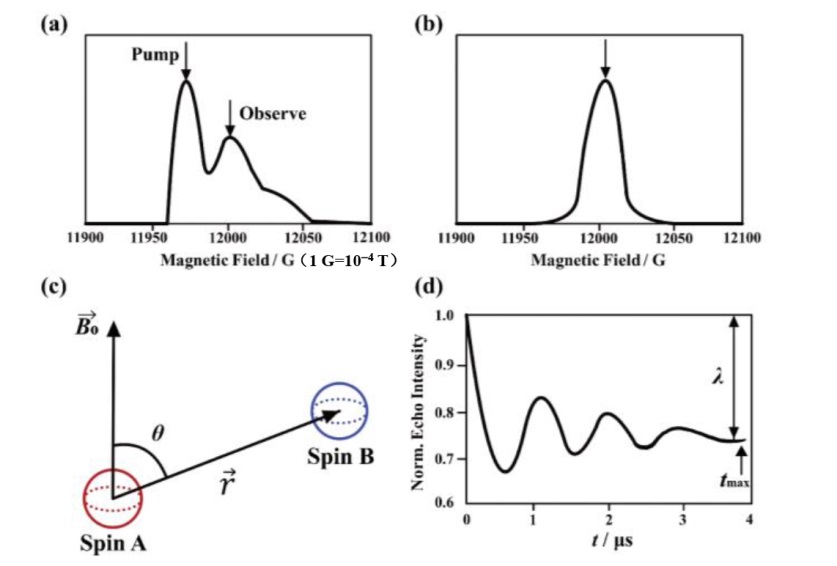
| 图2 偶极耦合脉冲EPR实验示意图. (a) DEER实验中泵浦脉冲与观测脉冲的位置关系示意图;(b) DQC和RIDME实验中的脉冲位置示意图;(c)实验中一对耦合电子自旋的空间构型示意,其中θ为自旋间距矢量 |
| Fig. 2 Schematic illustration of pulsed dipolar EPR experiments. (a) Relative positions of pump and observer pulses in a DEER experiment; (b) Pulse position in DQC and RIDME experiments; (c) Geometry representation of a coupled electron spin pair, where θ denotes the angle between the inter-spin vector |
|
|