脉冲偶极耦合EPR技术在生物大分子结构变化与互作研究中的应用
Applications of Pulsed Dipolar EPR Spectroscopy in Characterizing Interactions and Structural Changes of Biomacromolecules
脉冲偶极耦合EPR技术在生物大分子结构变化与互作研究中的应用 |
| 谢雅欣, 杨茵, 苏循成 |
|
Applications of Pulsed Dipolar EPR Spectroscopy in Characterizing Interactions and Structural Changes of Biomacromolecules |
| XIE Yaxin, YANG Yin, SU Xuncheng |
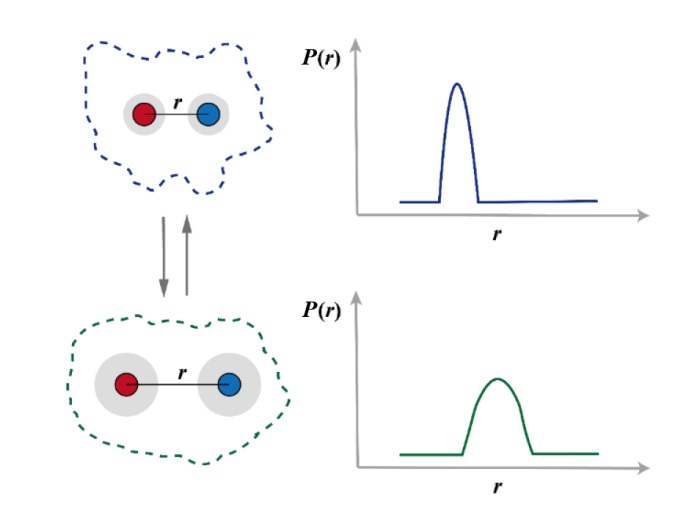
| 图5 基于PD-EPR的生物大分子动态结构研究示意图.展示标记到同一生物大分子情况下两个自旋标记位点之间的距离分布,其中灰色阴影表示两个自旋在不同条件下的分布变化.PD-EPR技术可以测量自旋间距离分布函数P(r),通过比较距离分布变化,研究生物大分子的结构变化 |
| Fig. 5 Scheme of structural variations determined by PD-EPR measurements. This distance distribution measured by PD-EPR between two spin labels attached to a biomacromolecule, and the gray shading area represents the range of spin label relocations under different conditions. The PD-EPR technique measures the spin distance distribution function P(r). By comparing the changes in the distance distribution, it allows the study of conformational changes in biomolecules |
|
|