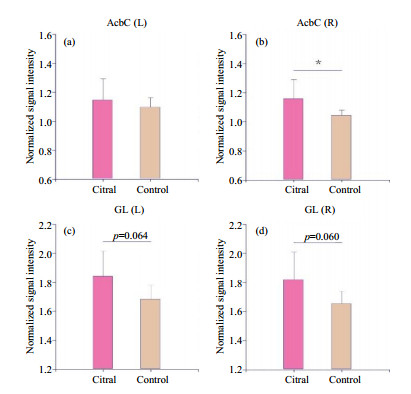
In this study, an olfactory inhalation instrument was devised to allow the rats to inhale volatile citral or odorless air. Manganese-enhanced magnetic resonance imaging (MEMRI) was used to reveal changes of accumulative brain activities after a 24 h inhalation of volatile citral. Compared with the control group, the rats in the citral group showed increased functional activities in the core of nucleus accumbens (AcbC) and olfactory glomerular layer (GL), and decreased Mn2+ accumulation in the brain regions of visual cortex (VC), auditory cortex (AC) and retrosplenial cortex (RSC). Functional correlations between the GL and associated brain regions increased after citral inhalation. These results suggested that MEMRI might be used to detect brain activation associated with sustained olfactory stimulation.
[1] LOGOTHETIS N K. What we can do and what we cannot do with fMRI[J]. Nature, 2008, 453(7197):869-878.
[2] MA Y, GUO H, WANG Q S, et al. Correlations between morphological characteristics and expression levels of specific molecular biomarkers in glioblastoma[J]. Chinese J Magn Reson, 2018, 35(1):22-30.马芸, 郭虹, 王秋实, 等. 基于影像的形态学特征与胶质母细胞瘤特征分子表达的相关性研究[J]. 波谱学杂志, 2018, 35(1):22-30.
[3] SHAO D D, WANG X X, PAN Z L, et al. Imaging hippocampus of mental patients with BLADE technique[J]. Chinese J Magn Reson, 2019, 36(3):261-267.邵丹丹, 王雪雪, 潘自来, 等. 刀锋伪影校正技术在精神疾病患者海马MRI检查中的应用[J]. 波谱学杂志, 2019, 36(3):261-267.
[4] SILVA A C. Using manganese-enhanced MRI to understand BOLD[J]. Neuroimage, 2012, 62(2):1009-1013.
[5] DUDEK M, ABO-RAMADAN U, HERMANN D, et al. Brain activation induced by voluntary alcohol and saccharin drinking in rats assessed with manganese-enhanced magnetic resonance imaging[J]. Addict Biol, 2015, 20(6):1012-1021.
[6] YU X, WADGHIRI Y Z, SANES D H, et al. In vivo auditory brain mapping in mice with Mn-enhanced MRI[J]. Nat Neurosci, 2005, 8(7):961-968.
[7] MALKOVA N V, GALLAGHER J J, YU C Z, et al. Manganese-enhanced magnetic resonance imaging reveals increased DOI-induced brain activity in a mouse model of schizophrenia[J]. Proc Natl Acad Sci USA, 2014, 111(24):E2492-E2500.
[8] WANG Y L, SUN B B. The manganese-enhanced MRI study on olfaction[J]. Chinese Journal of Ophthalmology and Otolaryngology, 2014, 14(5):327-329.王亚玲, 孙宝宾. 嗅觉的锰增强磁共振成像研究[J]. 中国眼耳鼻喉科杂志, 2014, 14(5):327-329.
[9] LEHALLIER B, RAMPIN O, SAINT-ALBIN A, et al. Brain processing of biologically relevant odors in the awake rat, as revealed by manganese-enhanced MRI[J]. PloS one, 2012, 7(10):e48491.
[10] GUTMAN D A, MAGNUSON M, MAJEED W, et al. Mapping of the mouse olfactory system with manganese-enhanced magnetic resonance imaging and diffusion tensor imaging[J]. Brain Struct Funct, 2013, 218(2):527-537.
[11] 方可. 锰离子增强磁共振成像(MEMRI)技术及其在研究大鼠嗅觉和脑缺血中的应用[D]. 武汉:中国科学院武汉物理与数学研究所, 2002.
[12] CHEN W, TENNEY J, KULKARNI P, et al. Imaging unconditioned fear response with manganese-enhanced MRI (MEMRI)[J]. Neuroimage, 2007, 37(1):221-229.
[13] DI RENZO F, BROCCIA M L, GIAVINI E, et al. Citral, an inhibitor of retinoic acid synthesis, attenuates the frequency and severity of branchial arch abnormalities induced by triazole-derivative fluconazole in rat embryos cultured in vitro[J]. Reprod Toxicol, 2007, 24(3-4):326-332.
[14] KOMORI T, MATSUMOTO T, MOTOMURA E, et al. The sleep-enhancing effect of valerian inhalation and sleep-shortening effect of lemon inhalation[J]. Chem Senses, 2006, 31(8):731-737.
[15] KOMORI T, MIYAHARA S, YAMAMOTO M, et al. Effects of odorants on the hypothalamic-pituitary-adrenal axis and interleukin-6(IL-6) and IL-6 receptor mRNA expression in rat hypothalamus after restraint stress[J]. Chem Senses, 2003, 28(9):767-771.
[16] BISSIG D, BERKOWITZ B A. Manganese-enhanced MRI of layer-specific activity in the visual cortex from awake and free-moving rats[J]. Neuroimage, 2009, 44(3):627-635.
[17] NIU H C, ZHANG G Q, Li H Y, et al. Multi-system state shifts and cognitive deficits induced by chronic morphine during abstinence[J]. Neurosci Lett, 2017, 640:144-151.
[18] BUCKNER R L, KRIENEN F M, YEO B T T. Opportunities and limitations of intrinsic functional connectivity MRI[J]. Nat Neurosci, 2013, 16(7):832-837.
[19] GOTTFRIED J A. Central mechanisms of odour object perception[J]. Nat Rev Neurosci, 2010, 11(9):628-641.
[20] MORI K, SAKANO H. How is theolfactory map formed and interpreted in the mammalian brain[J]? Annu Rev Neurosci, 2011, 34(1):467-499.
[21] GANGAROSSA G, ESPALLERGUES J, DE KERCHOVE D'EXAERDE A, et al. Distribution and compartmental organization of GABAergic medium-sized spiny neurons in the mouse nucleus accumbens[J]. Front Neural Circuits, 2013, 7(22):1-20.
[22] WANG W G, DEVER D, LOWE J, et al. Regulation of prefrontal excitatory neurotransmission by dopamine in the nucleus accumbens core[J]. J Physiol, 2012, 590(16):3743-3769.
[23] LEE S W, JEONG B S, CHOI J, et al. Sex differences in interactions between nucleus accumbens and visual cortex by explicit visual erotic stimuli:an fMRI study[J]. Int J Impot Res, 2015, 27(5):161-166.
[24] SALIMPOOR V N, VAN D B I, KOVACEVIC N, et al. Interactions between the nucleus accumbens and auditory cortices predict music reward value[J]. Science, 2013, 340(6129):216-219.