

基于全局和局部特征信息的生成对抗网络在海马体分割中的应用
收稿日期: 2024-09-03
网络出版日期: 2024-11-18
Application of Generative Adversarial Networks Based on Global and Local Feature Information in Hippocampus Segmentation
Received date: 2024-09-03
Online published: 2024-11-18
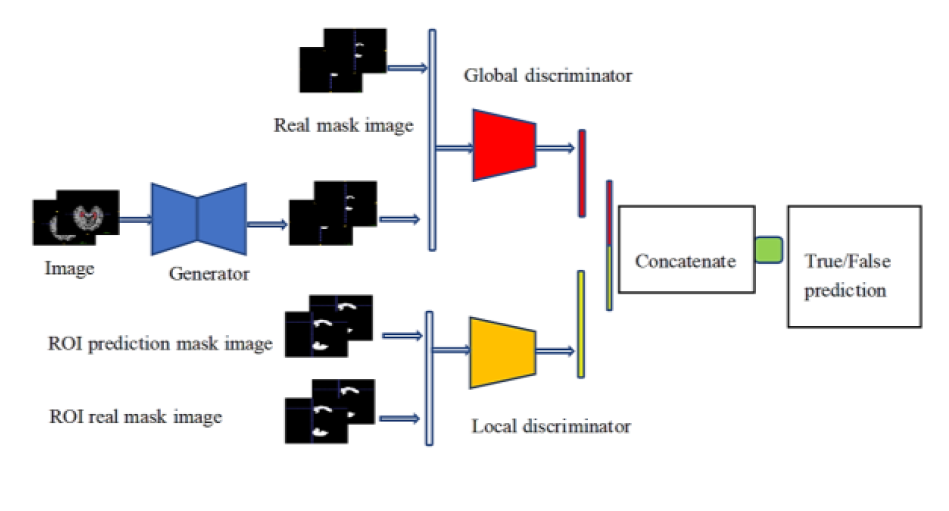
海马体由于结构复杂、体积小,导致对其进行精准分割较为困难.为此,本文提出一种基于全局和局部特征信息的生成对抗网络(GLGAN)分割方法.首先,为了提高网络稳定性和海马体分割精度,减少信息丢失和梯度爆炸等问题,本文通过改进生成对抗网络的生成器和损失函数,提出了全局生成对抗网络(GGAN).其次,由于判别器本质上是二分类的分类器,对微小局部变换不敏感,于是提出具有全局和局部特征信息的双判别器网络结构的生成对抗网络.最后,设计一个平衡生成对抗网络(GAN)对抗性损失和3D u-net分割损失的总损失函数.实验结果表明基于GLGAN的分割方法有利于密集评估海马体,促进判别器将生成器生成的掩膜值推向更真实分布,提高海马体分割精度.该方法分割海马体的Dice系数为0.804、IOU为0.672.
关键词: 生成对抗网络(GAN); 3D卷积神经网络; 分割; 海马体; 3D u-net
魏志宏 , 孔旭东 , 孔燕 , 闫士举 , 丁阳 , 魏贤顶 , 孔栋 , 杨波 . 基于全局和局部特征信息的生成对抗网络在海马体分割中的应用[J]. 波谱学杂志, 2025 , 42(2) : 143 -153 . DOI: 10.11938/cjmr20243130
Due to the complex structure and small size of the hippocampus, precise segmentation of the hippocampus remains challenging. To address this issue, this study proposes a generative adversarial network (GAN) based on global and local feature information (GLGAN) for hippocampus segmentation. First, to improve network stability and segmentation accuracy while reducing the likelihood of problems such as information loss and gradient explosion, we proposed the global GAN (GGAN) by optimizing the generator and loss function of GAN. Second, since the discriminator is essentially a binary classifier and is not sensitive to small local changes, we introduced a GAN method of dual discriminator network structure that integrates both global and local feature information. Finally, a total loss function was designed to balance GAN adversarial loss and 3D u-net segmentation loss. The experimental results show that proposed method based on GLGAN facilitates intensive evaluation of the hippocampus, and drives the discriminator to push the mask value provided by the generator to a more realistic distribution, thereby enhancing hippocampus segmentation accuracy. The Dice coefficient and IOU for hippocampus segmentation using GLGAN are 0.804 and 0.672 respectively.
Key words: generative adversarial network (GAN); 3D CNN; segmentation; hippocampus; 3D u-net
| [1] | 张鹏. 人类海马体功能剖分及连接模式分析[D]. 长沙: 国防科学技术大学, 2019. |
| [2] | INSAUSTI R, MUOZLóPEZ M, INSAUSTI A M. The CA2 hippocampal subfield in humans: A review[J]. Hippocampus, 2023, 33(6): 712-729. |
| [3] | AKKUS Z, GALIMZIANOVA A, HOOGI A, et al. Deep learning for brain MRI segmentation: state of the art and future directions[J]. J Digit Imaging, 2017, 30(4): 449-459. |
| [4] | LI W. Automatic segmentation of liver tumor in CT images with deep convolutional neural networks[J]. J Comput Commun, 2015, 3(11): 146-151. |
| [5] | MONDAL A K, DOLZ J, DESROSIERS C. Few-shot 3d multi-modal medical image segmentation using generative adversarial learning[J]. arXiv preprint arXiv: 1810.12241, 2018. |
| [6] | HALLER J W, CHRISTENSEN G E, JOSHI S C, et al. Hippocampal MR imaging morphometry by means of general pattern matching[J]. Radiology, 1996, 199(3): 787-791. |
| [7] | KWAK K, YOON U, LEE D K, et al. Fully-automated approach to hippocampus segmentation using a graph-cuts algorithm combined with atlas-based segmentation and morphological opening[J]. Magn Reson Imaging, 2013, 31(7): 1190-1196. |
| [8] | HECKEMANN R A, HAJNAL J V, ALJABAR P, et al. Automatic anatomical brain MRI segmentation combining label propagation and decision fusion[J]. NeuroImage, 2006, 33(1): 115-126. |
| [9] | WU G, SHEN D. Hierarchical Label Fusion with Multiscale Feature Representation and Label-Specific Patch Partition[C]// International Conference on Medical Image Computing and Computer-Assisted Intervention.Springer, Cham, 2014. |
| [10] | HU S, PIERRICK COUPé, PRUESSNER J C, et al. Appearance-based modeling for segmentation of hippocampus and amygdala using multi-contrast MR imaging[J]. NeuroImage, 2011, 58(2): 549-559. |
| [11] | ZARPALAS D, GKONTRA P, DARAS P, et al. Hippocampus segmentation through gradient based reliability maps for local blending of ACM energy terms[C]// Biomedical Imaging (ISBI), 2013 IEEE 10th International Symposium on.IEEE, 2013. |
| [12] | HAO Y F, WANG T Y, ZHANG X Q, et al. Local label learning (LLL) for subcortical structure segmentation: Application to hippocampus segmentation[J]. Hum Brain Mapp, 2014, 35: 2674-2697. |
| [13] | KHAN A R, CHERBUIN N, WEN W, et al. Optimal weights for local multi-atlas fusion using supervised learning and dynamic information (SuperDyn): Validation on hippocampus segmentation[J]. NeuroImage, 2011, 56(1): 126-139. |
| [14] | DE ALEJO R P, RUIZ-CABELLO J, CORTIJO M, et al. Computer-assisted enhanced volumetric segmentation magnetic resonance imaging data using a mixture of artificial neural networks[J]. Magn Reson Imaging, 2003, 21(8): 901-912. |
| [15] | CAO L, LI L, ZHENG J, et al. Multi-task neural networks for joint hippocampus segmentation and clinical score regression[J]. Multimedia Tools Appl, 2018, 77(1): 1-18. |
| [16] | ATALOGLOU D, DIMOU A, ZARPALAS D, et al. Fast and precise hippocampus segmentation through deep convolutional neural network ensembles and transfer learning[J]. Neuroinformatics, 2019, 17(4): 563-582. |
| [17] | HAZARIKA R A, MAJI A K, SYIEM R, et al. Hippocampus segmentation using u-net convolutional network from brain magnetic resonance imaging (MRI)[J]. J Digit Imaging, 2022, 35(4): 893-909. |
| [18] | DENG H, ZHANG Y, LI R, et al. Combining residual attention mechanisms and generative adversarial networks for hippocampus segmentation[J]. Tsinghua Sci Technol, 2022, 27(1): 68-78. |
| [19] | OU Y X, GAO M, ZHAO D, et al. SA-TF-UNet: MRI hippocampus segmentation based on spatial attention mechanism and Transformer[J]. Journal of Image and Graphics, 2023, 28: 3191-3202. |
| 欧宇轩, 高敏, 赵地, 等. SA-TF-UNet: 基于空间注意力机制和Transformer的MRI海马体分割[J]. 中国图象图形学报, 2023, 28: 3191-3202. | |
| [20] | WEI Z H, YAN S J, HAN B S, et al. Multi-output 3D convolutional neural network for diagnosis of Alzheimer's disease[J]. Chinese J Magn Reson, 2021, 38(1): 92-100. |
| 魏志宏, 闫士举, 韩宝三, 等. 基于多输出的3D卷积神经网络诊断阿尔兹海默病[J]. 波谱学杂志, 2021, 38(1): 92-100. | |
| [21] | LECUN Y, BENGIO Y, HINTON G. Deep learning[J]. Nature, 2015, 521(7553): 436-444. |
| [22] | ZHONG Z S, KIM Y S, PLICHTA K, et al. Simultaneous co-segmentation of tumors in PET-CT images using deep fully convolutional networks[J]. Med Phys, 2019, 46: 619-633. |
| [23] | ZHAO X, ZHANG X, LI X J, et al. Multimodal glioma segmentation with fusion of multiple self-attention and deformable convolutions[J]. Chinese J Magn Reson, 2023, 40(3): 280-292. |
| 赵欣, 张鑫, 李鑫杰, 等. 融合多重自注意力和可变形卷积的多模态脑胶质瘤分割[J]. 波谱学杂志, 2023, 40(3): 280-292. | |
| [24] | LOFFE S, SZEGEDY C. Batch normalization: Accelerating deep network training by reducing internal covariate shift[J]. ArXiv Preprint Arxiv: 1502.03167, 2015. |
| [25] | LIAO X, QIAN Y, CHEN Y, et al. MMTLNet: Multi-modality transfer learning network with adversarial training for 3D whole heart segmentation[J]. Comput Med Imaging Graphics, 2020(85): 101785. |
| [26] | MADANI A, MORADI M, SYEDA-MAHMOOD T F. Medical image classification based on a generative adversarial network trained discriminator: US, 10937540B2[P]. 2021-03-02. |
| [27] | ARUN PANDIAN J, KANCHANADEVI K, KUMAR D, et al. Deep convolutional generative adversarial network for metastatic tissue diagnosis in lymph node section[M]// System Design for Epidemics Using Machine Learning and Deep Learning. Springer, Cham, 2023: 153-166. |
| [28] | REN H J, MA Y, XIAO L. Knee joint model construction and local specific absorptivity estimation based on generative adversarial network[J]. Chinese J Magn Reson, 2023, 40(4): 410-422. |
| 任宏晋, 马岩, 肖亮. 基于生成对抗网络的膝关节模型构建与局部比吸收率估计[J]. 波谱学杂志, 2023, 40(4): 410-422. | |
| [29] | CHAKRABORTY S, CHATTERJEE S, DEY N, et al. Modified cuckoo search algorithm in microscopic image segmentation of hippocampus[J]. Microsc Res Techniq, 2017, 80(10): 1051-1072. |
| [30] | SMALL G W, HARRISON T M, BURGGREN A C, et al. Altered memory-related functional connectivity of the anterior and posterior hippocampus in older adults at increased genetic risk for alzheimer's disease[J]. Hum Brain Mapp, 2013, 37(1): 366-380. |
| [31] | PHAM D L, XU C, PRINCE J L. Current methods in medical image segmentation[J]. Annu Rev Biomed Eng, 2000, 2: 315-337. |
| [32] | SHIN H C, TENENHOLTZ N A, ROGERS J K, et al. Medical image synthesis for data augmentation and anonymization using generative adversarial networks[C]// International workshop on simulation and synthesis in medical imaging. Springer, Cham, 2018: 1-11. |
/
| 〈 |
|
〉 |