
Chinese Journal of Magnetic Resonance ›› 2026, Vol. 43 ›› Issue (2): 125-135.doi: 10.11938/cjmr20253179cstr: 32225.14.cjmr20253179
• Articles • Previous Articles Next Articles
LI Xueting, LIANG Wei, ZHANG Xintong, CUI Mengqi, LIN Yulan*( )
)
Received:2025-08-15
Published:2026-06-05
Online:2025-10-11
Contact:
LIN Yulan
E-mail:yulan.lin@xmu.edu.cn
CLC Number:
LI Xueting, LIANG Wei, ZHANG Xintong, CUI Mengqi, LIN Yulan. Resolving Crowded NMR Spectra Based on Longitudinal Multi-spin Order and Hadamard Encoding[J]. Chinese Journal of Magnetic Resonance, 2026, 43(2): 125-135.
Add to citation manager EndNote|Reference Manager|ProCite|BibTeX|RefWorks

Fig. 1
The Hadamard-DQF-LMO pulse sequence. The white rectangle represents the water suppression (WS) presaturation module, while the composite waveforms p1 and p2 correspond to the polychromatic 180° transition pulse and Hadamard-encoded polychromatic 180° pulse, respectively. The dashed and solid black rectangles denote non-selective 180° and 90° pulses, respectively. The rectangles G1 and G2 indicate the dephasing gradient fields with an intensity ratio of 1:2
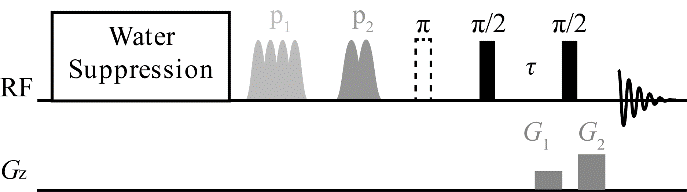
Fig. 2
(a) The encoding procedure of the order-N Hadamard-DQF-LMO spectrum; (b) The acquisition spectra of the order-4 Hadamard-DQF-LMO; (c) Resulting LMO spectra after Hadamard decoding of (b). The spectra are shown in absolute mode
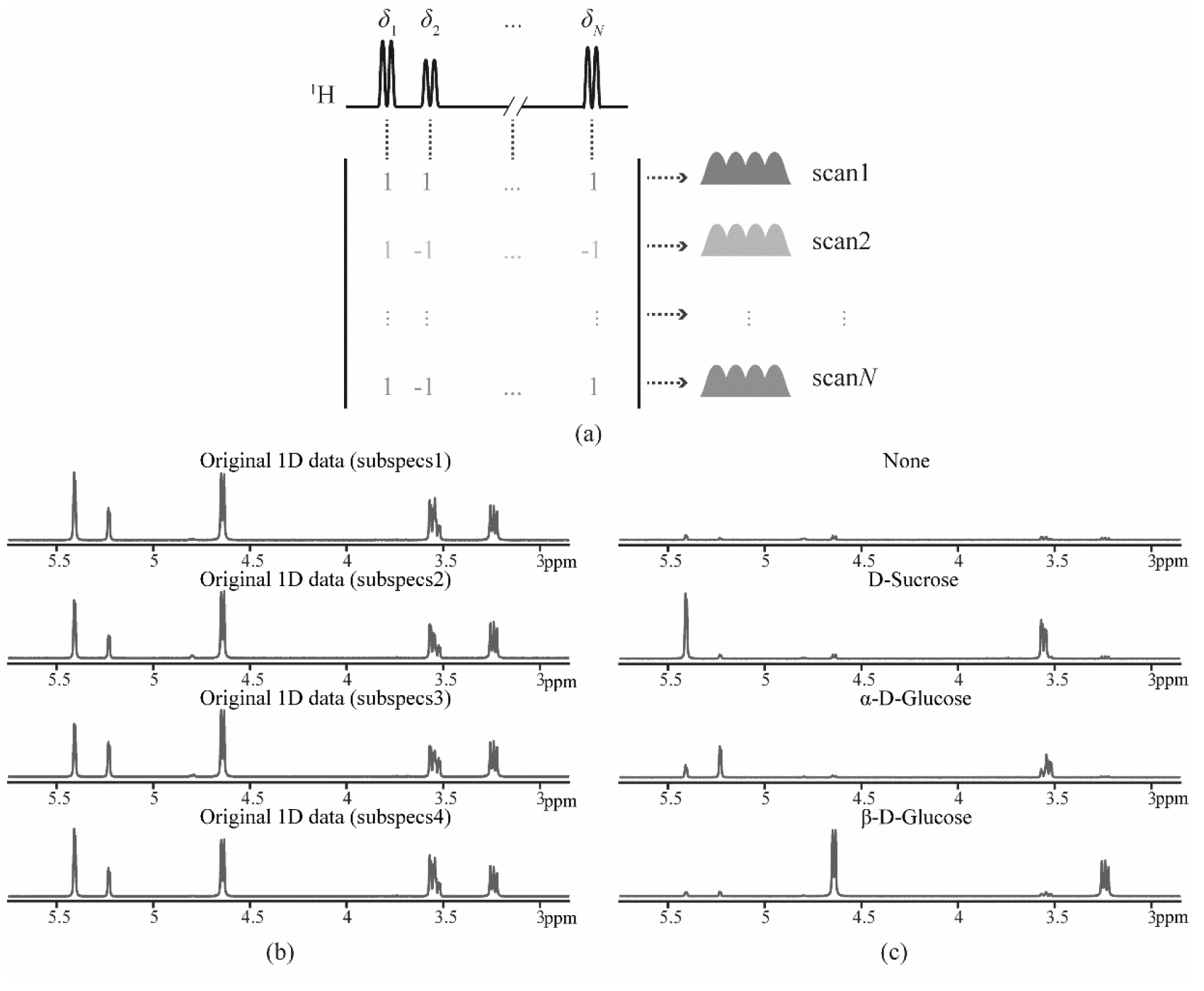
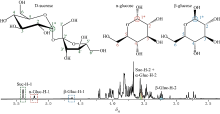
Fig. 3
1D 1H NMR spectrum of orange juice (Sample 1), with chemical structures of the target analytes (sucrose, α-glucose and β-glucose) shown above the spectrum
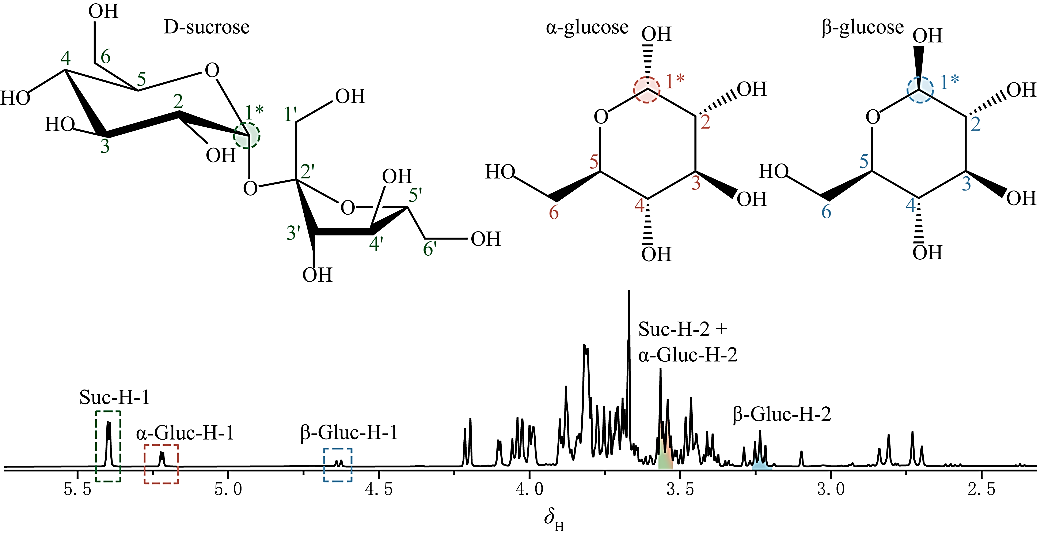
Fig. 4
1D LMO spectra of the orange-juice (absolute value display) acquired with (a) the DQF-LMO sequence and (b) the Hadamard-DQF-LMO sequence


Table 1
SNR comparison between DQF-LMO and Hadamard-DQF-LMO for orange-juice
| 偶合峰 | DQF-LMO | Hadamard-DQF-LMO | 提升效率 |
|---|---|---|---|
| Suc-H-2 | 227.85 | 426.29 | 187% |
| α-Gluc-H-2 | 123.40 | 252.54 | 204% |
| β-Gluc-H-2 | 213.29 | 386.36 | 181% |
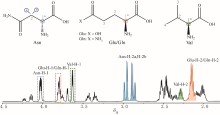
Fig. 5
1D 1H NMR spectrum of mixed amino acids (Sample 2), with chemical structures of the target analytes (asparagine, glutamic acid, glutamine and valine) shown above the spectrum
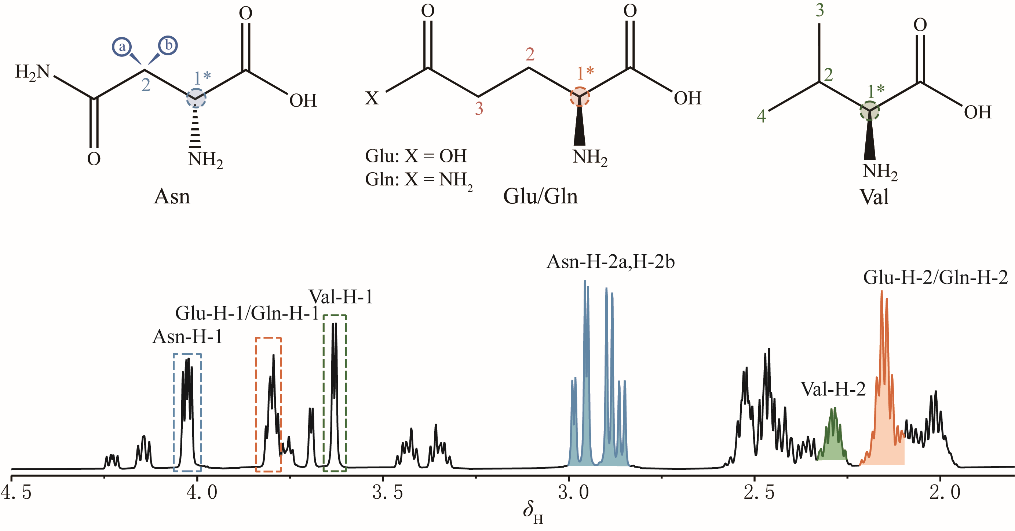
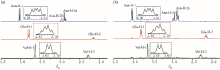
Fig. 6
1D LMO spectra of mixed amino acids acquired with (a) the DQF-LMO sequence and (b) the Hadamard-DQF-LMO sequence
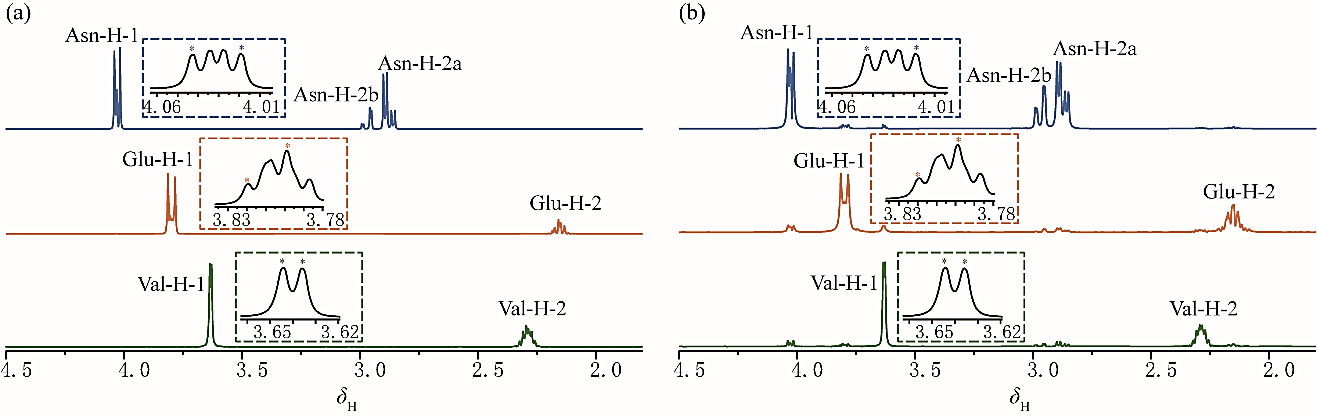
Table 2
SNR comparison between DQF-LMO and Hadamard-DQF-LMO for mixed amino acids
| 偶合峰 | DQF-LMO | Hadamard-DQF-LMO | 提升效率 |
|---|---|---|---|
| Asn-H-2a | 428.04 | 724.93 | 169% |
| Glu-H-2 | 76.24 | 135.22 | 177% |
| Val-H-2 | 123.62 | 227.68 | 184% |
| [1] | KOU X H, ZHANG Y B. Study on the enantiomeric recognition of chiral ureas containing amino acid units[J]. Chinese J Magn Reson, 2025, 42(3): 221-230. |
| 寇新慧, 张玉冰. 含氨基酸单元手性脲的对映体识别性能研究[J]. 波谱学杂志, 2025, 42(3): 221-230. | |
| [2] | ZHU X W, YANG X, WEI D X, et al. In vivo glutathione molecular MRS signal selection based on nuclear spin singlet states[J]. Chinese J Magn Reson, 2024, 41(4): 373-381. |
|
朱向炜, 杨雪, 魏达秀, 等. 基于核自旋单重态的活体谷胱甘肽分子MRS信号选择[J]. 波谱学杂志, 2024, 41(4): 373-381.
doi: 10.11938/cjmr20243105 |
|
| [3] |
VELAN S S, PICHUMANI K, MURRAY D, et al. Magnetic resonance spectroscopy with longitudinal multispin orders[J]. Curr Anal Chem, 2008, 4(1): 40-54.
doi: 10.2174/157341108783339106 |
| [4] |
DALVIT C, BODENHAUSEN G. Proton chemical-shift anisotropy-Detection of cross-correlation with dipole-dipole interactions by double-quantum filtered two-dimensional NMR exchange spectroscopy[J]. Chem Phys Lett, 1989, 161(6): 554-560.
doi: 10.1016/0009-2614(89)87037-X |
| [5] |
GRACE R C R, KUMAR A. Observation of cross correlations in a weakly coupled F-19-H-1 4-spin system[J]. J Magn Reson, Ser A, 1995, 115(1): 87-93.
doi: 10.1006/jmra.1995.1151 |
| [6] |
CHANDRAKUMAR N, VELAN S S. Separation of longitudinal multispin order by frequency cycling[J]. J Magn Reson, Ser A, 1993, 104(3): 363-365.
doi: 10.1006/jmra.1993.1237 |
| [7] |
VELAN S S. Analysis of longitudinal multispin orders in strongly coupled spin systems[J]. J Magn Reson, 2004, 171(2): 345-352.
pmid: 15546762 |
| [8] |
D'SILVA L, POLA A, DUTTA P, et al. Slow relaxation of longitudinal multispin orders in weakly and strongly coupled two-spin systems[J]. Magn Reson Chem, 2012, 50(6): 443-448.
doi: 10.1002/mrc.v50.6 |
| [9] |
TELEANU F, LUPULESCU A, VASOS P R. Selective excitation of long-lived nuclear spin states[J]. J Phys Chem Lett, 2022, 13(29): 6731-6736.
doi: 10.1021/acs.jpclett.2c01749 pmid: 35849533 |
| [10] |
KARUNANITHY G, REINSTEIN J, HANSEN D F. Multiquantum chemical exchange saturation transfer NMR to quantify symmetrical exchange: Application to rotational dynamics of the guanidinium group in arginine side chains[J]. J Phys Chem Lett, 2020, 11(14): 5649-5654.
doi: 10.1021/acs.jpclett.0c01322 pmid: 32543198 |
| [11] |
KLOIBER K, SPITZER R, GRUTSCH S, et al. Longitudinal exchange: an alternative strategy towards quantification of dynamics parameters in ZZ exchange spectroscopy[J]. J Biomol NMR, 2011, 51(1-2): 123-129.
doi: 10.1007/s10858-011-9547-8 pmid: 21947921 |
| [12] |
DE GRAAF R A, ROTHMAN D L. Detection of γ-aminobutyric acid (GABA) by longitudinal scalar order difference editing[J]. J Magn Reson, 2001, 152(1): 124-131.
doi: 10.1006/jmre.2001.2371 |
| [13] |
LIN Y L, LIANG W, CHEN L, et al. Enhanced detection of crowded NMR peaks using longitudinal multi-spin order for chemical analysis[J]. Anal Chim Acta, 2025, 1371: 344429.
doi: 10.1016/j.aca.2025.344429 |
| [14] |
BOER V O, LUIJTEN P R, KLOMP D W J. Refocused double-quantum editing for lactate detection at 7 T[J]. Magn Reson Med, 2013, 69(1): 1-6.
doi: 10.1002/mrm.24227 pmid: 22374843 |
| [15] |
MALY T, DEBELOUCHINA G T, BAJAJ V S, et al. Dynamic nuclear polarization at high magnetic fields[J]. J Chem Phys, 2008, 128(5): 052211.
doi: 10.1063/1.2833582 |
| [16] |
SCHIEMANN O, PRISNER T F. Long-range distance determinations in biomacromolecules by EPR spectroscopy[J]. Q Rev Biophys, 2007, 40(1): 1-53.
pmid: 17565764 |
| [17] |
KUPCE E, NISHIDA T, FREEMAN R. Hadamard NMR spectroscopy[J]. Prog Nucl Magn Reson Spectrosc, 2003, 42(3-4): 95-122.
doi: 10.1016/S0079-6565(03)00022-0 |
| [18] |
ZHOU J Y, LI L Y, YE C H. Application of the rotation approach to selective excitation of coupled spin systems by a shaped radiofrequency pulse[J]. Mol Phys, 1995, 86(5): 1173-1182.
doi: 10.1080/00268979500102651 |
| [19] |
KE H P, CAI H H, LIN Y Q, et al. Hadamard-encoded localized high-resolution NMR spectroscopy via intermolecular double-quantum coherences[J]. Chem Phys Lett, 2015, 622: 63-68.
doi: 10.1016/j.cplett.2015.01.025 |
| [20] |
KUPCE E, FREEMAN R. Frequency-domain Hadamard spectroscopy[J]. J Magn Reson, 2003, 162(1): 158-165.
pmid: 12762992 |
| [21] |
EBERHARDT K W, DEGEN C L, MEIER B H. Fast magnetic resonance force microscopy with Hadamard encoding[J]. Phys Rev B, 2007, 76(18): 180405.
doi: 10.1103/PhysRevB.76.180405 |
| [22] | KE H P, CAI H H. High-resolution localized NMR spectroscopy based on Hadamard-encoding[J]. Chinese J Magn Reson, 2020, 37(4): 524-532. |
|
柯汉平, 蔡宏浩. 基于哈德曼编码的新型高分辨定域谱[J]. 波谱学杂志, 2020, 37(4): 524-532.
doi: 10.11938/cjmr20192780 |
|
| [23] |
SIMPSON R, DEVENYI G A, JEZZARD P, et al. Advanced processing and simulation of MRS data using the FID appliance (FID-A)—An open source, MATLAB-based toolkit[J]. Magn Reson Med, 2017, 77(1): 23-33.
doi: 10.1002/mrm.v77.1 |
| [24] | DONG W, ZHAO Q, ZHAO J, et al. Qualitative analysis of aromatic compounds via 1D TOCSY techniques[J]. Magn Reson Lett, 2024, 4(1): 100091. |
| [25] |
KIRALY P, KERN N, PLESNIAK M P, et al. Single-scan selective excitation of individual NMR signals in overlapping multiplets[J]. Angew Chem Int Ed, 2021, 60: 666-671
doi: 10.1002/anie.v60.2 |
| [26] | WANG D, XIA J M, HUANG S, et al. A nuclear magnetic resonance method for mixture analysis based on one-dimensional doubly selective excitation total correlation spectroscopy[J]. Chinese J Anal Chem, 2022, 50(8): 1224-1232. |
| 王栋, 夏俊美, 黄帅, 等. 一种用于混合物分析的一维双选择性全相关谱核磁共振方法[J]. 分析化学, 2022, 50(8): 1224-1232. |
| [1] | WEN Yulin, LI Gaiying, WU Yupeng, LI Jianqi. Optimization of DW-MRS Acquisition Protocol: The Impact of Gating and Cycling Modes [J]. Chinese Journal of Magnetic Resonance, 2025, 42(4): 402-413. |
| [2] | TANG Shihao, YANG Jinyu, XU Yajie, WANG Ya, PENG Bowen, GAO Yuhao, YANG Xiaodong. A Design of Circularly Polarized Coil for Low-field Nuclear Magnetic Resonance Spectrometers [J]. Chinese Journal of Magnetic Resonance, 2025, 42(3): 308-320. |
| [3] | ZHU Xiangwei, YANG Xue, WEI Daxiu, YAO Yefeng. In Vivo Glutathione Molecular MRS Signal Selection Based on Nuclear Spin Singlet States [J]. Chinese Journal of Magnetic Resonance, 2024, 41(4): 373-381. |
| [4] | LI Ren, CHANG Xiao, ZHANG Jie, ZHANG Xiaoyong. Progress of Magnetic Resonance Spectroscopy in the Study of the Effects of Smoking on the Brain [J]. Chinese Journal of Magnetic Resonance, 2023, 40(4): 471-480. |
| [5] | Hui XU, Yi-ting WU, Xu-xia WANG, Yan KANG, Hao LEI, Li-feng GAO. Hippocampal Metabolite Alterations in Long-term Insulin-treated Type 1 Diabetes Mellitus Rats Revealed by 1H MRS [J]. Chinese Journal of Magnetic Resonance, 2022, 39(4): 393-400. |
| [6] | HUA Rui, SUN Yu, WEN Lin-fei, LIU Hui, WAN Sui-ren. Optimization of the MEGA-PRESS Sequence for Detection of γ-Aminobutyric Acid in Vivo [J]. Chinese Journal of Magnetic Resonance, 2018, 35(2): 188-197. |
| [7] | WANG Lu-lu, ZHU Yong, ZHONG Kai. Progresses in MRI and MRS Studies on Obesity [J]. Chinese Journal of Magnetic Resonance, 2016, 33(1): 168-178. |
| [8] | YANG Bao-lian*. Future of Ultra High Field MRI in Basic Research and Clinical Applications [J]. Chinese Journal of Magnetic Resonance, 2015, 32(4): 707-714. |
| [9] |
ZHANG Xiao-dong1*,HU Xiao-ping2.
Peak-Specific Phase Correction for Automated Spectrum Processing of In Vivo Magnetic Resonance Spectroscopic Imaging Using a Multiscale Approach
[J]. Chinese Journal of Magnetic Resonance, 2014, 31(1): 32-39.
|
| [10] | HUANG Yu-Ling, TANG Qi-Sheng, LI Ning, ZHU Chen-Jun. Effects of Yinao Jieyu Recipe in Intervening Cerebral Metabolism in Depressive-Like Rats Studied by In Vivo Magnetic Resonance Spectroscopy [J]. Chinese Journal of Magnetic Resonance, 2012, 29(3): 379-387. |
| [11] | HUANG Ming-Ming, LIN Fu-Chun, GAO Li-Feng, LEI Hao. Diabetic Encephalopathy Studied by Magnetic Resonance Imaging and Spectroscopy [J]. Chinese Journal of Magnetic Resonance, 2012, 29(3): 446-456. |
| [12] |
DONG Ai-sheng1;TIAN Jian-ming2*;LU Jian-ping2;ZUO Chang-jing1;WANG Li2;WANG Fei2;WANG Jian2.
Metabolic Profiles in Human Hepatic Tumors Analyzed by In Vitro High-resolution Magic-angle-spinning 1H NMR Spectroscopy [J]. Chinese Journal of Magnetic Resonance, 2009, 26(1): 51-57. |
| [13] | CHEN Yao-wen1; HE Jian-kang1,2, SHEN Zhi-wei3, HUANG Jing-xia2, WU Ren-hua3*. Quantitative Measurement of 1H MRS Brain tabolite Based on the QUEST [J]. Chinese Journal of Magnetic Resonance, 2008, 25(3): 315-321. |
| [14] | LI Jian-qi;WU Bin;TANG Feng;PENG Wei-jun;YU Yi-hua;CHEN Qun. In vivo 1H-MRS of Liver: The Effects of Frequency Correction [J]. Chinese Journal of Magnetic Resonance, 2007, 24(3): 335-340. |
| [15] | CHEN Yao-wen, SHEN Zhi-wei, SU Ji-wei, Liang Bing, WU Ren-hua. Quantitative Measurement of γ-Aminobutyric Acid Concentration in vivo by Magnetic Resonance Spectroscopy: A Review [J]. Chinese Journal of Magnetic Resonance, 2006, 23(3): 409-417. |
| Viewed | ||||||
|
Full text |
|
|||||
|
Abstract |
|
|||||
