
Chinese Journal of Magnetic Resonance ›› 2026, Vol. 43 ›› Issue (3): 268-278.doi: 10.11938/cjmr20263206cstr: 32225.14.cjmr20263206
• Articles • Previous Articles Next Articles
LU Xingyun1,2, YAO Shouquan1,2, XU Juncheng1,2, JIANG Yu1,2,*( )
)
Received:2026-02-07
Published:2026-09-05
Online:2026-08-11
Contact:
JIANG Yu *Tel: 021-62233871, E-mail: yjiang@phy.ecnu.edu.cn.
CLC Number:
LU Xingyun, YAO Shouquan, XU Juncheng, JIANG Yu. A High-stability Shimming Current Amplifier Design for Low-field Permanent Magnet NMR Systems[J]. Chinese Journal of Magnetic Resonance, 2026, 43(3): 268-278.
Add to citation manager EndNote|Reference Manager|ProCite|BibTeX|RefWorks
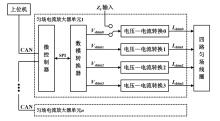
Fig. 1
Overall design of the shimming current amplifier unit
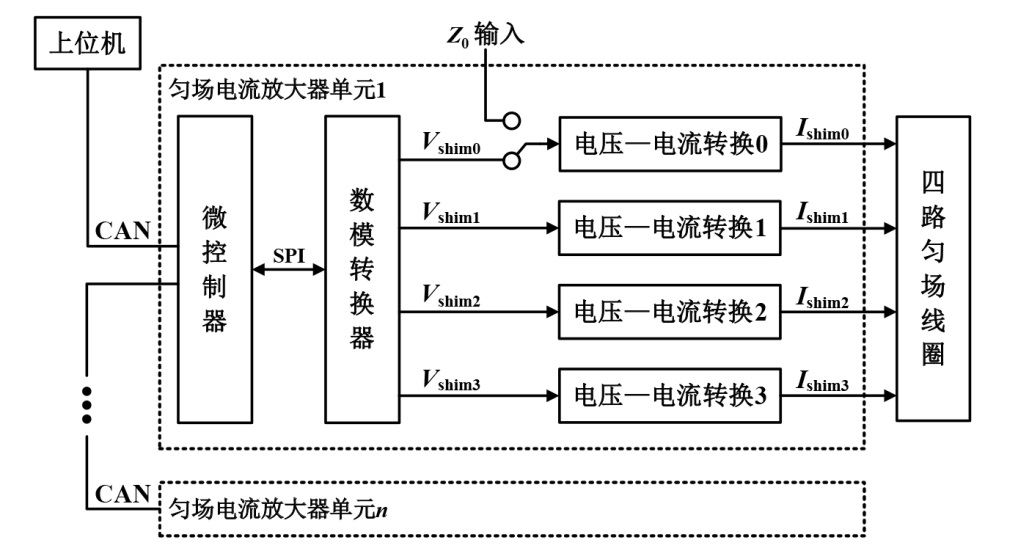
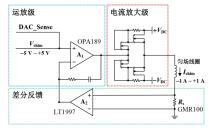
Fig. 2
Design of voltage-to-current conversion circuit
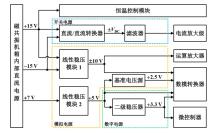
Fig. 3
Power supply scheme design of the shimming current amplifier unit
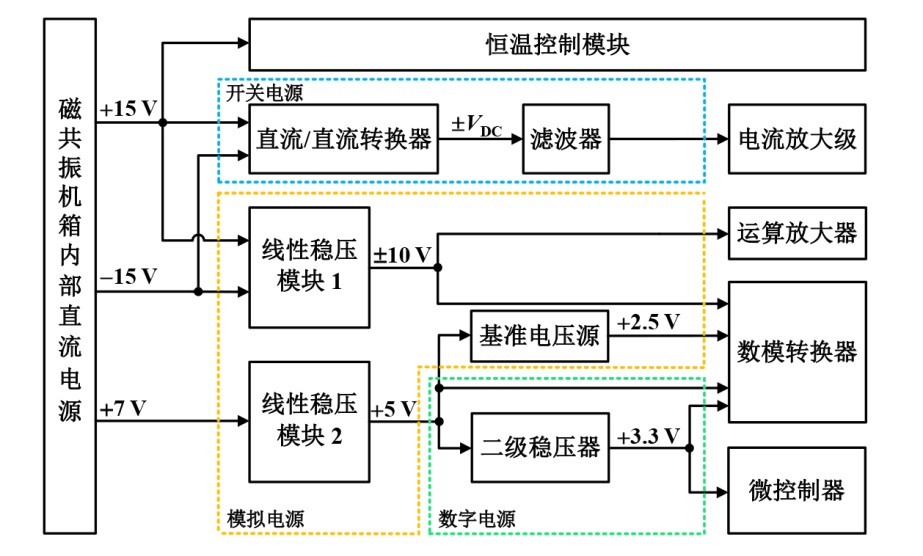

Table 1
Core command set of the shim amplifier unit
| 序号 | 命令 | 功能 |
|---|---|---|
| 1 | [SWITCHCH0 <value>] | 切换通道0输入源(value=0,切换为Z0输入;value=1,切换为DAC输入) |
| 2 | [SETALL <value>] | 设定所有通道输出电流值为(value=0~65535) |
| 3 | [SETCH0 <value>] | 设定通道0输出电流值(value=0~65535) |
| 4 | [SETCH1 <value>] | 设定通道1输出电流值(value=0~65535) |
| 5 | [SETCH2 <value>] | 设定通道2输出电流值(value=0~65535) |
| 6 | [SETCH3 <value>] | 设定通道3输出电流值(value=0~65535) |
| 7 | [GETALL] | 查询所有通道当前电流设定值 |
| 8 | [GETCH0] | 查询通道0当前电流设定值 |
| 9 | [GETCH1] | 查询通道1当前电流设定值 |
| 10 | [GETCH2] | 查询通道2当前电流设定值 |
| 11 | [GETCH3] | 查询通道3当前电流设定值 |
| 12 | [RDATACH0 <value>] | 返回通道0当前输出电流值(value=0~65535) |
| 13 | [RDATACH1 <value>] | 返回通道1当前输出电流值(value=0~65535) |
| 14 | [RDATACH2 <value>] | 返回通道2当前输出电流值(value=0~65535) |
| 15 | [RDATACH3 <value>] | 返回通道3当前输出电流值(value=0~65535) |
Fig. 4
Photograph of shimming current amplifier unit
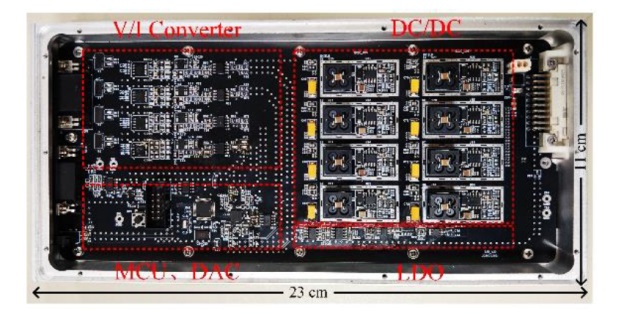
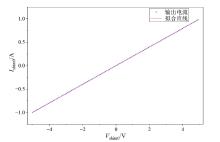
Fig. 5
Output current linearity measurement
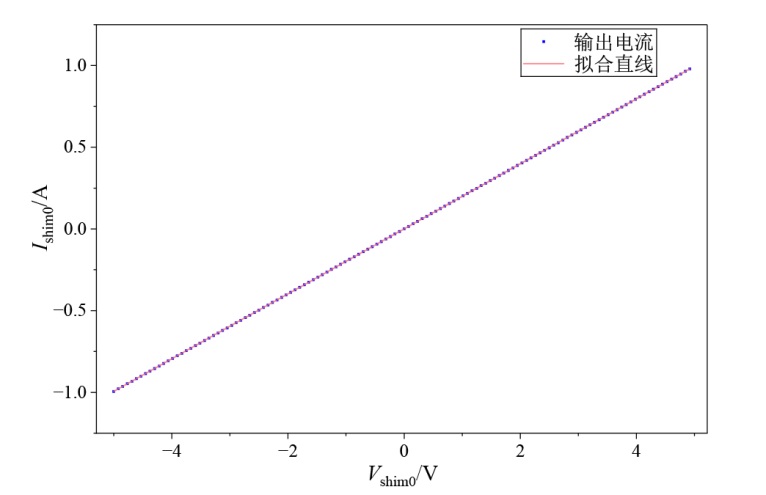
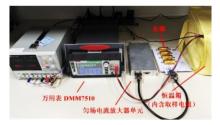
Fig. 6
Experimental setup for long-term stability measurement
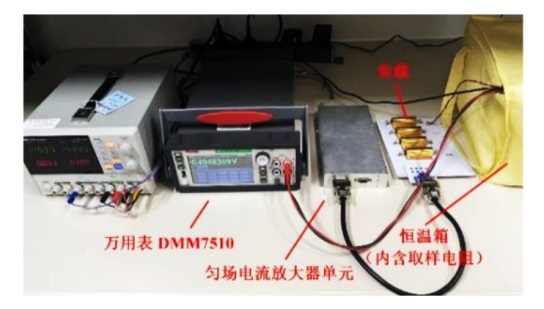
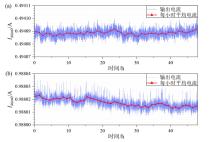
Fig. 7
Long-term stability measurement. (a) +0.5 A output current; (b) +1 A output current
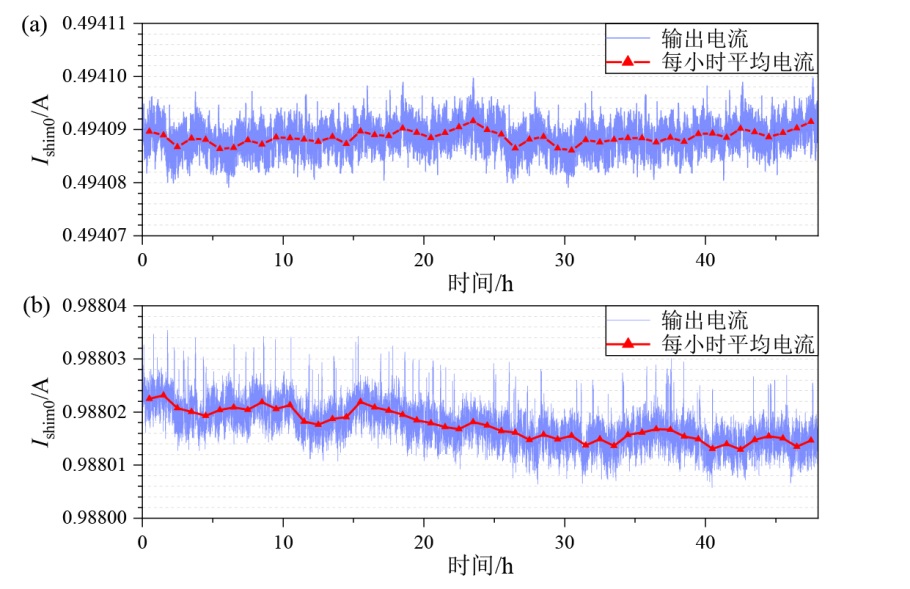
Fig. 8
Crossover distortion measurement
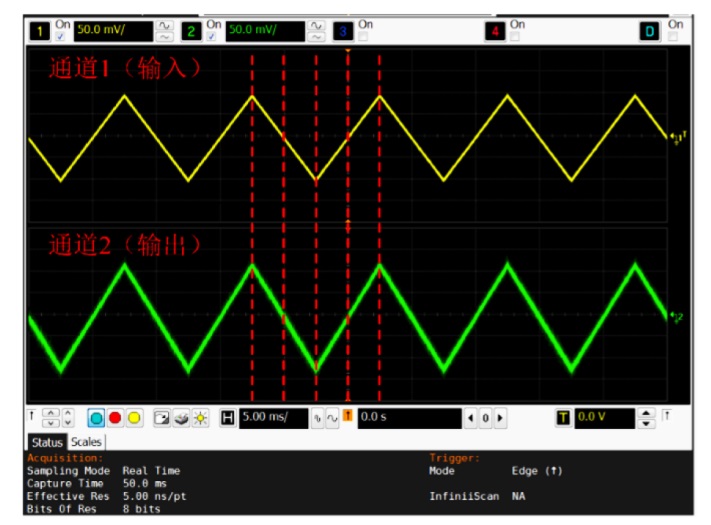
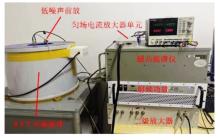
Fig. 9
Experimental platform for the 0.5 T permanent magnet shimming
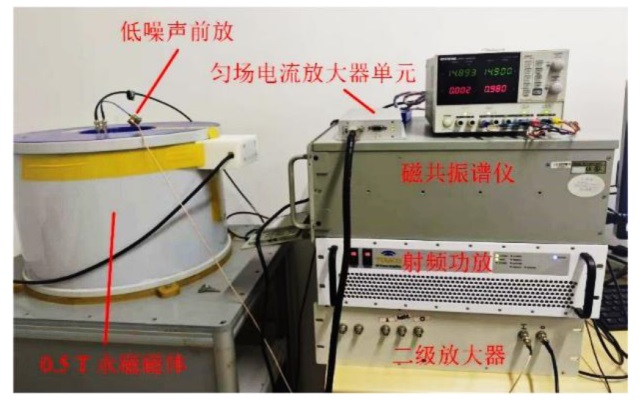
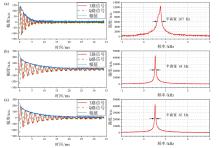
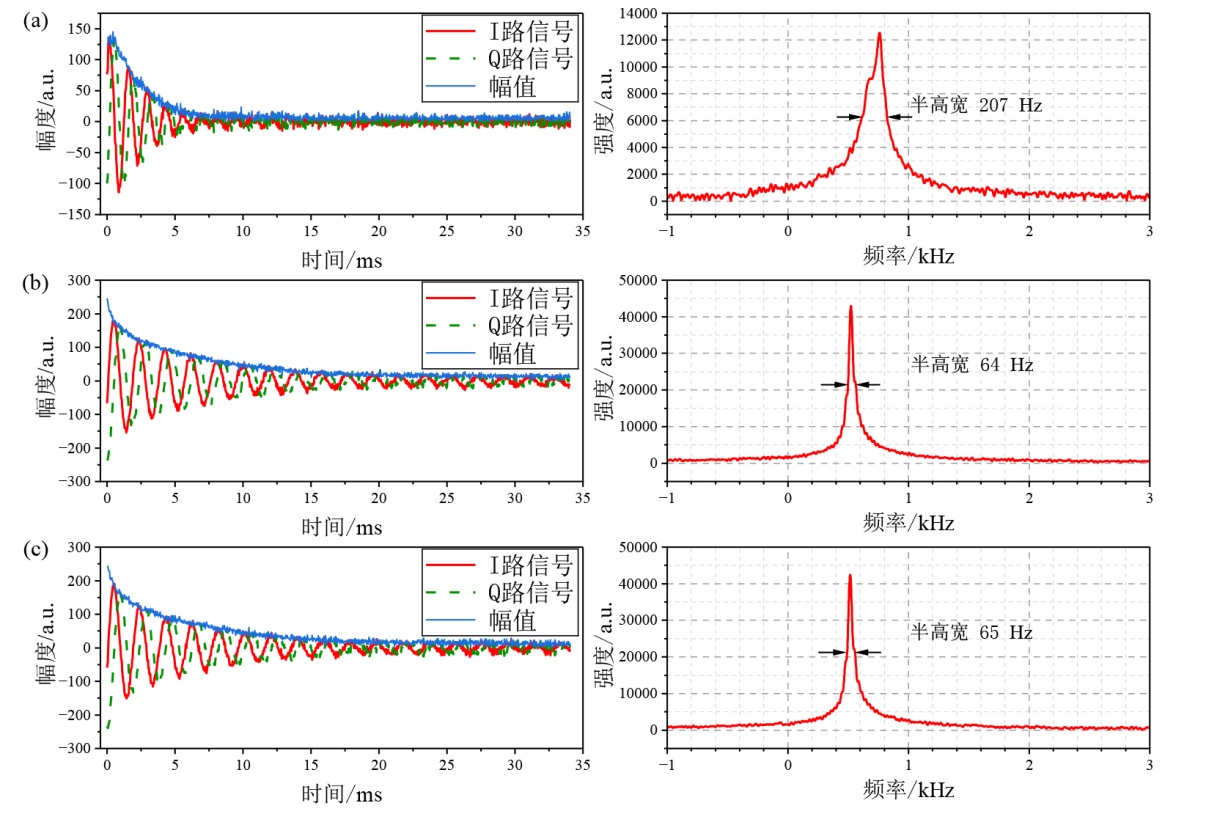
Fig. 10
Comparison of results before and after active shimming. (a) FID signal (left) and its spectrum (right) before active shimming; (b) FID signal (left) and its spectrum (right) after shimming using the shimming current amplifier; (c) FID signal (left) and its spectrum (right) after shimming using a commercial shimming power supply.
| [1] |
GRASSI S, BORGONOVO G, GENNARO M, et al. NMR-based approach to detect white wine vinegar fraud[J]. Food Chem, 2024, 456: 139953.
doi: 10.1016/j.foodchem.2024.139953 |
| [2] | GE X M, ZHANG R X, LI J Y, et al. Predicting the compressive strength of tight sandstone based on the low field NMR and pseudo-triaxial compression measurements[J]. Geomech Geophys Geo, 2024, 10(1): 1-15. |
| [3] | DU Q J. Experimental study on accurate determination of shale porosity by nuclear magnetic resonance[J]. Chinese J Magn Reson, 2025, 42(3): 275-284. |
| 杜群杰. 页岩核磁共振孔隙度精确测定实验研究[J]. 波谱学杂志, 2025, 42(3): 275-284. | |
| [4] | ZHAO Y J, XIE R H, HUANG K, et al. A hybrid denoising method for low-field nuclear magnetic resonance data[J]. Magn Reson Lett, 2024, 5(2): 200167. |
| [5] |
DANIELI E, PERLO J, BLÜMICH B, et al. Small magnets for portable NMR spectrometers[J]. Angew Chem Int Ed, 2010, 49(24): 4133-4135.
doi: 10.1002/anie.201000221 pmid: 20446281 |
| [6] |
CHEN Y S, CAI S H, CAI C B, et al. High-resolution NMR spectroscopy in inhomogeneous fields via Hadamard-encoded intermolecular double-quantum coherences[J]. NMR Biomed, 2012, 25(9): 1088-1094.
doi: 10.1002/nbm.2773 pmid: 22290717 |
| [7] | CHEN S S, XIA T, BI X, et al. Design and implementation of an active shimming system for low-field NMR analyzers[J]. Chinese J Magn Reson, 2017, 34(1): 87-99. |
|
陈珊珊, 夏天, 毕昕, 等. 高性能核磁共振弛豫分析仪匀场系统的设计与实现[J]. 波谱学杂志, 2017, 34(1): 87-99.
doi: 10.11938/cjmr20170111 |
|
| [8] |
BLÜMICH B. Low-field and benchtop NMR[J]. J Magn Reson, 2019, 306: 27-35.
doi: S1090-7807(19)30159-4 pmid: 31311709 |
| [9] | LI H Z, WU Y B, SUN W D, et al. Design and implementation of low-field NMR main magnet based on Halbach structure[J]. Chinese Journal of Scientific Instrument, 2022, 43(5): 46-56. |
| 励洪泽, 邬杨波, 孙伟达, 等. 基于Halbach结构的低场核磁共振主磁体的设计与实现[J]. 仪器仪表学报, 2022, 43(5): 46-56. | |
| [10] | LI Z Z, GUO L, REN X H. Research on passive shimming method for Halbach magnet based on numerical optimization methods[J]. Chinese J Magn Reson, 2024, 41(2): 128-138. |
|
李正喆, 郭亮, 任旭虎. 基于数值优化方法的Halbach磁体无源匀场方法研究[J]. 波谱学杂志, 2024, 41(2): 128-138.
doi: 10.11938/cjmr20233091 |
|
| [11] | CHEN L M, PENG C L, ZHU X W. The development of an active shimming system for 0.2 T open-style permanent magnet MRI[J]. Journal of Biomedical Engineering, 2004, 21(2): 288-291. |
| 陈历明, 彭承琳, 朱学武. 0.2 T开放式永磁型医用核磁共振成像仪有源匀场系统的研制[J]. 生物医学工程学杂志, 2004, 21(2): 288-291. | |
| [12] | HERREROS Q. Very low field magnetic resonance imaging[D]. Paris: Université René Descartes Paris V, 2013. |
| [13] | CHEN X F, DU L, ZHAO B S. Precision voltage controlled current source based on Howland[J]. Application of Electronic Technique, 2012, 38(9): 71-74. |
| 陈笑风, 杜雷, 赵柏树. 基于Howland电流源的精密压控电流源[J]. 电子设计工程, 2012, 38(9): 71-74. | |
| [14] | ZHANG A W, ZHOU M, CAI Z P, et al. Design of a new-style and high-stability LD drive power supply[C]// 1st International Symposium on Systems and Control in Aerospace and Astronautics (ISSCAA). Harbin, China: IEEE, 2006: 452-455. |
| [15] | WANG J R, WU S E, QIU Y E, et al. Research of high stability and high-power semiconductor laser driving power supply[J]. Applied Laser, 2023, 43(8): 170-175. |
| 王锦荣, 武双娥, 邱彦儿, 等. 高稳定大功率半导体激光器驱动电源的研究[J]. 应用激光, 2023, 43(8): 170-175. | |
| [16] | WANG N, ZHANG Z H, HAN B, et al. A 250 mA high-precision DC current source with improved stability for the Joule balance at NIM[C]// 2014 Conference on Precision Electromagnetic Measurements (CPEM). Rio de Janeiro, Brazil: IEEE, 2014: 644-645. |
| [17] | ZHAO J J, LI Z K, WANG Y, et al. Development of a high-stable DC current source with improved resolution for the joule balance[J]. IEEE Trans Instrum Meas, 2025, 74: 2002908. |
| [18] | ZHOU Z C, SUN Z H. Design of dynamic shim amplifier based on DSP[J]. Automation & Instrumentation, 2011, 26(2): 45-49. |
| 周泽畅, 孙宗海. 基于DSP的动态匀场放大器设计[J]. 自动化与仪表, 2011, 26(2): 45-49. | |
| [19] | 刘畅. 磁共振成像系统匀场电源优化设计[D]. 成都: 西南交通大学, 2018. |
| [20] | LIU T W, PENG B W, XU Y J, et al. Design of an active shimming power supply for magnetic resonance spectrometer[J]. Chinese J Magn Reson, 2024, 41(2): 117-127. |
|
刘庭伟, 彭博文, 徐雅洁, 等. 一种用于磁共振波谱仪的主动匀场电源设计[J]. 波谱学杂志, 2024, 41(2): 117-127.
doi: 10.11938/cjmr20233066 |
|
| [21] | QIU X B, LI N, SUN D Y, et al. Research on miniaturized and highly stable semiconductor laser driving circuit[J]. Laser & Infrared, 2018, 48(4): 469-475. |
| 邱选兵, 李宁, 孙冬远, 等. 小型化高稳定半导体激光驱动电路研究[J]. 激光与红外, 2018, 48(4): 469-475. |
| [1] | WU Zhaobo, WANG Jiaxin, LIU Wanzhen, CHENG Xin, WEI Wei, HUANG Zhen, CHEN Fang, ZHANG Zhi, LIU Chaoyang. Design and Development of Key Components for a Low-field Solid-state NMR Magic Angle Spinning (MAS) Probe [J]. Chinese Journal of Magnetic Resonance, 2026, 43(1): 1-15. |
| [2] | LI Keyan, CHENG Xin, CHEN Junfei, CAO Li, HUANG Zhen, LIU Chaoyang. Development of Low-noise Preamplifier for Low-field NMR [J]. Chinese Journal of Magnetic Resonance, 2025, 42(3): 321-333. |
| [3] | LI Junyao, LI Chengkang, ZHAO Feng, WANG Chen, WANG Fang, KANG Songbai, WANG Pengfei, MEI Ganghua, MING Gang. Research on Pressure Compensation for the Rubidium Atomic Clock Working in Atmospheric Environment [J]. Chinese Journal of Magnetic Resonance, 2025, 42(1): 96-102. |
| [4] | LIU Tingwei, PENG Bowen, XU Yajie, WANG Ya, WANG Feng, YU Peng, YANG Xiaodong. A Design of Active Shimming Power Supply for Magnetic Resonance Spectrometers [J]. Chinese Journal of Magnetic Resonance, 2024, 41(2): 117-127. |
| [5] | CUI Jiaqi, LIU Kangqi, LI Junyao, WANG Fang, MING Gang, ZHAO Feng, MEI Ganghua, ZHONG Da. Investigation of an Ultra High Signal-to-noise Ratio Physics Package for the Rubidium Atomic Clock [J]. Chinese Journal of Magnetic Resonance, 2023, 40(4): 462-470. |
| [6] | SHI Guanghui,XIAO Lizhi,LIAO Guangzhi,LUO Sihui,HOU Xueli,LU Yapu. A New Method and Circuit of Ringing Suppression for Low-field NMR Instruments [J]. Chinese Journal of Magnetic Resonance, 2023, 40(1): 68-78. |
| [7] | Wen-jie WAN,Zi-jing QIU,Feng QI,Gang-hua MEI,Da ZHONG. Design of a Miniaturized Low Noise 10 MHz Crystal Oscillator for Rubidium Atomic Frequency Standard [J]. Chinese Journal of Magnetic Resonance, 2022, 39(4): 467-475. |
| [8] | Shuai NIE,Peng-fei WANG,Feng ZHAO,Fang WANG,Gang MING,Zi-jing QIU,Song-bai KANG,Gang-hua MEI. A Physics Package with Shot-noise Limited Frequency Stability Better Than 1×10-13τ-1/2 for Rubidium Atomic Frequency Standards [J]. Chinese Journal of Magnetic Resonance, 2022, 39(1): 108-114. |
| [9] | Han LI,Song-bai KANG,Peng-fei WANG,Feng ZHAO. A Cavity-cell Assembly of Rubidium Frequency Standard Based on a Non-standard Rectangular Microwave Cavity [J]. Chinese Journal of Magnetic Resonance, 2021, 38(2): 249-254. |
| [10] | ZHANG Shi-mao, GE Xiang, WANG Xin, HOU Ke-jun. A Two-Dimensional NMR Logging Method for Gas-Water Identification in Dolomite Reservoir of the Western Sichuan Gas Field [J]. Chinese Journal of Magnetic Resonance, 2020, 37(3): 360-369. |
| [11] | BAO Wan-jing, ZENG Qing-qi, YU Fang, QIN Lei, CHEN Zhi-yong. A Scheme for Generating Discontinuous Microwave Inquiry Signal in Rubidium Atomic Frequency Standard [J]. Chinese Journal of Magnetic Resonance, 2020, 37(2): 209-215. |
| [12] | HE Ke-liang, ZHANG Wei-qun, Lin Chuan-fu. Design of the Atomic Storage Time of a Miniaturized Hydrogen Maser [J]. Chinese Journal of Magnetic Resonance, 2020, 37(2): 200-208. |
| [13] | LIU Zhuo, OU-YANG Chuan-xiang, WANG Chang-quan, HAN Deng-lin, WU Qiong, GAO Xing. Construct NMR Capillary Pressure Curves by Piecewise Power Function Based on T2 Cutoff Values [J]. Chinese Journal of Magnetic Resonance, 2019, 36(1): 45-54. |
| [14] | YANG Chang, CHEN Jun-fei, CHEN Li, ZHANG Zhi, FENG Ji-wen, CHEN Fang, LIU Chao-yang. Design and Implementation of NMR Permanent Magnet Precision Temperature Controller [J]. Chinese Journal of Magnetic Resonance, 2018, 35(3): 294-302. |
| [15] | CHANG Xiao, SU Guan-qun, NIE Sheng-dong. Wavelet Transform-Based Signal Denoising in Low-Field NMR [J]. Chinese Journal of Magnetic Resonance, 2018, 35(3): 393-406. |
| Viewed | ||||||
|
Full text |
|
|||||
|
Abstract |
|
|||||
