
Chinese Journal of Magnetic Resonance ›› 2026, Vol. 43 ›› Issue (3): 350-366.doi: 10.11938/cjmr20253191cstr: 32225.14.cjmr20253191
• Review Articles • Previous Articles Next Articles
XIE Yaxin, YANG Yin#( ), SU Xuncheng*()
Received:2025-12-11
Published:2026-09-05
Online:2026-08-11
Contact:
YANG Yin,#Tel: 022-2350623, E-mail: yangyin@nankai.edu.cn; SU Xuncheng*Tel: 022-23503691, E-mail: xunchengsu@nankai.
CLC Number:
XIE Yaxin, YANG Yin, SU Xuncheng. Applications of Pulsed Dipolar EPR Spectroscopy in Characterizing Interactions and Structural Changes of Biomacromolecules[J]. Chinese Journal of Magnetic Resonance, 2026, 43(3): 350-366.
Add to citation manager EndNote|Reference Manager|ProCite|BibTeX|RefWorks
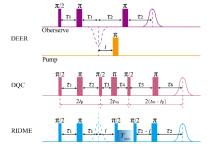
Fig. 1
Pulse sequences used in DEER, DQC, and RIDME experiments
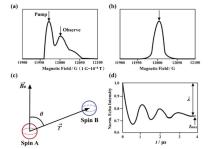
Fig. 2
Schematic illustration of pulsed dipolar EPR experiments. (a) Relative positions of pump and observer pulses in a DEER experiment; (b) Pulse position in DQC and RIDME experiments; (c) Geometry representation of a coupled electron spin pair, where θ denotes the angle between the inter-spin vector$\overrightarrow{r}$and the external magnetic field$\overrightarrow{B0}$; (d) Background-corrected time trace, modulation depth λ and maximum dipolar evolution time tmax obtained from a DEER experiment

Table 1
Correspondence between interspin distance r and maximum dipolar evolution time tmax
| r/nm | tmax/μs |
|---|---|
| 2 | 0.15 |
| 3 | 0.52 |
| 4 | 1.23 |
| 5 | 2.39 |
| 6 | 4.14 |
| 7 | 6.57 |
| 8 | 9.81 |
Table 2
Comparison of three PD-EPR techniques
| 技术方法 | 微波频率要求 | 样品要求 | 主要优势 | 主要局限 | 适用自旋探针类型 |
|---|---|---|---|---|---|
| DEER | 双频微波 | 避免浓度过高导致背景增强 | 方法成熟,应用最广;软件支持完善 | 仪器要求高;要求自旋谱线具有足够频率分离 | 氮氧自由基、Mn2+、Gd3+等 |
| DQC | 单频微波 | 要求自旋具有较长相干时间 | 理论灵敏度高;适合低浓度样品;可用于谱线重叠体系 | 实验脉冲序列复杂;对样品相干时间敏感 | 氮氧自由基、三苯甲基自由基为主 |
| RIDME | 单频微波 | T1不宜过短 | 对宽谱、快速弛豫的体系具有显著优势 | 易受核调制干扰 | 顺磁性金属离子、三苯甲基自由基 |
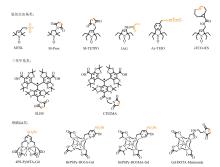
Fig. 3
Chemical structures of representative spin labels commonly used in PD-EPR experiments, in which the reactive moiety for protein modification was highlighted in yellow
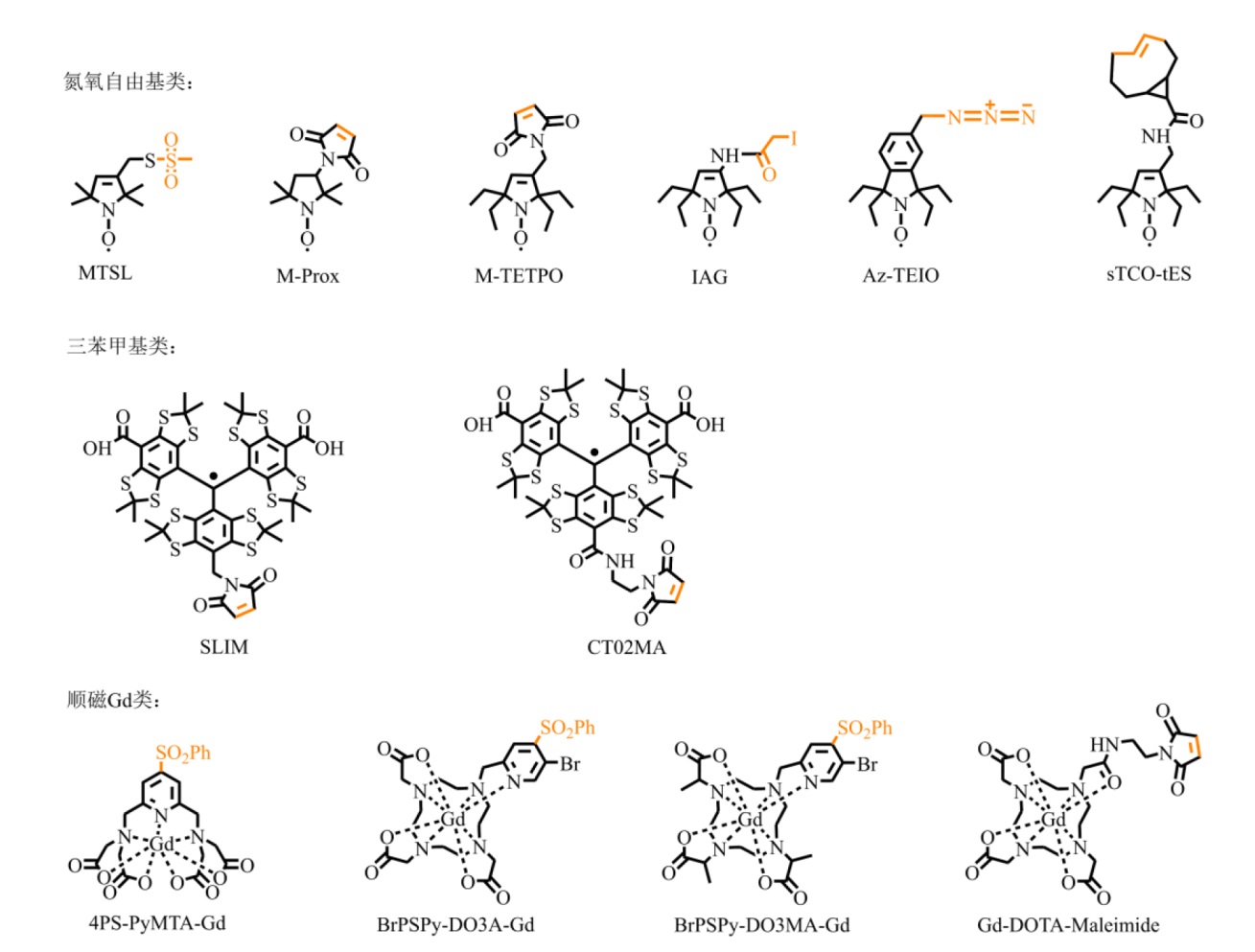
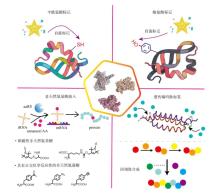
Fig. 4
Schematic illustration of general strategies for site-specific modification of proteins with spin labels
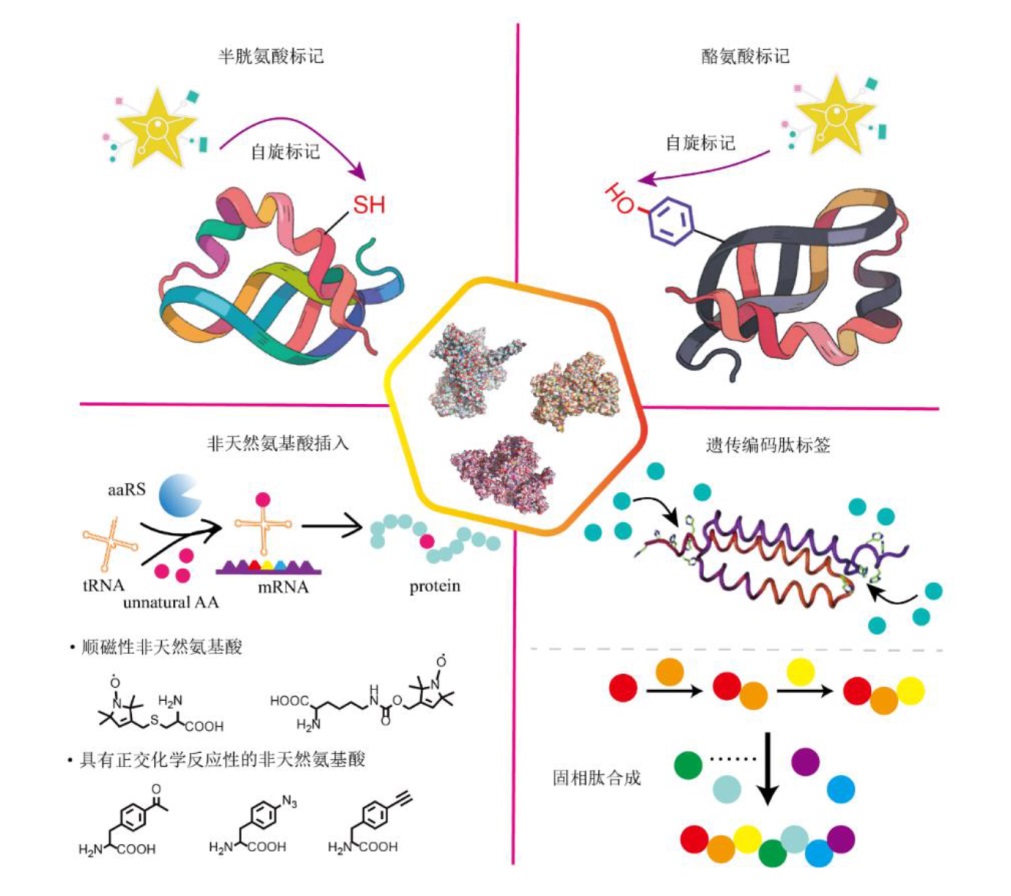
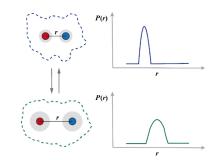
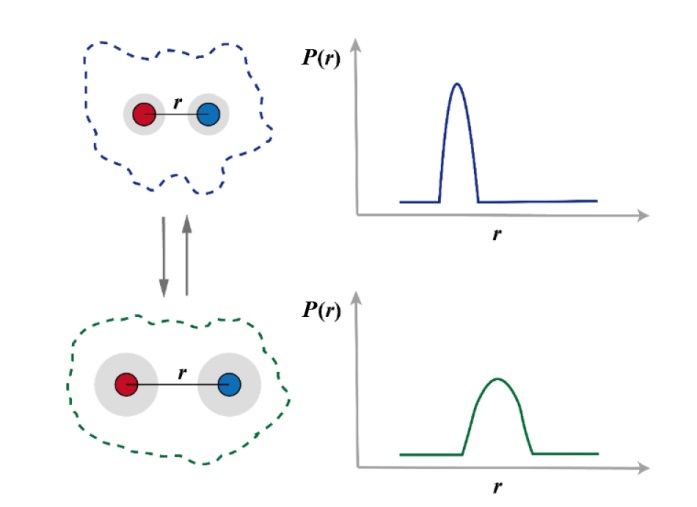
Fig. 5
Scheme of structural variations determined by PD-EPR measurements. This distance distribution measured by PD-EPR between two spin labels attached to a biomacromolecule, and the gray shading area represents the range of spin label relocations under different conditions. The PD-EPR technique measures the spin distance distribution function P(r). By comparing the changes in the distance distribution, it allows the study of conformational changes in biomolecules
| [1] | DRENTH J. Principles of protein X-ray crystallography[M]. 3rd ed. New York: Springer, 2007. |
| [2] |
SHI Y A. Glimpse of structural biology through X-ray crystallography[J]. Cell, 2014, 159(5): 995-1014.
doi: 10.1016/j.cell.2014.10.051 |
| [3] |
BAI X-C, MCMULLAN G, SCHERES S H W. How cryo-EM is revolutionizing structural biology[J]. Trends Biochem Sci, 2015, 40(1): 49-57.
doi: 10.1016/j.tibs.2014.10.005 |
| [4] |
FERNANDEZ-LEIRO R, SCHERES S H W. Unravelling biological macromolecules with cryo-electron microscopy[J]. Nature, 2016, 537(7620): 339-346.
doi: 10.1038/nature19948 |
| [5] |
PALMER A G. NMR characterization of the dynamics of biomacromolecules[J]. Chem Rev, 2004, 104(8): 3623-3640.
pmid: 15303831 |
| [6] |
BANARI A, SAMANTA A K, MUNKE A, et al. Advancing time-resolved structural biology: latest strategies in cryo-EM and X-ray crystallography[J]. Nat Methods, 2025, 22(7): 1420-1435.
doi: 10.1038/s41592-025-02659-6 |
| [7] |
RÜDIGER S, FREUND S M V, VEPRINTSEV D B, et al. CRINEPT-TROSY NMR reveals p53 core domain bound in an unfolded form to the chaperone Hsp90[J]. Proc Natl Acad Sci USA, 2002, 99(17): 11085-11090.
pmid: 12163643 |
| [8] |
SCHIEMANN O, PRISNER T F. Long-range distance determinations in biomacromolecules by EPR spectroscopy[J]. Q Rev Biophys, 2007, 40(1): 1-53.
pmid: 17565764 |
| [9] |
SCHIEMANN O, HEUBACH C A, ABDULLIN D, et al. Benchmark test and guidelines for DEER/PELDOR experiments on nitroxide-labeled biomolecules[J]. J Am Chem Soc, 2021, 143(43): 17875-17890.
doi: 10.1021/jacs.1c07371 pmid: 34664948 |
| [10] |
JESCHKE G. DEER distance measurements on proteins[J]. Annu Rev Phys Chem, 2012, 63: 419-446.
doi: 10.1146/annurev-physchem-032511-143716 pmid: 22404592 |
| [11] |
BORDIGNON E, SEEGER M A, GALAZZO L, et al. From in vitro towards in situ: structure-based investigation of ABC exporters by electron paramagnetic resonance spectroscopy[J]. FEBS Lett, 2020, 594(23): 3839-3856.
doi: 10.1002/feb2.v594.23 |
| [12] |
SAHU I D, LORIGAN G A. Role of membrane mimetics on biophysical EPR studies of membrane proteins[J]. BBA-Biomembranes, 2023, 1865(4): 184138.
doi: 10.1016/j.bbamem.2023.184138 |
| [13] |
FACCHETTI D, DANG Y F, SEIF-EDDINE M, et al. Film-electrochemical EPR spectroscopy to investigate electron transfer in membrane proteins in their native environment[J]. Chem Commun, 2024, 60(87): 12690-12693.
doi: 10.1039/D4CC04013A |
| [14] |
BALO A R, LEE J, ERNST O P. Stationary phase EPR spectroscopy for monitoring membrane protein refolding by conformational response[J]. Anal Chem, 2019, 91(1): 1071-1079.
doi: 10.1021/acs.analchem.8b04542 pmid: 30474972 |
| [15] |
VALERA S, ACKERMANN K, PLIOTAS C, et al. Accurate extraction of nanometer distances in multimers by pulse EPR[J]. Chem-Eur J, 2016, 22(14): 4700-4703.
doi: 10.1002/chem.201505143 pmid: 26865468 |
| [16] | ABRAGAM A, BLEANEY B. Electron paramagnetic resonance of transition ions[M]. Oxford: Oxford University Press, 1970. |
| [17] |
ABDULLIN D, SCHIEMANN O. Pulsed dipolar EPR spectroscopy and metal ions: Methodology and biological applications[J]. ChemPlusChem, 2020, 85(2): 353-372.
doi: 10.1002/cplu.201900705 pmid: 31950648 |
| [18] |
BEDILO A F, MARYASOV A G. Electron spin resonance of dipole-coupled anisotropic pairs in disordered systems[J]. J Magn Reson, 1995, 116(1): 87-96.
doi: 10.1006/jmra.1995.1193 |
| [19] |
KLARE J P. Site-directed spin labeling EPR spectroscopy in protein research[J]. Biol Chem, 2013, 394(10): 1281-1300.
doi: 10.1515/hsz-2013-0155 pmid: 23912220 |
| [20] |
GARCÍA-RUBIO I. EPR of site-directed spin-labeled proteins: A powerful tool to study structural flexibility[J]. Arch Biochem Biophys, 2020, 684: 108323.
doi: 10.1016/j.abb.2020.108323 |
| [21] |
MILOV A D, MARYASOV A G, TSVETKOV Y D. Pulsed electron double resonance (PELDOR) and its applications in free-radicals research[J]. Appl Magn Reson, 1998, 15(1): 107-143.
doi: 10.1007/BF03161886 |
| [22] |
STEIN R A, BETH A H, HUSTEDT E J. A straightforward approach to the analysis of double electron-electron resonance data[J]. Methods Enzymol, 2015, 563: 531-567.
doi: 10.1016/bs.mie.2015.07.031 pmid: 26478498 |
| [23] | MILOV A D, SALIKHOV K M, SHIROV M D. Application of ELDOR in electron-spin echo for paramagnetic center space distribution in solids[J]. Fiz Tverd Tela, 1981, 23(4): 975-982. |
| [24] |
JESCHKE G, POLYHACH Y. Distance measurements on spin-labelled biomacromolecules by pulsed electron paramagnetic resonance[J]. Phys Chem Chem Phys, 2007, 9(16): 1895-1910.
doi: 10.1039/b614920k pmid: 17431518 |
| [25] |
BORBAT P P, FREED J H. Multiple-quantum ESR and distance measurements[J]. Chem Phys Lett, 1999, 313(1-2): 145-154.
doi: 10.1016/S0009-2614(99)00972-0 |
| [26] |
SUNIL S, FREED J H. Double quantum two-dimensional Fourier transform electron spin resonance: Distance measurements[J]. Chem Phys Lett, 1996, 251(1-2): 102-110.
doi: 10.1016/0009-2614(96)00075-9 |
| [27] |
SUNIL S, FREED J H. Theory of double quantum two-dimensional electron spin resonance with application to distance measurements[J]. J Chem Phys, 1997, 107(5): 1317-1340.
doi: 10.1063/1.474490 |
| [28] |
KUZIN S, YULIKOV M. RIDME spectroscopy: New topics beyond the determination of electron spin-spin distances[J]. J Phys Chem Lett, 2025, 16(4): 1024-1037.
doi: 10.1021/acs.jpclett.4c02667 |
| [29] |
COLLAUTO A, FRYDMAN V, LEE M D, et al. RIDME distance measurements using Gd(III) tags with a narrow central transition[J]. Phys Chem Chem Phys, 2016, 18(28): 19037-19049.
doi: 10.1039/c6cp03299k pmid: 27355583 |
| [30] |
MEYER A, SCHIEMANN O. PELDOR and RIDME measurements on a high-spin manganese(II)bisnitroxide model complex[J]. J Phys Chem A, 2016, 120(20): 3463-3472.
doi: 10.1021/acs.jpca.6b00716 |
| [31] |
AKHMETZYANOV D, CHING H Y V, DENYSENKOV V, et al. RIDME spectroscopy on high-spin Mn2+ centers[J]. Phys Chem Chem Phys, 2016, 18(44): 30857-30866.
doi: 10.1039/C6CP05239H |
| [32] |
RITSCH I, HINTZ H, JESCHKE G, et al. Improving the accuracy of Cu(II)-nitroxide RIDME in the presence of orientation correlation in water-soluble Cu(II)-nitroxide rulers[J]. Phys Chem Chem Phys, 2019, 21(19): 9810-9830.
doi: 10.1039/c8cp06573j pmid: 31025988 |
| [33] |
WORT J L, ACKERMANN K, GIANNOULIS A, et al. Sub-micromolar pulse dipolar EPR spectroscopy reveals increasing CuII-labelling of double-histidine motifs with lower temperature[J]. Angew Chem Int Ed, 2019, 58(34): 11681-11685.
doi: 10.1002/anie.v58.34 |
| [34] |
ABDULLIN D, DUTHIE F, MEYER A, et al. Comparison of PELDOR and RIDME for distance measurements between nitroxides and low-spin Fe(III) ions[J]. J Phys Chem B, 2015, 119(43): 13534-13542.
doi: 10.1021/acs.jpcb.5b02118 |
| [35] |
ASTASHKIN A V. Mapping the structure of metalloproteins with RIDME[J]. Methods Enzymol, 2015, 563: 251-284.
doi: 10.1016/bs.mie.2015.06.031 pmid: 26478488 |
| [36] |
ORANGES M, WORT J L, FUKUSHIMA M, et al. Pulse dipolar electron paramagnetic resonance spectroscopy reveals buffer-modulated cooperativity of metal-templated protein dimerization[J]. J Phys Chem Lett, 2022, 13(33): 7847-7852.
doi: 10.1021/acs.jpclett.2c01719 pmid: 35976741 |
| [37] |
KUZHELEV A A, KRUMKACHEVA O A, SHEVELEV G Y, et al. Room-temperature distance measurements using RIDME and the orthogonal spin labels trityl/nitroxide[J]. Phys Chem Chem Phys, 2018, 20(15): 10224-10230.
doi: 10.1039/c8cp01093e pmid: 29594278 |
| [38] |
KULIK L V, DZUBA S A, GRIGORYEV I A, et al. Electron dipole-dipole interaction in ESEEM of nitroxide biradicals[J]. Chem Phys Lett, 2001, 343(3-4): 315-324.
doi: 10.1016/S0009-2614(01)00721-7 |
| [39] |
JESCHKE G, CHECHIK V, IONITA P, et al. DeerAnalysis2006—a comprehensive software package for analyzing pulsed ELDOR data[J]. Appl Magn Reson, 2006, 30(3): 473-498.
doi: 10.1007/BF03166213 |
| [40] |
AMEY J L, KEELEY J, CHOUDHURY T, et al. Neural network interpretation using descrambler groups[J]. Proc Natl Acad Sci USA, 2021, 118(5): e2016917118.
doi: 10.1073/pnas.2016917118 |
| [41] |
FÁBREGAS IBÁÑEZ L, JESCHKE G, STOLL S. DeerLab: a comprehensive software package for analyzing dipolar electron paramagnetic resonance spectroscopy data[J]. Magn Reson, 2020, 1: 209-224.
doi: 10.5194/mr-1-209-2020 |
| [42] |
HAUGLAND M M, LOVETT J E, ANDERSON E A. Advances in the synthesis of nitroxide radicals for use in biomolecule spin labelling[J]. Chem Soc Rev, 2018, 47(3): 668-680.
doi: 10.1039/c6cs00550k pmid: 29192696 |
| [43] |
SAMUNI A, GOLDSTEIN S, RUSSO A, et al. Kinetics and mechanism of hydroxyl radical and OH-adduct radical reactions with nitroxides and with their hydroxylamines[J]. J Am Chem Soc, 2002, 124(29): 8719-8724.
pmid: 12121116 |
| [44] |
KIRILYUK I A, POLIENKO Y F, KRUMKACHEVA O A, et al. Synthesis of 2,5-Bis(spirocyclohexane)-substituted nitroxides of pyrroline and pyrrolidine series, including thiol-specific spin label: An analogue of MTSSL with long relaxation time[J]. J Org Chem, 2012, 77(18): 8016-8027.
pmid: 22917445 |
| [45] |
PALETTA J T, PINK M, FOLEY B, et al. Synthesis and reduction kinetics of sterically shielded pyrrolidine nitroxides[J]. Org Lett, 2012, 14(20): 5322-5325.
doi: 10.1021/ol302506f pmid: 23050653 |
| [46] |
JAGTAP A P, KRSTIC I, KUNJIR N C, et al. Sterically shielded spin labels for in-cell EPR spectroscopy: Analysis of stability in reducing environment[J]. Free Radic Res, 2015, 49(1): 78-85.
doi: 10.3109/10715762.2014.979409 |
| [47] |
KUZHELEV A A, TRUKHIN D V, KRUMKACHEVA O A, et al. Room-temperature electron spin relaxation of triarylmethyl radicals at the X- and Q-bands[J]. J Phys Chem B, 2015, 119(43): 13630-13640.
doi: 10.1021/acs.jpcb.5b03027 |
| [48] |
MILIKISYANTS S, SCARPELLI F, FINIGUERRA M G, et al. A pulsed EPR method to determine distances between paramagnetic centers with strong spectral anisotropy and radicals: The dead-time free RIDME sequence[J]. J Magn Reson, 2009, 201(1): 48-56.
doi: 10.1016/j.jmr.2009.08.008 pmid: 19758831 |
| [49] |
HUNTER H R, KANKATI S, HASANBASRI Z, et al. Endogenous Cu(II) labeling for distance measurements on proteins by EPR[J]. Chem-Eur J, 2024, 30(72): e202403160.
doi: 10.1002/chem.v30.72 |
| [50] | HEUBACH C A, HASANBASRI Z, ABDULLIN D, et al. Differentiating between label and protein conformers in pulsed dipolar EPR spectroscopy with the dHis-Cu2+(NTA) motif[J]. Chem-Eur J, 2023, 29(72): e202302541. |
| [51] |
BOGETTI X W, HASANBASRI Z, HUNTER H R, et al. An optimal acquisition scheme for Q-band EPR distance measurements using Cu2+-based protein labels[J]. Phys Chem Chem Phys, 2022, 24(24): 14727-14739.
doi: 10.1039/D2CP01032A |
| [52] |
KISGEROPOULOS E C, GAN Y J, GREER S M, et al. Pulsed multifrequency electron paramagnetic resonance spectroscopy reveals key branch points for one- vs two-electron reactivity in Mn/Fe proteins[J]. J Am Chem Soc, 2022, 144(27): 11991-12006.
doi: 10.1021/jacs.1c13738 pmid: 35786920 |
| [53] |
CASTO J, MANDATO A, HOFMANN L, et al. Cu(II)-based DNA labeling identifies the structural link between transcriptional activation and termination in a metalloregulator[J]. Chem Sci, 2022, 13(6): 1693-1697.
doi: 10.1039/d1sc06563g pmid: 35282619 |
| [54] |
YANG Y, YANG F, GONG Y J, et al. High sensitivity in-cell EPR distance measurements on proteins using an optimized Gd(III) spin label[J]. J Phys Chem Lett, 2018, 9(20): 6119-6123.
doi: 10.1021/acs.jpclett.8b02663 pmid: 30277780 |
| [55] |
PROKOPIOU G, LEE M D, COLLAUTO A, et al. Small Gd(III) tags for Gd(III)-Gd(III) distance measurements in proteins by EPR spectroscopy[J]. Inorg Chem, 2018, 57(9): 5048-5059.
doi: 10.1021/acs.inorgchem.8b00133 pmid: 29629761 |
| [56] |
KUCHER S, KORNEEV S, KLARE J P, et al. In cell Gd3+-based site-directed spin labeling and EPR spectroscopy of eGFP[J]. Phys Chem Chem Phys, 2020, 22(24): 13358-13362.
doi: 10.1039/D0CP01930E |
| [57] | BEN-ISHAY Y, BARAK Y, FEINTUCH A, et al. Exploring the dynamics and structure of PpiB in living Escherichia coli cells using electron paramagnetic resonance spectroscopy[J]. Protein Sci, 2024, 33(3): e4903. |
| [58] |
FIELDING A J, CONCILIO M G, HEAVEN G, et al. New developments in spin labels for pulsed dipolar EPR[J]. Molecules, 2014, 19(10): 16998-17025.
doi: 10.3390/molecules191016998 pmid: 25342554 |
| [59] |
AZARKH M, BIEBER A, QI M, et al. Gd(III)-Gd(III) relaxation-induced dipolar modulation enhancement for in-cell electron paramagnetic resonance distance determination[J]. J Phys Chem Lett, 2019, 10(7): 1477-1481.
doi: 10.1021/acs.jpclett.9b00340 pmid: 30864799 |
| [60] |
MILEO E, ETIENNE E, MARTINHO M, et al. Enlarging the panoply of site-directed spin labeling electron paramagnetic resonance (SDSL-EPR): Sensitive and selective spin-labeling of tyrosine using an isoindoline-based nitroxide[J]. Bioconjugate Chem, 2013, 24(6): 1110-1117.
doi: 10.1021/bc4000542 pmid: 23642211 |
| [61] |
GMEINER C, KLOSE D, MILEO E, et al. Orthogonal tyrosine and cysteine site-directed spin labeling for dipolar pulse EPR spectroscopy on proteins[J]. J Phys Chem Lett, 2017, 8(19): 4852-4857.
doi: 10.1021/acs.jpclett.7b02220 pmid: 28933855 |
| [62] |
LORENZI M, PUPPO C, LEBRUN R, et al. Tyrosine-targeted spin labeling and EPR spectroscopy: An alternative strategy for studying structural transitions in proteins[J]. Angew Chem Int Ed, 2011, 50(39): 9108-9111.
doi: 10.1002/anie.201102539 pmid: 21919142 |
| [63] |
NOREN C J, ANTHONY-CAHILL S J, GRIFFITH M C, et al. A general method for site-specific incorporation of unnatural amino acids into proteins[J]. Science, 1989, 244(4901): 182-188.
pmid: 2649980 |
| [64] |
CORNISH V W, BENSON D R, ALTENBACH C A, et al. Site-specific incorporation of biophysical probes into proteins[J]. Proc Natl Acad Sci USA, 1994, 91(8): 2910-2914.
pmid: 8159678 |
| [65] |
SCHMIDT M J, BORBAS J, DRESCHER M, et al. A genetically encoded spin label for electron paramagnetic resonance distance measurements[J]. J Am Chem Soc, 2014, 136(4): 1238-1241.
doi: 10.1021/ja411535q pmid: 24428347 |
| [66] |
WANG L, ZHANG Z W, BROCK A, et al. Addition of the keto functional group to the genetic code of Escherichia coli[J]. Proc Natl Acad Sci U S A, 2003, 100(1): 56-61.
doi: 10.1073/pnas.0234824100 |
| [67] |
KALAI T, FLEISSNER M R, JEKO J, et al. Synthesis of new spin labels for Cu-free click conjugation[J]. Tetrahedron Lett, 2011, 52(21): 2747-2749.
doi: 10.1016/j.tetlet.2011.03.077 |
| [68] |
FLEISSNER M R, BRUSTAD E M, KALAI T, et al. Site-directed spin labeling of a genetically encoded unnatural amino acid[J]. Proc Natl Acad Sci USA, 2009, 106(51): 21637-21642.
doi: 10.1073/pnas.0912009106 pmid: 19995976 |
| [69] |
WORT J L, ARYA S, ACKERMANN K, et al. Pulse dipolar EPR reveals double-histidine motif CuII-NTA spin-labeling robustness against competitor ions[J]. J Phys Chem Lett, 2021, 12(11): 2815-2819.
doi: 10.1021/acs.jpclett.1c00211 |
| [70] |
CHING H Y V, MASCALI F C, BERTRAND H C, et al. The use of Mn(II) bound to His-tags as genetically encodable spin-label for nanometric distance determination in proteins[J]. J Phys Chem Lett, 2016, 7(6): 1072-1076.
doi: 10.1021/acs.jpclett.6b00362 pmid: 26938795 |
| [71] |
JARVI A G, BOGETTI X, SINGEWALD K, et al. Going the dHis-tance: Site-directed Cu2+ labeling of proteins and nucleic acids[J]. Acc Chem Res, 2021, 54(6): 1481-1491.
doi: 10.1021/acs.accounts.0c00761 |
| [72] |
STOLLER S, SICOLI G, BARANOVA T Y, et al. TOPP: A novel nitroxide-labeled amino acid for EPR distance measurements[J]. Angew Chem Int Ed, 2011, 50(41): 9743-9746.
doi: 10.1002/anie.201103315 pmid: 21898726 |
| [73] |
KARIM C B, KIRBY T L, ZHANG Z W, et al. Phospholamban structural dynamics in lipid bilayers probed by a spin label rigidly coupled to the peptide backbone[J]. Proc Natl Acad Sci USA, 2004, 101(40): 14437-14442.
pmid: 15448204 |
| [74] |
BECKER C F W, LAUSECKER K, BALOG M, et al. Incorporation of spin-labelled amino acids into proteins[J]. Magn Reson Chem, 2005, 43: S34-S39.
doi: 10.1002/(ISSN)1097-458X |
| [75] |
TESSMER M H, STOLL S. Protein modeling with DEER spectroscopy[J]. Annu Rev Biophys, 2025, 54: 35-57.
doi: 10.1146/biophys.2025.54.issue-1 |
| [76] | KONG L W, KUANG G L, WU X Y. Research progress of EPR spectrometer under high frequency and high field[J]. Chinese J Magn Reson, 2023, 40(3): 341-364. |
|
孔令文, 匡光力, 吴向阳. 高频高场下EPR谱仪的研究进展[J]. 波谱学杂志, 2023, 40(3): 341-364.
doi: 10.11938/cjmr20233051 |
|
| [77] |
PETER M F, GEBHARDT C, MAECHTEL R, et al. Cross-validation of distance measurements in proteins by PELDOR/DEER and single-molecule FRET[J]. Nat Commun, 2022, 13(1): 4396.
doi: 10.1038/s41467-022-31945-6 pmid: 35906222 |
| [78] |
JOSEPH B, JAUMANN E A, SIKORA A, et al. In situ observation of conformational dynamics and protein ligand-substrate interactions in outer-membrane proteins with DEER/PELDOR spectroscopy[J]. Nature Protocols, 2019, 14(8): 2344-2369.
doi: 10.1038/s41596-019-0182-2 pmid: 31278399 |
| [79] |
JOSEPH B, SIKORA A, CAFISO D S. Ligand induced conformational changes of a membrane transporter in E. coli cells observed with DEER/PELDOR[J]. J Am Chem Soc, 2016, 138(6): 1844-1847.
doi: 10.1021/jacs.5b13382 pmid: 26795032 |
| [80] |
WU T, STEIN R A, KAO T-Y, et al. Modeling protein conformational ensembles by guiding AlphaFold2 with double electron electron resonance (DEER) distance distributions[J]. Nat Commun, 2025, 16(1): 7107.
doi: 10.1038/s41467-025-62582-4 |
| [81] |
TANG Q, SINCLAIR M, HASDEMIR H S, et al. Asymmetric conformations and lipid interactions shape the ATP-coupled cycle of a heterodimeric ABC transporter[J]. Nat Commun, 2023, 14(1): 7184.
doi: 10.1038/s41467-023-42937-5 pmid: 37938578 |
| [82] |
KARTHIKEYAN G, BONUCCI A, CASANO G, et al. A bioresistant nitroxide spin label for in-cell EPR spectroscopy: In vitro and in oocytes protein structural dynamics studies[J]. Angew Chem Int Ed, 2018, 57(5): 1366-1370.
doi: 10.1002/anie.201710184 pmid: 29227566 |
| [83] |
HAYSOM S F, MACHIN J, WHITEHOUSE J M, et al. Darobactin B stabilises a lateral-closed conformation of the bam complex in E. coli cells[J]. Angew Chem Int Ed, 2023, 62(34): e202218783.
doi: 10.1002/anie.v62.34 |
| [84] |
JOSEPH B, TORMYSHEV V M, ROGOZHNIKOVA O Y, et al. Selective high-resolution detection of membrane protein-ligand interaction in native membranes using trityl-nitroxide PELDOR[J]. Angew Chem Int Ed, 2016, 55(38): 11538-11542.
doi: 10.1002/anie.201606335 pmid: 27511025 |
| [85] |
HALBMAIR K, SEIKOWSKI J, TKACH I, et al. High-resolution measurement of long-range distances in RNA: pulse EPR spectroscopy with TEMPO-labeled nucleotides[J]. Chem Sci, 2016, 7(5): 3172-3180.
doi: 10.1039/c5sc04631a pmid: 29997809 |
| [86] |
HEINZ M, ERLENBACH N, STELZL L S, et al. High-resolution EPR distance measurements on RNA and DNA with the non-covalent Ǵ spin label[J]. Nucleic Acids Res, 2020, 48(2): 924-933.
doi: 10.1093/nar/gkz1096 pmid: 31777925 |
| [87] |
ZHANG J, FANG X. Empowering the molecular ruler techniques with unnatural base pair system to explore conformational dynamics of flaviviral RNAs[J]. Curr Opin Struct Biol, 2024, 89: 102944.
doi: 10.1016/j.sbi.2024.102944 |
| [88] |
DUSS O, YULIKOV M, JESCHKE G, et al. EPR-aided approach for solution structure determination of large RNAs or protein-RNA complexes[J]. Nat Commun, 2014, 5: 3669.
doi: 10.1038/ncomms4669 pmid: 24828280 |
| [89] |
WARD R, KEEBLE D J, EL-MKAMI H, et al. Distance determination in heterogeneous DNA model systems by pulsed EPR[J]. ChemBioChem, 2007, 8(16): 1957-1964.
pmid: 17886320 |
| [90] |
SCHMIDT T, JEON J, OKUNO Y, et al. Submillisecond freezing permits cryoprotectant-free EPR double electron-electron resonance spectroscopy[J]. ChemPhysChem, 2020, 21: 1224-1229.
doi: 10.1002/cphc.202000312 pmid: 32383308 |
| [91] | CHEN Y T, ZHANG X, CHEN J L, et al. Rigid and stable nitroxide spin label for high-resolution distance measurements on proteins by DEER experiments[J]. Magn Reson Lett, 2025, 5(3): 200194. |
| [92] |
GRAENZ M, ERLENBACH N, SPINDLER P, et al. Dynamics of nucleic acids at room temperature revealed by pulsed EPR spectroscopy[J]. Angew Chem Int Ed, 2018, 57(33): 10540-10543.
doi: 10.1002/anie.201803682 pmid: 29858557 |
| [93] |
QIN Z, WANG Z, KONG F, et al. In situ electron paramagnetic resonance spectroscopy using single nanodiamond sensors[J]. Nat Commun, 2023, 14(1): 6278.
doi: 10.1038/s41467-023-41903-5 pmid: 37805509 |
| [94] |
SHI F, KONG F, ZHAO P, et al. Single-DNA electron spin resonance spectroscopy in aqueous solutions[J]. Nat Methods, 2018, 15(9): 697-699.
doi: 10.1038/s41592-018-0084-1 |
| [1] | WEI Qing1,2,SONG Rui-bo2,ZHOU Xiao-dong2,TANG Wei-jun4,ZHANG Wei-guo3,CHEN Qun1*. Sequence Development and Parameter Optimization for A Pseudo-Continuous Arterial Spin Labeling Method on 1.5 T Clinical Magnetic Resonance Imaging Systems [J]. Chinese Journal of Magnetic Resonance, 2015, 32(4): 574-583. |
| [2] | ZHAO Bao-Lu. Applications of Electron Spin Resonance in Biology and Medicine [J]. Chinese Journal of Magnetic Resonance, 2010, 27(1): 51-67. |
| [3] | GUO Lin-Chao, WANG Chang-Zhen, CONG Jian-Bo, XIAN Hong, WU Ke. An EPR Spectrum Simulation-Fourier Deconvolution Method for Distance Measurement in Proteins [J]. Chinese Journal of Magnetic Resonance, 2010, 27(1): 113-120. |
| [4] | SONG Yu-Guang, SUN Jian, Nohl Hans, LIU Yang. Influence of Hydroxylamine Derivatives and Phenolic Compounds on the Fluidity of Erythrocyte Membrane [J]. Chinese Journal of Magnetic Resonance, 2005, 22(4): 349-356. |
| [5] | Xiang Bosong, Chen Binhuan, Wan Qian. THE EFFECTS OF THE DIELECTRIC PROPERTY OF SAMPLES ON ST-ESR SPECTRA [J]. Chinese Journal of Magnetic Resonance, 1989, 6(4): 453-460. |
| [6] | Liu Fang. ESR SPECTROSCOPY STUDIES OF INTERACTIONS BETWEEN INSULIN AND ITS RECEPTOR [J]. Chinese Journal of Magnetic Resonance, 1989, 6(3): 341-346. |
| Viewed | ||||||
|
Full text |
|
|||||
|
Abstract |
|
|||||
