


引言
核磁共振(NMR)技术凭借无损检测、定量分析、检测效率高等显著优势,已在物质成分分析、生物医学检测等众多领域实现广泛应用[1-
然而,Halbach磁体作为一种非常规异型结构磁体,其初始磁场均匀度普遍较差,导致适用于NMR检测的有效均匀区域狭小,难以满足大体积岩芯测试的空间需求.即使单纯扩大Halbach磁体内径,也无法直接拓展适用于NMR检测的均匀磁场区域,其核心原因在于Halbach磁体结构复杂度随口径增大而显著提升,大口径磁体需由更多磁块装配构成,而复杂结构难以完全规避制造与装配误差,进而导致大口径Halbach磁体初始均匀度进一步恶化.因此,设计兼具优良初始均匀度与大口径的Halbach磁体,并针对性优化其磁场均匀度,是扩大Halbach磁体可用空间、拓展其在便携式低场NMR领域(尤其是大体积岩芯弛豫分析)应用范围的关键技术难题.
目前,大口径高均匀度Halbach磁体的研制核心技术集中于磁体结构优化与无源匀场方法两大方向.Purchase等通过遗传算法优化磁块位置,设计出磁场强度67 mT,口径32 cm的离散型Halbach磁体,在直径27 cm,高1 cm的薄层目标区域内实现了11 152 ppm(1 ppm=10-6)的初始均匀度,但该磁体的目标区域厚度有限,未能实现大体积目标区域的高磁场均匀度[14].Gao等采用线性规划与遗传算法相结合(LP-GA)的优化方案,对磁场强度48 mT,口径170 mm的Halbach磁体开展目标场法无源匀场,将直径30 mm球形目标区域的初始均匀度从1 229 ppm优化至320 ppm,该工作虽然在一定程度上改善了磁场均匀度,但优化效果有限[15].Yang等研制一款磁场强度为169 mT易于装配的低成本Halbach磁体,并通过改进的目标场无源匀场方法将直径10 mm的球形区域磁场均匀度优化至11.8 ppm,虽然该工作大幅提高了磁场均匀度,但可用于NMR的有效均匀区域较小,且双极板式无源匀场装置占用了过多的磁体内部空间[16].O’Reilly等通过改变离散型Halbach磁体每层磁环的外径优化初始磁场均匀度,研制出磁场强度 50.7 mT,口径270 mm的Halbach磁体,并通过无源匀场将直径20 cm的球形目标区域的磁场均匀度从 13 000 ppm优化至2 486 ppm,其设计流程较为完整,但磁场均匀度优化效果仍存在提升空间[17].
为突破现有研究在提高Halbach磁体均匀度、扩大有效均匀区域范围的局限,实现大体积岩芯弛豫分析,本文将Halbach磁体理论与有限元仿真技术深度融合,通过针对性结构优化,提升直径100 mm的球形目标区域初始磁场均匀度,设计了磁场强度158.4 mT的多层离散型Halbach磁体.完成磁体装配后,采用改进的谐波分析无源匀场方法对磁体进行匀场,仅用5组匀场磁块阵列,共52个匀场磁块将直径100 mm的球形目标区域的磁场均匀度从22 502 ppm优化至1 496 ppm,并在匀场后成功采集到Φ 100 mm × H 100 mm(直径100 mm、高100 mm)的硫酸铜水溶液中1H的FID,其频域谱峰半高宽为4 096 Hz/723 ppm,与匀场前采集到的Φ 25 mm × H 25 mm(直径25 mm、高25 mm)的硫酸铜水溶液中1H NMR信号的半高宽 3 239 Hz/477 ppm数量级相当,随后在该磁体上进行了双组分硫酸铜水溶液CPMG实验,通过T2值分辨出不同样品组分,上述实验结果表明改进的谐波无源匀场方法显著提高了磁场均匀度与可用于NMR的有效空间. 综上所述,本文提出的磁体结构设计与无源匀场方案,为可用于大体积样品(如大体积岩芯)检测的大口径高均匀度Halbach磁体的研制提供了切实可行的技术路径.
1 磁体设计
1.1 磁体结构选择
其中Br为磁材的剩磁,rout为磁体外径,rin为磁体内径,然而理想的Halbach磁体难以建造,实际工程中的Halbach磁体为多个磁块组合而成的非理想的近似结构,非理想Halbach磁体产生的磁场强度进行修正后可近似为[20]:
其中
图1
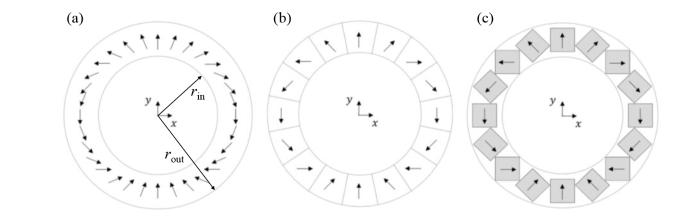
图1
(a)理想型、(b)紧凑型和(c)离散型Halbach磁体结构示意图
Fig. 1
Schematic diagram of (a) ideal Halbach magnet, (b) compact Halbach magnet and (c) discrete Halbach magnet structure
1.2 磁块排列方案
本文以直径100 mm的球形区域作为目标区域,预留无源匀场、有源匀场、射频线圈等结构所需空间后,将磁体的内径设定在220 mm左右.由(2)式可知,构成磁环的磁块数量越多,磁体越接近理想Halbach磁体模型,磁体产生的磁场强度越大,但磁块数量的增加将提高磁体的复杂度,进而导致更大的制造与装配误差.因此本文以(2)式作为理论依据,结合有限元仿真方法研究磁块数量对磁场强度的影响.研究过程中,磁块采用尺寸完全一致的长方体磁块,如图2(a)所示,长宽均为25 mm,高度40 mm,充磁方向垂直于侧面,磁材为钕铁硼NdFeB-N52(Br≈1.43 T).磁环圆心到每块磁块中心的距离为126 mm以确保磁体内径约为220 mm,磁体总高设定在350 mm左右,将构成磁环的磁块数量作为唯一变量进行仿真对比(由于Halbach磁体结构的对称性,构成磁环的磁块数量为4的整数倍),结果如图2(b)所示,构成磁环的磁块数量为24个时,目标区域的磁场强度最大,磁块数量增加到28块时,由于磁块数量过多,磁块间出现干涉,必须将磁块的长宽减小至21 mm才能正常排列,磁块尺寸的减小最终导致目标区域磁场强度下降.因此,根据仿真结果最终确定每层磁环由24块完全相同的长方体磁块构成,每相邻两个磁块的夹角为2π/24=π/12,磁环结构如图2(c)所示,磁环内径为2R1=216.6 mm,磁环外径为2R2=287.2 mm.
图2

图2
(a) 40 × 25 × 25 mm3磁块示意图;(b)目标区域磁场强度随构成磁环磁块数量的变化曲线;(c)单圈磁环排列示意图
Fig. 2
(a) Schematic diagram of magnetic block with dimensions of 40 × 25 × 25 mm3; (b) The influence of the number of magnetic blocks on the magnetic field strength; (c) Schematic diagram of a single-loop magnetic ring arrangement
1.3 磁体层数与端部结构的确定
确定磁环由24块磁块构成后,还需确定磁环层数,进而完善磁体结构.由于Halbach磁体的初始磁场不均匀性主要由磁体有限长度导致,因此可以通过增加磁环数量,即增大磁体长度来提高目标区域磁场均匀度,本文通过有限元仿真方法定量分析磁环总层数对目标区域磁场均匀度的影响,由于磁环后续需要通过机械结构固定,每层磁环需要留出大约3~8 mm的厚度,同时为了在有限元仿真分析时将磁环层数作为单一变量,故将每层磁环间距设定为10 mm,结果如图3中实线曲线所示,目标区域磁场均匀度随着磁环总层数的增加而提升,但单纯增加磁环数量对均匀度的提升效果有限,当磁环总数为9层时,目标区域初始均匀度才接近10 000 ppm,且此方案磁体装配后高度将接近600 mm,磁体高度远大于磁体外径,提高加工成本的同时,将引入更多的制造与装配误差.
图3

图3
磁环层数及端部磁环结构对目标区域磁场均匀度的影响
Fig. 3
Effects of the number of magnet ring layers and the end ring structure on the magnetic field homogeneity in the ROI
上述通过仅增加磁环层数提高磁体均匀度的方案效果不佳,需要更高效的方案优化磁体目标区域初始磁场均匀度,且尽可能控制磁体体积与制造成本的提升.增大Halbach磁体端部磁环产生的磁场强度,可以削弱磁体有限长度带来的端环效应,是另一种提升磁体磁场均匀度的方法[20,24],为保持磁体内径不变,本文在磁体上下两端磁环的外侧额外增加一圈磁环用于提高端部磁环产生的磁场强度,额外增加的磁环由36个尺寸完全一致的长方体磁块构成,如图4(a)所示,磁块的长宽均为20 mm,高30 mm,磁材为钕铁硼NdFeB-N52(Br≈1.43 T),每两个相邻磁块的夹角为2π/36=π/18,磁体上下两端双圈磁环结构(端部双环结构)如图4(b),磁块的充磁方向未在图4(b)中标出,具体充磁方向及排布方法与图2(b)所示磁块排布与充磁方向类似,磁体的上下两端磁环采用双环结构后,磁体外径从287.2 mm增大至2R3=336.2 mm.通过有限元仿真方法验证上述增加磁环的方案对目标区域磁场均匀度的影响,仿真对比结果如图3所示,额外增加磁环后,即磁体端部磁环为双环结构时,目标区域磁场均匀度更优,且随着磁环层数的增加,双环结构对均匀度的提升倍数更大.由仿真结果可知,当磁环总层数为7层时,磁体端部的双环结构将目标区域磁场均匀度从35 448 ppm提升至10 269 ppm,提高了3.45倍,具体磁场分布情况如图5所示,目标区域均匀度提升的同时磁场强度也提升约7 mT.但若继续增加磁体层数,磁场均匀度提升不再显著,增加制造成本的同时会引入更大的误差,因此最终确定磁体总层数为7层,且此时磁体高度约350 mm,与外径 (336.2 mm)尺寸相近,磁体的装配与移动较为便捷.
图4
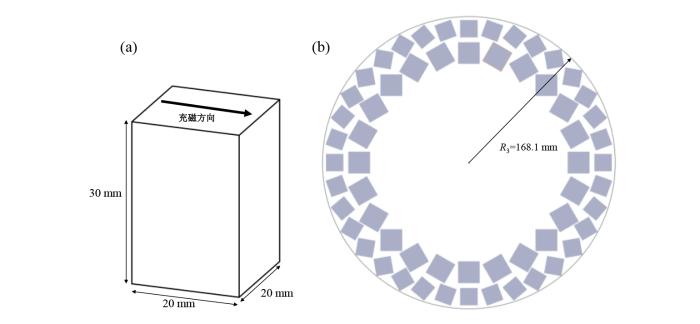
图4
(a) 30 × 20 × 20 mm3磁块示意图;(b)磁体上下两端的双圈磁环排列示意图
Fig. 4
(a) Schematic diagram of magnetic block with dimensions of 30 × 20 × 20 mm3; (b) Schematic diagram of the double loop magnetic rings at the top and bottom ends of the magnet
图5
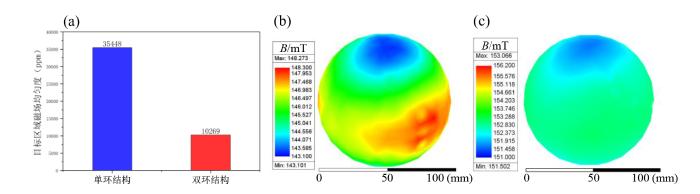
图5
(a)磁体端部单、双环结构对目标区域磁场均匀度的影响(共7层磁环)对比;(b)磁体上下两端未添加磁环时(单环结构),目标区域磁场分布仿真结果;(c)磁体上下两端添加磁环后(双环结构),目标区域磁场分布仿真结果
Fig. 5
(a) The effect of adding magnetic rings at both ends of the magnet on the homogeneity of the ROI (seven magnet ring layers in total); (b) Simulation result of magnetic field distribution in the ROI when no magnetic rings are added at the top and bottom ends of the magnet; (c) Simulation result of magnetic field distribution in the ROI after adding magnetic rings at both ends of the magnet
确定磁体总层数为7层后,通过有限元分析方法,以提高目标区域磁场均匀度为目标,优化每层磁环之间的间距,最终结果如图6(a),当磁体总高度为348 mm,第1层与第2层磁环间距L1为8 mm,第2层与第3层磁环间距L2为14 mm,第3层与第4层磁环间距L3为12 mm时(由于磁体轴向对称性,第4层与第5层磁环间距为L3,第5层与第6层磁环间距为L2,第6层与第7层磁环间距为L1),磁体的初始均匀度较好为6 286 ppm,磁场强度约为147 mT,磁体结构与目标区域磁场仿真结果如图6(b)、6(c)所示.
图6
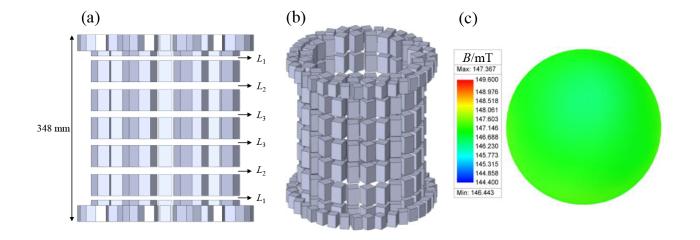
图6
(a)磁体正视图;(b)磁体最终结构示意图;(c)目标区域磁场分布仿真结果
Fig. 6
(a) Front view of the magnet; (b) Schematic of the final magnet structure; (c) Effect of the number of magnet layers on the magnetic-field homogeneity within the ROI
1.4 磁体装配与磁场强度测量
磁块与磁体机械支撑结构加工完成后,先对每层磁环进行装配,如图7所示,图7(a)为单圈磁环,每个磁块被放置在带有凹槽的聚甲醛(POM)塑料板内,所有磁块安装完成后,通过铝合金上盖与螺丝压紧磁块,防止磁块脱出凹槽,图7(b)为磁体上下两端的双圈磁环,完成装配的磁体实物如图7(c)所示.采用高斯计测量目标区域中心磁场强度为158.388 mT,实测磁场强度比仿真得到的磁场强度高约11.4 mT,与仿真结果相差7%,可能是由于下列原因导致:(1)仿真时,为避免计算量过大,将磁块以外的所有区域设定为空气,而实际的磁体机械结构中包含了POM、铝合金、钛合金、黄铜等材料,这些材料的磁导率各不相同;(2)磁块、机械支撑结构的加工误差与磁体装配误差;(3)钕铁硼磁材对温度敏感,其剩磁温度系数约为-0.1%/℃,温度的变化使得磁体磁场强度漂移.虽然磁体的实测磁场强度与仿真结果未完全吻合,但差异在可接受的范围内,实际磁场强度对应的1H核拉莫进动频率约为6.74 MHz,符合低场NMR实验需求.
图7
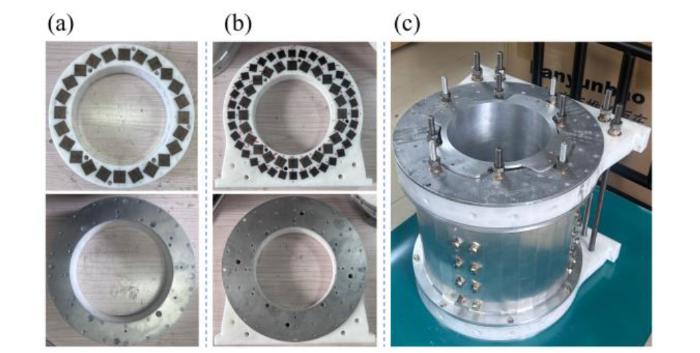
图7
(a)单圈磁环、(b)双圈磁环和(c)完成装配的Halbach磁体实物图
Fig. 7
Photographs of (a) single magnet ring, (b) double ring assembly, and (c) fully assembled Halbach magnet
2 无源匀场方案
2.1 谐波分析无源匀场原理
目标区域磁场满足拉普拉斯方程,用谐波分解方式可以直观地体现导致磁场不均匀的主要不均匀项,目标区域各个点的磁场强度在笛卡尔坐标系下可表示为(本文定义Y方向为主磁场方向):
(3)式中每一项待定系数可通过测量磁场分布进行求解,其中C0是目标区域中心即笛卡尔下坐标(0,0,0)位置的磁场强度,C11、C12、C13为一阶不均匀分量的系数,C21、C22、C23、C24、C25为二阶不均匀分量的系数,(3)式剩余的分量为三阶不均匀分量及更高的谐波分量,谐波分析无源匀场就是尽可能消除各阶不均匀分量,从而提高磁场均匀度.
基于谐波分析的无源匀场方法通过构建磁块阵列消除对应的不均匀项,以消除Y方向一阶不均匀项C12y为例,需要构建一组仅在Y方向上产生线性磁场梯度的磁块阵列,其核心条件为:
其中,By是匀场磁块阵列在目标区域产生的沿主磁场方向(Y方向)的磁场分量,Gy为匀场磁块阵列在目标区域产生的Y方向梯度磁场的梯度值.
在构建二阶匀场磁块阵列时,以消除磁体轴向即Z方向二阶不均匀项即z2为例,构建的磁块阵列需满足的核心条件为:
其中
在构建匀场磁块阵列时,每个匀场磁块在目标区域产生的磁场强度通过磁偶极子模型进行计算:
其中,
2.2 改进的谐波分析无源匀场
图8

图8
(a)目标区域及X、Y、Z轴向100 mm磁场分布测量线;(b) X、Y、Z轴向100 mm范围内初始磁场分布
Fig. 8
(a) ROI and the 100 mm field mapping lines along the X, Y, and Z axes; (b) Initial magnetic field profiles within a 100 mm range along the X, Y, and Z axes
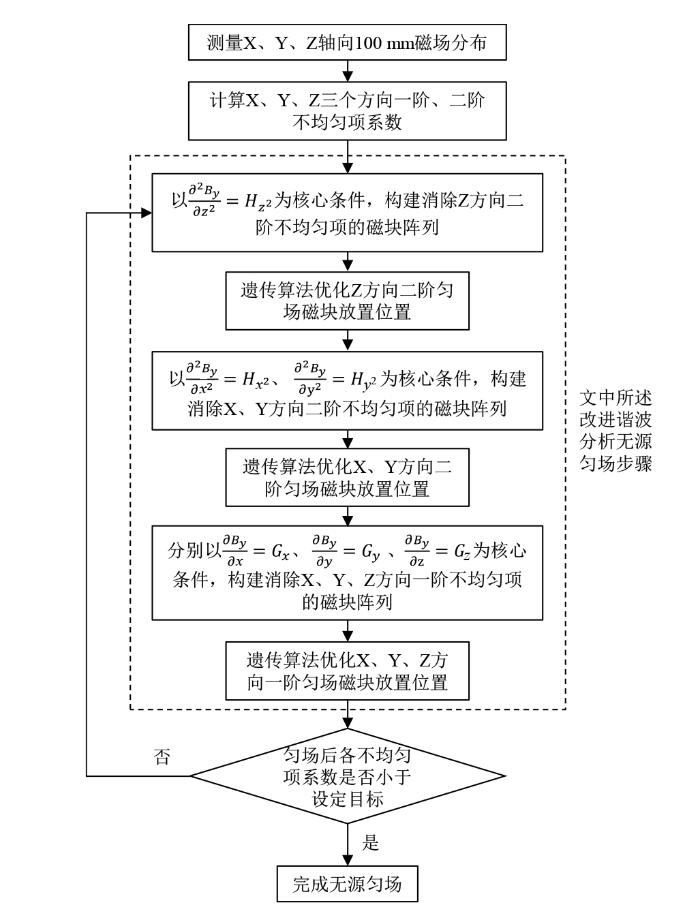
从实测X、Y、Z轴线上的磁场强度分析,磁体上述三个轴向存在着明显的一阶与二阶不均匀分量,因此本文主要针对X、Y、Z三个轴向的一阶与二阶不均匀分量:
由轴向初始磁场测量结果与谐波分析可知,X、Y、Z三个轴向的磁场二阶不均匀项相较于一阶不均匀项对磁场的不均匀性贡献更大,具体来说二阶不均匀项系数比一阶不均匀项系数大一个数量级,并且考虑到进行二阶匀场可能会对一阶不均匀项有扰动,因此先对X、Y、Z方向的二阶不均匀项进行匀场.用于消除Z方向二阶不均匀性的磁块阵列会对X和Y方向的磁场造成干扰,因此在进行二阶匀场时优先对Z方向的二阶不均匀性进行优化,随后再优化
图9
2.3 无源匀场后磁场分布测量
最终改进的谐波分析无源匀场方案仅用5组匀场磁块阵列共52个磁块即完成了对直径100 mm的球形目标区域的快速便捷的无源匀场,5组匀场磁块阵列分别对应
图10
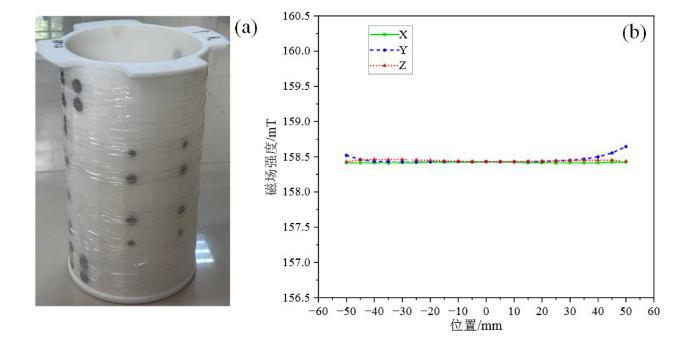
图10
(a)无源匀场筒实物图;(b)匀场后X、Y、Z轴向100 mm范围内磁场分布
Fig. 10
(a) Photograph of the passive shimming cylinder; (b) Magnetic-field profiles along the X, Y, and Z axes within a 100 mm range after passive shimming
3 NMR实验
3.1 测试平台
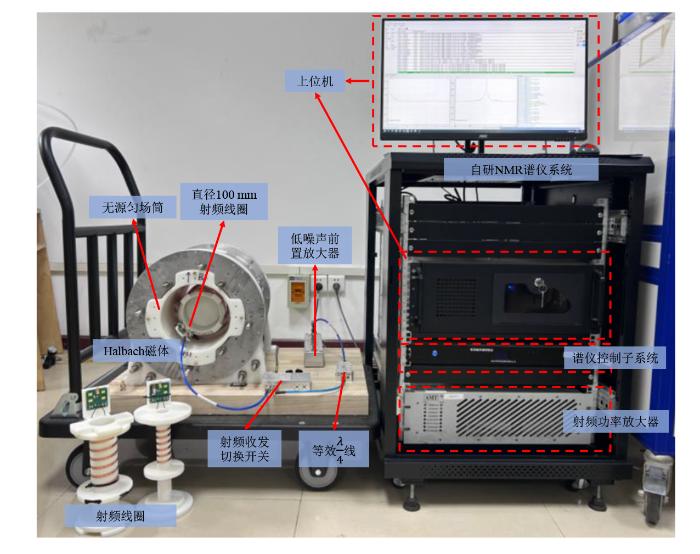
表1 测试平台各部件性能参数表
Table 1
| 测试系统部件 | 部件核心指标 | 性能参数 |
|---|---|---|
| 谱仪控制子系统 | 激发频率范围 | 1~100 MHz |
| 最小脉冲宽度 | 150 ns | |
| 最大接收带宽 | 1 MHz | |
| 射频功率放大器 | 工作频段 | 6~220 MHz |
| 最大输出功率 | 300 W | |
| 前置放大器 | 工作频段 | 5~100 MHz |
| 6.79 MHz频点放大倍数 | 25 dB | |
| 25 mm内径射频线圈 | 调谐频率 | 6.791 MHz |
| 回波损耗(S11) | -26.73 dB | |
| 品质因子(Q值) | 75.3 | |
| 100 mm内径射频线圈 | 调谐频率 | 6.792 MHz |
| 回波损耗(S11) | -40.01 dB | |
| 品质因子(Q值) | 26.3 |
图11
3.2 测试结果
为表征直径100 mm的球形目标区域的磁场均匀度,并验证该Halbach磁体可用于实际的NMR实验,对Φ 100 mm × H 100 mm(直径100 mm、高度100 mm)的硫酸铜(武汉欣申试化工科技有限公司,五水硫酸铜,25 g,纯度>99%)水溶液(1.5 mmol/L,该样品体积可将目标区域完全覆盖)进行测试,为直观地比较改进的谐波分析无源匀场对目标区域磁场均匀度的提升,分别在匀场前后测试磁场均匀度.图12所示为Φ 100 mm × H 100 mm范围内均匀度测试结果,如图12(b)所示,匀场前,进行10次累加实验,几乎无法检测到NMR信号;无源匀场后,仅一次实验即可以检测到NMR信号,如图12(c)所示,频域信号半高宽为4 906 Hz,对应磁场均匀度为723 ppm,该测试结果表明直径100 mm的球形目标区域的磁场均匀度优于723 ppm.
图12

图12
(a)直径100 mm球形目标区域与Φ 100 mm × H 100 mm测试区域关系示意图;(b)匀场前,Φ 100 mm × H 100 mm硫酸铜水溶液1H NMR信号(累加10次);(c)匀场后,Φ 100 mm × H 100 mm硫酸铜水溶液1H NMR信号(无累加,仅一次实验)
Fig. 12
(a) Schematic illustrating the relationship between the ROI and the Φ 100 mm × H 100 mm test region; (b) NMR signal of a Φ 100 mm × H 100 mm CuSO4 aqueous solution before shimming (10 signal averages); (c) NMR signal of the same sample after shimming (single acquisition, no averaging)
由于未采集到匀场前直径Φ 100 mm × H 100 mm范围内NMR信号,为更加直观地体现无源匀场对磁场均匀度的改善,测量了匀场前后Φ 25 mm × H 25 mm(直径25 mm、高度25 mm)范围内磁场均匀度,如图13所示(图中的数据进行了归一化处理),匀场前半高宽为3 239 Hz(磁场均匀度477 ppm),匀场后半高宽为939 Hz(磁场均匀度138 ppm),在Φ 25 mm × H 25 mm范围内磁场均匀度提高了3.4倍.
图13
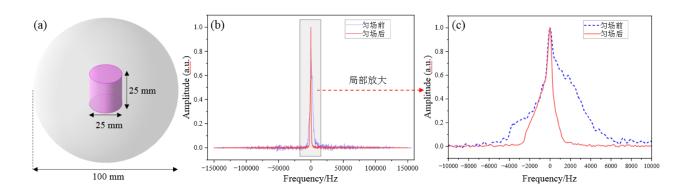
图13
(a)直径100 mm球形目标区域与Φ 25 mm × H 25 mm测试区域关系示意图;(b)匀场前后,Φ 25 mm × H 25 mm硫酸铜水溶液1H NMR信号对比图(进行归一化处理);(c)信号峰局部放大图
Fig. 13
(a) Schematic illustrating the relationship between the ROI and the Φ 25 mm × H 25 mm test region; (b) Comparison of the NMR signals from a Φ 25 mm × H 25 mm CuSO₄ aqueous solution before and after shimming (normalized); (c) Zoomed-in view of the peak region in (b)
虽然本文未在匀场前采集到Φ 100 mm × H 100 mm的硫酸铜水溶液的1H NMR信号,无法通过谱峰半高宽量化均匀度提升倍数,但高斯计测场结果反映出目标区域内磁场均匀度从22 502 ppm提升至1 496 ppm,提高了15倍.从上述NMR测试结果还可知,无源匀场后Φ 100 mm × H 100 mm的硫酸铜水溶液的1H NMR信号谱峰半高宽与匀场前Φ 25 mm × H 25 mm的硫酸铜水溶液中1H NMR信号谱峰半高宽数量级一致,证明本文中的谐波无源匀场在提高磁体均匀度的同时,也扩大了磁体可用于NMR实验的有效空间.
为进一步证明该大口径Halbach磁体具有更广泛的应用范围,本文进行了双组分硫酸铜溶液测试实验,双组分样品分别为48 mmol/L与12 mmol/L硫酸铜(武汉欣申试化工科技有限公司,五水硫酸铜,25 g,纯度>99%)水溶液,测试结果如图14所示,测量得到上述两种浓度硫酸铜溶液中1H的横向弛豫时间T2分别约为11 ms、43 ms.该CPMG实验虽然在匀场前也采集到信号,但由于磁场均匀度差,CPMG信号强度明显偏低,完成无源匀场后,采用相同的实验参数进行测试,取得更优的实验结果,因此磁场均匀度的提升对NMR弛豫分析具有重要意义,上述CPMG实验进一步验证了本文中的无源匀场对提高磁场均匀度的重要性和有效性.
图14
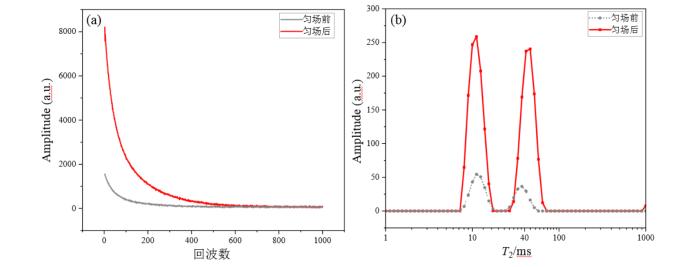
图14
(a)双组分硫酸铜溶液CPMG包络衰减曲线(回波间隔时间TE=0.3ms);(b)双组分硫酸铜溶液T2分布谱
Fig. 14
(a) CPMG echo envelope decay curve of a two component CuSO4 aqueous solution (TE = 0.3 ms); (b) T2 distribution spectrum of the two component CuSO4 aqueous solution
综合分析上述实验结果,本文所设计的大口径Halbach磁体在匀场前具备初步的NMR信号检测与弛豫分析能力,随后改进的谐波分析法无源匀场提高了磁体目标区域的磁场均匀度、扩大了可用于NMR实验的有效均匀区域.
4 讨论
完成对磁体均匀度测试及CPMG实验后,通过对比匀场后Φ 25 mm × H 25 mm与Φ 100 mm × H 100 mm两个测量范围的磁场均匀度可知,小范围的磁场均匀度显著优于大范围,且匀场后Φ 100 mm × H 100 mm范围内磁场均匀度仍劣于匀场前Φ 25 mm × H 25 mm范围内的水平.其原因在于:(1)空间覆盖范围不同:Φ 100 mm × H 100 mm区域包含Φ 25 mm × H 25 mm区域,体积是后者的64倍,更容易覆盖磁场偏差较大的空间,因此大范围内的最大磁场偏差ΔB(100) 依旧大于小范围内最大磁场偏差ΔB(25)(ΔB = Bmax-Bmin).(2)从谐波分解的角度分析,各个不均匀分量对磁场偏差的贡献与测量点位到磁体中心的距离密切相关,尤其是二阶、三阶等高阶磁场不均匀分量,在磁体中心附近的小体积区域内,磁场对不均匀项不敏感,而当测量范围扩大到Φ 100 mm × H 100 mm时,其边界与磁场中心距离随之增大,各阶不均匀项对磁场的影响被放大.结合上述理论分析结果,在匀场后,Φ 100 mm × H 100 mm范围内磁场均匀度是有望优于匀场前Φ 25 mm × H 25 mm范围内磁场均匀度的,本文未实现上述目标的主要原因为:(1)本文未对二阶项中的交叉项xy、yz、xz及三阶等更高阶的不均匀项进行匀场;(2)虽然本文对一阶不均匀项(x、y、z)及部分二阶轴向不均匀项(x2-y2、2z2-x2-y2)进行了匀场,但在实际工程中无法完全消除这些不均匀项.上述在匀场后未完全消除的残余不均匀项与高阶不均匀项共同作用于Φ 100 mm × H 100 mm大体积区域,最终导致即使在匀场后,该区域的磁场均匀度也未达到Φ 25 mm × H 25 mm范围匀场前的均匀度水平.后续将针对二阶交叉项及高阶项进行匀场,并且考虑在完成谐波分析法无源匀场后,设计基于目标场方法的无源匀场,更加细致地对磁场均匀度进行优化.
谱峰半高宽是衡量NMR系统分辨率和评估匀场效果的重要指标,但本文未在匀场前采集到Φ 100 mm × H 100 mm硫酸铜水溶液中1H的NMR信号,主要是匀场前磁场均匀度差,FID信号衰减过快,在开始采集前,信号近乎完全衰减,所以即使进行多次累加实验也几乎无法检测到信号.针对该问题,后续计划制作死时间更短的射频线圈(本文中射频线圈的死时间为50 μs),在FID信号完全衰减前对其进行检测,获得匀场前Φ 100 mm × H 100 mm硫酸铜水溶液中1H的NMR信号,进而反应该区域的初始磁场均匀度,便于与匀场后的磁场均匀度进行对比,更加具体全面地体现本文无源匀场的效果.
本文所设计的大口径Halbach磁体最终将用于大体积岩芯弛豫分析等领域,进行低场弛豫分析样品的信号量通常较小,往往需用长时间累加获取信噪比较高的信号,因此在实验过程中,磁体及整个NMR系统的稳定性极为重要.然而构成该Halbach磁体的磁材为钕铁硼,该磁材温度稳定性较差,剩磁温度系数约为-0.1%/℃,即温度每升高1 ℃,磁材的剩磁将减小0.1%,该磁体对应 1H核的拉莫进动频率则会漂移约6.8 kHz,这会导致NMR系统难以长期、稳定地开展NMR实验,当环境温度波动较大时,甚至无法采集到NMR信号.因此,后续将设计温控系统,对磁体进行精细化控温,以保障磁体与NMR系统长期稳定运行.并且在实际的NMR弛豫分析实验中,岩芯等复杂样品会对磁场分布造成扰动,而无源匀场方案一旦确定通常不再频繁改动,因此具备动态调节能力的有源匀场在实验过程中至关重要,其能够在无源匀场的基础上进一步精细化调整磁场均匀度,且可以通过调节匀场电流动态化补偿样品所导致的磁场均匀度恶化.考虑到匀场线圈通电带来的发热效应及其对磁体升温和场强漂移的影响,后续将协同优化设计匀场线圈与温控系统,在进一步优化磁场均匀度的同时,确保系统能够持续、稳定运行.
5 结论
本文结合Halbach磁体理论与有限元仿真方法,成功设计并装配了一款磁场强度为158.4 mT的大口径Halbach磁体,直径100 mm的球形目标区域初始均匀度为22 502 ppm,随后通过改进的谐波无源匀场方法仅用52个磁块即将目标区域的磁场均匀度提升至1 496 ppm,均匀度提高了15倍,并在匀场后仅一次实验就采集到Φ 100 mm × H 100 mm硫酸铜水溶液中1H NMR信号,其谱峰半高宽与匀场前Φ 25 mm × H 25 mm硫酸铜水溶液中1H NMR信号数量级一致,并采集到双组分硫酸铜溶液中1H的CPMG信号,通过T2分辨不同组分,证明本文中的无源匀场方案提高了磁体均匀度,扩大了磁体的可用空间.综上所述,本文提出的磁体设计方案与无源匀场方法能够为NMR大口径、高均匀度、大均匀区域Halbach磁体的设计提供有效的技术支持.
利益冲突
无
参考文献
NMR at low magnetic fields
[J].DOI:10.1016/j.cplett.2009.06.096 URL [本文引用: 1]
A study on multi-exponential inversion of nuclear magnetic resonance relaxation data using deep learning
[J].DOI:10.1016/j.jmr.2022.107358 URL
Tips and challenges for clinical use and interpretation of low field portable MRI in neuroimaging
[J].DOI:10.1007/s10140-025-02323-8 [本文引用: 1]
Contributed review: nuclear magnetic resonance core analysis at 0.3 T
[J].
DOI:10.1063/1.4902093
URL
[本文引用: 1]

Nuclear magnetic resonance (NMR) provides a powerful toolbox for petrophysical characterization of reservoir core plugs and fluids in the laboratory. Previously, there has been considerable focus on low field magnet technology for well log calibration. Now there is renewed interest in the study of reservoir samples using stronger magnets to complement these standard NMR measurements. Here, the capabilities of an imaging magnet with a field strength of 0.3 T (corresponding to 12.9 MHz for proton) are reviewed in the context of reservoir core analysis. Quantitative estimates of porosity (saturation) and pore size distributions are obtained under favorable conditions (e.g., in carbonates), with the added advantage of multidimensional imaging, detection of lower gyromagnetic ratio nuclei, and short probe recovery times that make the system suitable for shale studies. Intermediate field instruments provide quantitative porosity maps of rock plugs that cannot be obtained using high field medical scanners due to the field-dependent susceptibility contrast in the porous medium. Example data are presented that highlight the potential applications of an intermediate field imaging instrument as a complement to low field instruments in core analysis and for materials science studies in general.
The impact of heterogeneity and multi-scale measurements on reservoir characterization and STOOIP estimations
[C]//
A transportable magnetic resonance imaging system for in situ measurements of living trees: the Tree Hugger
[J].
DOI:10.1016/j.jmr.2012.02.019
PMID:22445351
[本文引用: 1]
This paper presents the design of the 'Tree Hugger', an open access, transportable, 1.1 MHz (1)H nuclear magnetic resonance imaging system for the in situ analysis of living trees in the forest. A unique construction employing NdFeB blocks embedded in a reinforced carbon fibre frame is used to achieve access up to 210 mm and to allow the magnet to be transported. The magnet weighs 55 kg. The feasibility of imaging living trees in situ using the 'Tree Hugger' is demonstrated. Correlations are drawn between NMR/MRI measurements and other indicators such as relative humidity, soil moisture and net solar radiation.Copyright © 2012 Elsevier Inc. All rights reserved.
Design of magnets for in situ NMR detection devices intended for preservation of ancient architectures
[J].
用于长城等古建筑探测的NMR探测器的磁体设计
[J].
A unilateral nuclear magnetic resonance sensor for nondestructive wood moisture measurements
[J].
用于木材水分检测的单边核磁共振传感器设计
[J].为了实现对木材水分的无损检测,设计了一种单边核磁共振(unilateral nuclear magnetic resonance,UMR)传感器,该传感器由单边磁体、抗涡流板、射频线圈、阻抗匹配和调谐电路构成.在距离传感器表面上方75 mm处的50 mm×50 mm的平面内,建立了71.1 mT(共振频率为3.027 MHz)的静态磁场.本文详细介绍了该传感器的设计思路和实现方法,并开展了初步的木材水分无损测量实验.对圆柱形树桩的径向水分分布进行了一维扫描测量,观察了水分由树皮向树芯逐步深入过程中横向弛豫时间(T<sub>2</sub>)的变化规律,还使用UMR仪对木材干燥过程中水分的挥发进行了测量.实验结果表明,随着干燥的加剧,被测样品T<sub>2</sub>谱的长T<sub>2</sub>波峰明显左移、积分面积渐减,而且积分面积与木材样品含水率呈正比.本文为木材研究提供了一种便携的NMR测量设备设计方案,且可以实现野外活体树木的无损测量.
Low-field benchtop NMR spectroscopy: status and prospects in natural product analysis (dagger)
[J].DOI:10.1002/pca.v32.1 URL [本文引用: 1]
Research progress of portable NMR spectrometers
[J].
便携式核磁共振谱仪的研究进展
[J].
DOI:10.11938/cjmr20140405
[本文引用: 1]
与超导核磁共振谱仪相比,便携式核磁共振谱仪虽然在灵敏度和分辨率方面存在不足,但是其在快速现场检测方面具有明显的优势和广阔的应用前景.近年来,新技术和新方法的出现有效提高了便携式NMR 谱仪的分析能力,使得它更具实用性.该文介绍了便携式NMR 谱仪在核心软硬件、高分辨实验方法和实际应用等方面的最新进展,并对以后的发展方向进行了展望.
A low-cost home-built NMR using Halbach magnet
[J].
DOI:S1090-7807(18)30191-5
PMID:30055440
The objective of this work is to develop a low-cost compact desktop NMR system based on Halbach magnets with the advantages of small size and ability to generate relatively high field strength. Considering the cost of manufacturing and assembling the magnetic blocks, the system utilized a 3-layer Halbach magnet and a wedge-shaped mechanical structure, which was designed for magnet rapid assembling. The comparison between simulation and calculation results of the initial magnetic field strength distribution showed that design theory and practice were in accordance. The initial homogeneity was 576 ppm in a square with a length of 5 mm. After passive shimming with two magnetic blocks and steel pieces, the uniformity reached 120 ppm in the same area. We developed and tested a compact single board spectrometer with digital modulation and demodulation in order to enhance the system mobility and improve the SNR. A self-made probe was used to carry out experiments with the spectrometer, and the spectral width at half-height reached 20 ppm in a cylinder with a diameter of 1.5 mm and a length of 1 mm. Compact structure and low cost of the system will facilitate and extend the application of desktop NMR system.Copyright © 2018 Elsevier Inc. All rights reserved.
A portable Halbach NMR sensor for detecting the moisture content of soybeans
[J].
A short and light, sparse dipolar Halbach magnet for MRI
[J].DOI:10.1109/ACCESS.2021.3093530 URL [本文引用: 1]
Easy-to-implement passive shimming approach of Halbach magnet for low-field NMR measurement
[J].DOI:10.1016/j.jmr.2025.107887 URL [本文引用: 2]
An easy-built Halbach magnet for LF-NMR with high homogeneity using optimized target-field passive shimming method
[J].DOI:10.1016/j.jmr.2023.107582 URL [本文引用: 1]
Three-dimensional MRI in a homogenous 27 cm diameter bore Halbach array magnet
[J].DOI:10.1016/j.jmr.2019.106578 URL [本文引用: 1]
Perturbation effects in segmented rare earth cobalt multipole magnets
[J].DOI:10.1016/0167-5087(82)90258-7 URL [本文引用: 1]
Design of permanent multipole magnets with oriented rare earth cobalt material
[J].
Magnetic field homogeneity perturbations in finite Halbach dipole magnets
[J].
DOI:10.1016/j.jmr.2013.10.026
PMID:24316186
[本文引用: 2]
Halbach hollow cylinder dipole magnets of a low or relatively low aspect ratio attract considerable attention due to their applications, among others, in compact NMR and MRI systems for investigating small objects. However, a complete mathematical framework for the analysis of magnetic fields in these magnets has been developed only for their infinitely long precursors. In such a case the analysis is reduced to two-dimensions (2D). The paper details the analysis of the 3D magnetic field in the Halbach dipole cylinders of a finite length. The analysis is based on three equations in which the components of the magnetic flux density Bx, By and Bz are expanded to infinite power series of the radial coordinate r. The zeroth term in the series corresponds to a homogeneous magnetic field Bc, which is perturbed by the higher order terms due to a finite magnet length. This set of equations is supplemented with an equation for the field profile B(z) along the magnet axis, presented for the first time. It is demonstrated that the geometrical factors in the coefficients of particular powers of r, defined by intricate integrals are the coefficients of the Taylor expansion of the homogeneity profile (B(z)-Bc)/Bc. As a consequence, the components of B can be easily calculated with an arbitrary accuracy. In order to describe perturbations of the field due to segmentation, two additional equations are borrowed from the 2D theory. It is shown that the 2D approach to the perturbations generated by the segmentation can be applied to the 3D Halbach structures unless r is not too close to the inner radius of the cylinder ri. The mathematical framework presented in the paper was verified with great precision by computations of B by a highly accurate integration of the magnetostatic Coulomb law and utilized to analyze the inhomogeneity of the magnetic field in the magnet with the accuracy better than 1 ppm.Copyright © 2013 Elsevier Inc. All rights reserved.
Design and shimming method of low length-to-interdiameter ratio Halbach magnet
[J].
A portable Halbach magnet that can be opened and closed without force: the NMR-CUFF
[J].
DOI:10.1016/j.jmr.2010.09.020
PMID:21036637
[本文引用: 1]
Portable equipment for nuclear magnetic resonance (NMR) is becoming increasingly attractive for use in a variety of applications. One of the main scientific challenges in making NMR portable is the design of light-weight magnets that possess a strong and homogeneous field. Existing NMR magnets can provide such magnetic fields, but only for small samples or in small regions, or are rather heavy. Here we show a simple yet elegant concept for a Halbach-type permanent magnet ring, which can be opened and closed with minimal mechanical force. An analytical solution for an ideal Halbach magnet shows that the magnetic forces cancel if the structure is opened at an angle of 35.3° relative to its poles. A first prototype weighed only 3.1 kg, and provided a flux density of 0.57 T with a homogeneity better than 200 ppm over a spherical volume of 5mm in diameter without shimming. The force needed to close it was found to be about 20 N. As a demonstration, intact plants were imaged and water (xylem) flow measured. Magnets of this type (NMR-CUFF = Cut-open, Uniform, Force Free) are ideal for portable use and are eminently suited to investigate small or slender objects that are part of a larger or immobile whole, such as branches on a tree, growing fruit on a plant, or non-metallic tubing in industrial installations. This new concept in permanent-magnet design enables the construction of openable, yet strong and homogeneous magnets, which aside from use in NMR or MRI could also be of interest for applications in accelerators, motors, or magnetic bearings.Copyright © 2010 Elsevier Inc. All rights reserved.
Improved Halbach sensor for NMR scanning of drill cores
[J].A lightweight Halbach magnet system for use in nuclear magnetic resonance (NMR) studies on drill cores was designed and built. It features an improved homogeneous magnetic field with a strength of 0.22 T and a maximum accessible sensitive volume. Additionally, it is furnished with a sliding table for automatic scans of cylindrical samples. This device is optimized for nondestructive online measurements of porosity and pore size distributions of water-saturated full cylindrical and split semicylindrical drill cores of different diameters. The porosity of core plugs with diameters from 20 to 80 mm can be measured routinely using exchangeable radiofrequency coils. Advanced NMR techniques that provide 2D T(1)-T(2) correlations with an average measurement time of 30 min and permeability estimates can be performed with a special insert suitable for small core plugs with diameter and length of 20 mm.
Theoretical foundation for designing multilayer Halbach array magnets for benchtop NMR and MRI
[J].DOI:10.1016/j.jmr.2022.107322 URL [本文引用: 1]
A passive shimming method for Halbach magnet based on magnetic sheet arrays
[J].DOI:10.1016/j.jmr.2022.107210 URL [本文引用: 1]
Multipole shimming of permanent magnets using harmonic corrector rings
[J].DOI:10.1063/1.2713438 URL [本文引用: 1]


