
波谱学杂志 ›› 2026, Vol. 43 ›› Issue (3): 350-366.doi: 10.11938/cjmr20253191cstr: 32225.14.cjmr20253191
谢雅欣, 杨茵#( ), 苏循成*()
收稿日期:2025-12-11
出版日期:2026-09-05
在线发表日期:2026-08-11
通讯作者:
杨茵,#Tel: 022-2350623, E-mail: yangyin@nankai.edu.cn;苏循成*Tel: 022-23503691, E-mail: xunchengsu@nankai.edu.cn.
基金资助:
XIE Yaxin, YANG Yin#(), SU Xuncheng*()
Received:2025-12-11
Published:2026-09-05
Online:2026-08-11
Contact:
YANG Yin,#Tel: 022-2350623, E-mail: yangyin@nankai.edu.cn; SU Xuncheng*Tel: 022-23503691, E-mail: xunchengsu@nankai.
摘要:
脉冲偶极耦合电子顺磁共振(PD-EPR)技术是一种研究蛋白质等生物大分子结构变化与相互作用的重要生物物理技术.该技术通过测量定点引入到目标分子上的自旋探针之间未成对电子的偶极相互作用,直接获取纳米尺度下电子自旋之间的距离分布信息,并通过比较不同实验条件下自旋对间的距离分布,解析生物大分子的结构变化、互作与动态行为.本文系统综述了三种主要的PD-EPR技术包括双电子-电子共振(DEER)、双量子相干(DQC)和弛豫诱导偶极调制增强(RIDME)的基本原理、技术特点及相关应用,总结了PD-EPR研究中常用的自旋探针类型及蛋白质标记策略,重点介绍了近年来该技术在生物大分子及其复合物研究中的最新进展.
中图分类号:
谢雅欣, 杨茵, 苏循成. 脉冲偶极耦合EPR技术在生物大分子结构变化与互作研究中的应用[J]. 波谱学杂志, 2026, 43(3): 350-366.
XIE Yaxin, YANG Yin, SU Xuncheng. Applications of Pulsed Dipolar EPR Spectroscopy in Characterizing Interactions and Structural Changes of Biomacromolecules[J]. Chinese Journal of Magnetic Resonance, 2026, 43(3): 350-366.
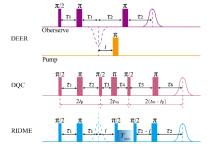
图1
DEER、DQC和RIDME实验的脉冲序列
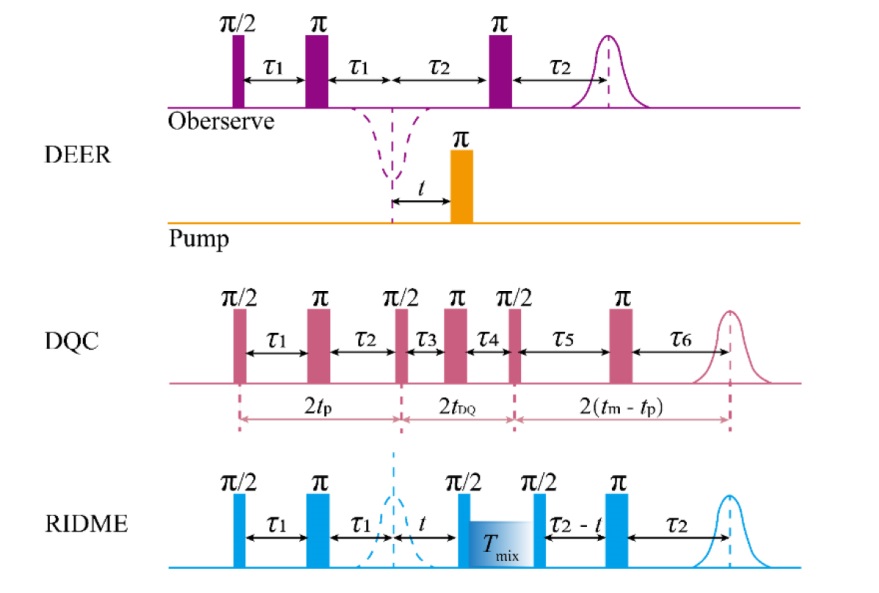
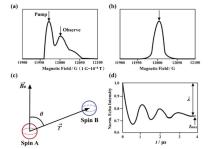
图2
偶极耦合脉冲EPR实验示意图. (a) DEER实验中泵浦脉冲与观测脉冲的位置关系示意图;(b) DQC和RIDME实验中的脉冲位置示意图;(c)实验中一对耦合电子自旋的空间构型示意,其中θ为自旋间距矢量$\overrightarrow{r}$与外加磁场$\overrightarrow{B0}$之间的夹角;(d)背景校正后的DEER时间轨迹、调制深度λ及最大偶极演化时间tmax的示意图
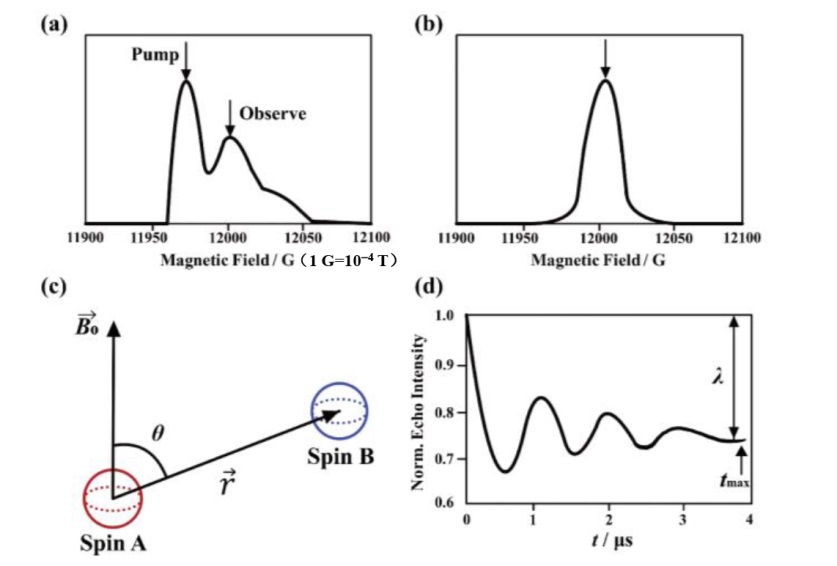

表1
自旋间距离r与最大偶极演化时间tmax的对应关系
| r/nm | tmax/μs |
|---|---|
| 2 | 0.15 |
| 3 | 0.52 |
| 4 | 1.23 |
| 5 | 2.39 |
| 6 | 4.14 |
| 7 | 6.57 |
| 8 | 9.81 |
表2
三种PD-EPR技术的比较
| 技术方法 | 微波频率要求 | 样品要求 | 主要优势 | 主要局限 | 适用自旋探针类型 |
|---|---|---|---|---|---|
| DEER | 双频微波 | 避免浓度过高导致背景增强 | 方法成熟,应用最广;软件支持完善 | 仪器要求高;要求自旋谱线具有足够频率分离 | 氮氧自由基、Mn2+、Gd3+等 |
| DQC | 单频微波 | 要求自旋具有较长相干时间 | 理论灵敏度高;适合低浓度样品;可用于谱线重叠体系 | 实验脉冲序列复杂;对样品相干时间敏感 | 氮氧自由基、三苯甲基自由基为主 |
| RIDME | 单频微波 | T1不宜过短 | 对宽谱、快速弛豫的体系具有显著优势 | 易受核调制干扰 | 顺磁性金属离子、三苯甲基自由基 |
图3
PD-EPR实验中部分常用自旋探针的化学结构,其中与蛋白质反应基团以橙色标注
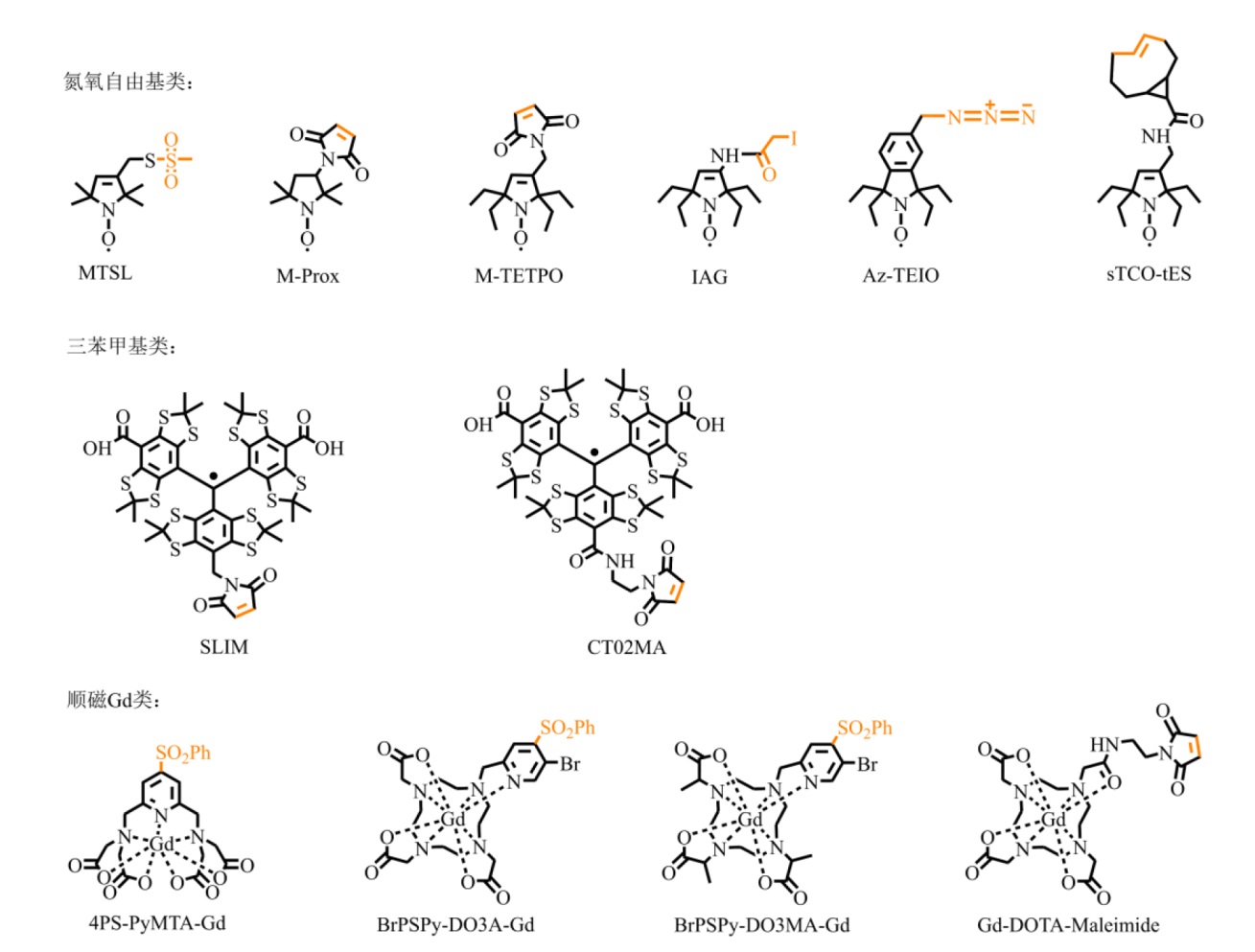
图4
蛋白质自旋标记的主要方法
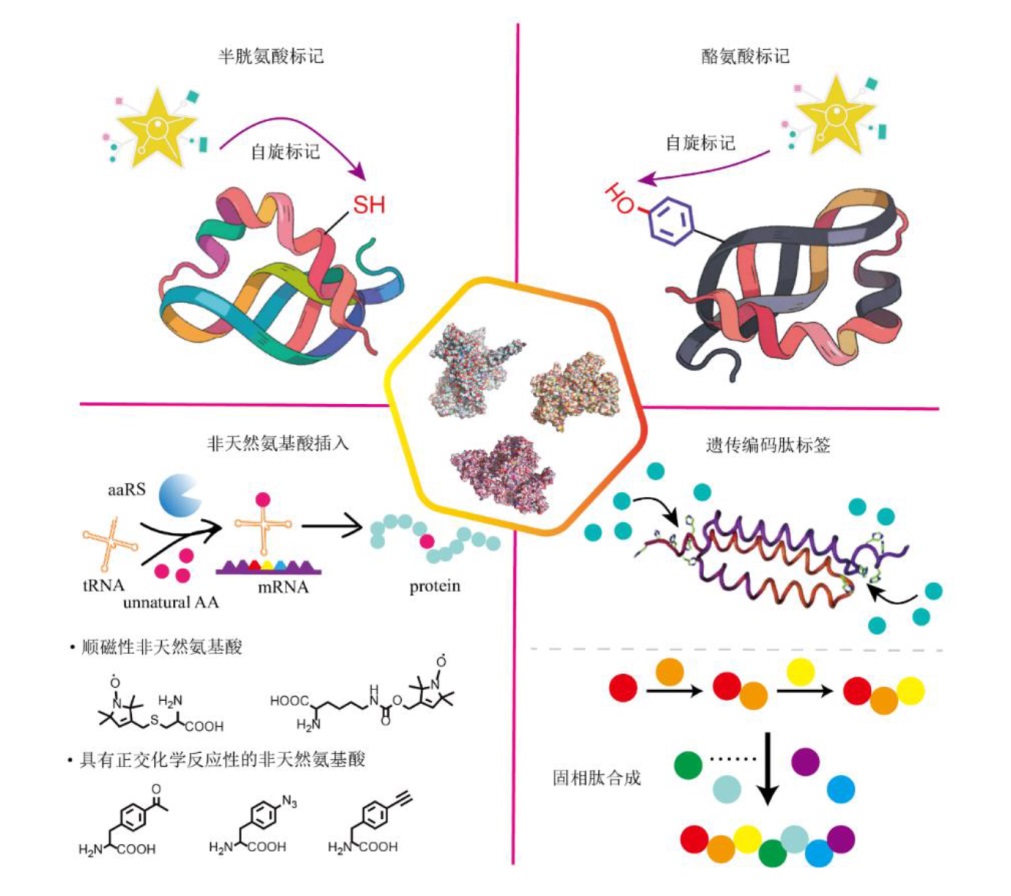
图5
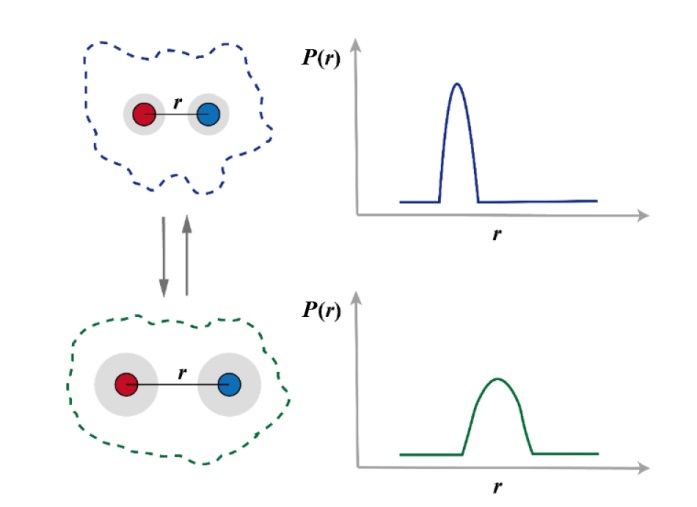
基于PD-EPR的生物大分子动态结构研究示意图.展示标记到同一生物大分子情况下两个自旋标记位点之间的距离分布,其中灰色阴影表示两个自旋在不同条件下的分布变化.PD-EPR技术可以测量自旋间距离分布函数P(r),通过比较距离分布变化,研究生物大分子的结构变化
| [1] | DRENTH J. Principles of protein X-ray crystallography[M]. 3rd ed. New York: Springer, 2007. |
| [2] |
SHI Y A. Glimpse of structural biology through X-ray crystallography[J]. Cell, 2014, 159(5): 995-1014.
doi: 10.1016/j.cell.2014.10.051 |
| [3] |
BAI X-C, MCMULLAN G, SCHERES S H W. How cryo-EM is revolutionizing structural biology[J]. Trends Biochem Sci, 2015, 40(1): 49-57.
doi: 10.1016/j.tibs.2014.10.005 |
| [4] |
FERNANDEZ-LEIRO R, SCHERES S H W. Unravelling biological macromolecules with cryo-electron microscopy[J]. Nature, 2016, 537(7620): 339-346.
doi: 10.1038/nature19948 |
| [5] |
PALMER A G. NMR characterization of the dynamics of biomacromolecules[J]. Chem Rev, 2004, 104(8): 3623-3640.
pmid: 15303831 |
| [6] |
BANARI A, SAMANTA A K, MUNKE A, et al. Advancing time-resolved structural biology: latest strategies in cryo-EM and X-ray crystallography[J]. Nat Methods, 2025, 22(7): 1420-1435.
doi: 10.1038/s41592-025-02659-6 |
| [7] |
RÜDIGER S, FREUND S M V, VEPRINTSEV D B, et al. CRINEPT-TROSY NMR reveals p53 core domain bound in an unfolded form to the chaperone Hsp90[J]. Proc Natl Acad Sci USA, 2002, 99(17): 11085-11090.
pmid: 12163643 |
| [8] |
SCHIEMANN O, PRISNER T F. Long-range distance determinations in biomacromolecules by EPR spectroscopy[J]. Q Rev Biophys, 2007, 40(1): 1-53.
pmid: 17565764 |
| [9] |
SCHIEMANN O, HEUBACH C A, ABDULLIN D, et al. Benchmark test and guidelines for DEER/PELDOR experiments on nitroxide-labeled biomolecules[J]. J Am Chem Soc, 2021, 143(43): 17875-17890.
doi: 10.1021/jacs.1c07371 pmid: 34664948 |
| [10] |
JESCHKE G. DEER distance measurements on proteins[J]. Annu Rev Phys Chem, 2012, 63: 419-446.
doi: 10.1146/annurev-physchem-032511-143716 pmid: 22404592 |
| [11] |
BORDIGNON E, SEEGER M A, GALAZZO L, et al. From in vitro towards in situ: structure-based investigation of ABC exporters by electron paramagnetic resonance spectroscopy[J]. FEBS Lett, 2020, 594(23): 3839-3856.
doi: 10.1002/feb2.v594.23 |
| [12] |
SAHU I D, LORIGAN G A. Role of membrane mimetics on biophysical EPR studies of membrane proteins[J]. BBA-Biomembranes, 2023, 1865(4): 184138.
doi: 10.1016/j.bbamem.2023.184138 |
| [13] |
FACCHETTI D, DANG Y F, SEIF-EDDINE M, et al. Film-electrochemical EPR spectroscopy to investigate electron transfer in membrane proteins in their native environment[J]. Chem Commun, 2024, 60(87): 12690-12693.
doi: 10.1039/D4CC04013A |
| [14] |
BALO A R, LEE J, ERNST O P. Stationary phase EPR spectroscopy for monitoring membrane protein refolding by conformational response[J]. Anal Chem, 2019, 91(1): 1071-1079.
doi: 10.1021/acs.analchem.8b04542 pmid: 30474972 |
| [15] |
VALERA S, ACKERMANN K, PLIOTAS C, et al. Accurate extraction of nanometer distances in multimers by pulse EPR[J]. Chem-Eur J, 2016, 22(14): 4700-4703.
doi: 10.1002/chem.201505143 pmid: 26865468 |
| [16] | ABRAGAM A, BLEANEY B. Electron paramagnetic resonance of transition ions[M]. Oxford: Oxford University Press, 1970. |
| [17] |
ABDULLIN D, SCHIEMANN O. Pulsed dipolar EPR spectroscopy and metal ions: Methodology and biological applications[J]. ChemPlusChem, 2020, 85(2): 353-372.
doi: 10.1002/cplu.201900705 pmid: 31950648 |
| [18] |
BEDILO A F, MARYASOV A G. Electron spin resonance of dipole-coupled anisotropic pairs in disordered systems[J]. J Magn Reson, 1995, 116(1): 87-96.
doi: 10.1006/jmra.1995.1193 |
| [19] |
KLARE J P. Site-directed spin labeling EPR spectroscopy in protein research[J]. Biol Chem, 2013, 394(10): 1281-1300.
doi: 10.1515/hsz-2013-0155 pmid: 23912220 |
| [20] |
GARCÍA-RUBIO I. EPR of site-directed spin-labeled proteins: A powerful tool to study structural flexibility[J]. Arch Biochem Biophys, 2020, 684: 108323.
doi: 10.1016/j.abb.2020.108323 |
| [21] |
MILOV A D, MARYASOV A G, TSVETKOV Y D. Pulsed electron double resonance (PELDOR) and its applications in free-radicals research[J]. Appl Magn Reson, 1998, 15(1): 107-143.
doi: 10.1007/BF03161886 |
| [22] |
STEIN R A, BETH A H, HUSTEDT E J. A straightforward approach to the analysis of double electron-electron resonance data[J]. Methods Enzymol, 2015, 563: 531-567.
doi: 10.1016/bs.mie.2015.07.031 pmid: 26478498 |
| [23] | MILOV A D, SALIKHOV K M, SHIROV M D. Application of ELDOR in electron-spin echo for paramagnetic center space distribution in solids[J]. Fiz Tverd Tela, 1981, 23(4): 975-982. |
| [24] |
JESCHKE G, POLYHACH Y. Distance measurements on spin-labelled biomacromolecules by pulsed electron paramagnetic resonance[J]. Phys Chem Chem Phys, 2007, 9(16): 1895-1910.
doi: 10.1039/b614920k pmid: 17431518 |
| [25] |
BORBAT P P, FREED J H. Multiple-quantum ESR and distance measurements[J]. Chem Phys Lett, 1999, 313(1-2): 145-154.
doi: 10.1016/S0009-2614(99)00972-0 |
| [26] |
SUNIL S, FREED J H. Double quantum two-dimensional Fourier transform electron spin resonance: Distance measurements[J]. Chem Phys Lett, 1996, 251(1-2): 102-110.
doi: 10.1016/0009-2614(96)00075-9 |
| [27] |
SUNIL S, FREED J H. Theory of double quantum two-dimensional electron spin resonance with application to distance measurements[J]. J Chem Phys, 1997, 107(5): 1317-1340.
doi: 10.1063/1.474490 |
| [28] |
KUZIN S, YULIKOV M. RIDME spectroscopy: New topics beyond the determination of electron spin-spin distances[J]. J Phys Chem Lett, 2025, 16(4): 1024-1037.
doi: 10.1021/acs.jpclett.4c02667 |
| [29] |
COLLAUTO A, FRYDMAN V, LEE M D, et al. RIDME distance measurements using Gd(III) tags with a narrow central transition[J]. Phys Chem Chem Phys, 2016, 18(28): 19037-19049.
doi: 10.1039/c6cp03299k pmid: 27355583 |
| [30] |
MEYER A, SCHIEMANN O. PELDOR and RIDME measurements on a high-spin manganese(II)bisnitroxide model complex[J]. J Phys Chem A, 2016, 120(20): 3463-3472.
doi: 10.1021/acs.jpca.6b00716 |
| [31] |
AKHMETZYANOV D, CHING H Y V, DENYSENKOV V, et al. RIDME spectroscopy on high-spin Mn2+ centers[J]. Phys Chem Chem Phys, 2016, 18(44): 30857-30866.
doi: 10.1039/C6CP05239H |
| [32] |
RITSCH I, HINTZ H, JESCHKE G, et al. Improving the accuracy of Cu(II)-nitroxide RIDME in the presence of orientation correlation in water-soluble Cu(II)-nitroxide rulers[J]. Phys Chem Chem Phys, 2019, 21(19): 9810-9830.
doi: 10.1039/c8cp06573j pmid: 31025988 |
| [33] |
WORT J L, ACKERMANN K, GIANNOULIS A, et al. Sub-micromolar pulse dipolar EPR spectroscopy reveals increasing CuII-labelling of double-histidine motifs with lower temperature[J]. Angew Chem Int Ed, 2019, 58(34): 11681-11685.
doi: 10.1002/anie.v58.34 |
| [34] |
ABDULLIN D, DUTHIE F, MEYER A, et al. Comparison of PELDOR and RIDME for distance measurements between nitroxides and low-spin Fe(III) ions[J]. J Phys Chem B, 2015, 119(43): 13534-13542.
doi: 10.1021/acs.jpcb.5b02118 |
| [35] |
ASTASHKIN A V. Mapping the structure of metalloproteins with RIDME[J]. Methods Enzymol, 2015, 563: 251-284.
doi: 10.1016/bs.mie.2015.06.031 pmid: 26478488 |
| [36] |
ORANGES M, WORT J L, FUKUSHIMA M, et al. Pulse dipolar electron paramagnetic resonance spectroscopy reveals buffer-modulated cooperativity of metal-templated protein dimerization[J]. J Phys Chem Lett, 2022, 13(33): 7847-7852.
doi: 10.1021/acs.jpclett.2c01719 pmid: 35976741 |
| [37] |
KUZHELEV A A, KRUMKACHEVA O A, SHEVELEV G Y, et al. Room-temperature distance measurements using RIDME and the orthogonal spin labels trityl/nitroxide[J]. Phys Chem Chem Phys, 2018, 20(15): 10224-10230.
doi: 10.1039/c8cp01093e pmid: 29594278 |
| [38] |
KULIK L V, DZUBA S A, GRIGORYEV I A, et al. Electron dipole-dipole interaction in ESEEM of nitroxide biradicals[J]. Chem Phys Lett, 2001, 343(3-4): 315-324.
doi: 10.1016/S0009-2614(01)00721-7 |
| [39] |
JESCHKE G, CHECHIK V, IONITA P, et al. DeerAnalysis2006—a comprehensive software package for analyzing pulsed ELDOR data[J]. Appl Magn Reson, 2006, 30(3): 473-498.
doi: 10.1007/BF03166213 |
| [40] |
AMEY J L, KEELEY J, CHOUDHURY T, et al. Neural network interpretation using descrambler groups[J]. Proc Natl Acad Sci USA, 2021, 118(5): e2016917118.
doi: 10.1073/pnas.2016917118 |
| [41] |
FÁBREGAS IBÁÑEZ L, JESCHKE G, STOLL S. DeerLab: a comprehensive software package for analyzing dipolar electron paramagnetic resonance spectroscopy data[J]. Magn Reson, 2020, 1: 209-224.
doi: 10.5194/mr-1-209-2020 |
| [42] |
HAUGLAND M M, LOVETT J E, ANDERSON E A. Advances in the synthesis of nitroxide radicals for use in biomolecule spin labelling[J]. Chem Soc Rev, 2018, 47(3): 668-680.
doi: 10.1039/c6cs00550k pmid: 29192696 |
| [43] |
SAMUNI A, GOLDSTEIN S, RUSSO A, et al. Kinetics and mechanism of hydroxyl radical and OH-adduct radical reactions with nitroxides and with their hydroxylamines[J]. J Am Chem Soc, 2002, 124(29): 8719-8724.
pmid: 12121116 |
| [44] |
KIRILYUK I A, POLIENKO Y F, KRUMKACHEVA O A, et al. Synthesis of 2,5-Bis(spirocyclohexane)-substituted nitroxides of pyrroline and pyrrolidine series, including thiol-specific spin label: An analogue of MTSSL with long relaxation time[J]. J Org Chem, 2012, 77(18): 8016-8027.
pmid: 22917445 |
| [45] |
PALETTA J T, PINK M, FOLEY B, et al. Synthesis and reduction kinetics of sterically shielded pyrrolidine nitroxides[J]. Org Lett, 2012, 14(20): 5322-5325.
doi: 10.1021/ol302506f pmid: 23050653 |
| [46] |
JAGTAP A P, KRSTIC I, KUNJIR N C, et al. Sterically shielded spin labels for in-cell EPR spectroscopy: Analysis of stability in reducing environment[J]. Free Radic Res, 2015, 49(1): 78-85.
doi: 10.3109/10715762.2014.979409 |
| [47] |
KUZHELEV A A, TRUKHIN D V, KRUMKACHEVA O A, et al. Room-temperature electron spin relaxation of triarylmethyl radicals at the X- and Q-bands[J]. J Phys Chem B, 2015, 119(43): 13630-13640.
doi: 10.1021/acs.jpcb.5b03027 |
| [48] |
MILIKISYANTS S, SCARPELLI F, FINIGUERRA M G, et al. A pulsed EPR method to determine distances between paramagnetic centers with strong spectral anisotropy and radicals: The dead-time free RIDME sequence[J]. J Magn Reson, 2009, 201(1): 48-56.
doi: 10.1016/j.jmr.2009.08.008 pmid: 19758831 |
| [49] |
HUNTER H R, KANKATI S, HASANBASRI Z, et al. Endogenous Cu(II) labeling for distance measurements on proteins by EPR[J]. Chem-Eur J, 2024, 30(72): e202403160.
doi: 10.1002/chem.v30.72 |
| [50] | HEUBACH C A, HASANBASRI Z, ABDULLIN D, et al. Differentiating between label and protein conformers in pulsed dipolar EPR spectroscopy with the dHis-Cu2+(NTA) motif[J]. Chem-Eur J, 2023, 29(72): e202302541. |
| [51] |
BOGETTI X W, HASANBASRI Z, HUNTER H R, et al. An optimal acquisition scheme for Q-band EPR distance measurements using Cu2+-based protein labels[J]. Phys Chem Chem Phys, 2022, 24(24): 14727-14739.
doi: 10.1039/D2CP01032A |
| [52] |
KISGEROPOULOS E C, GAN Y J, GREER S M, et al. Pulsed multifrequency electron paramagnetic resonance spectroscopy reveals key branch points for one- vs two-electron reactivity in Mn/Fe proteins[J]. J Am Chem Soc, 2022, 144(27): 11991-12006.
doi: 10.1021/jacs.1c13738 pmid: 35786920 |
| [53] |
CASTO J, MANDATO A, HOFMANN L, et al. Cu(II)-based DNA labeling identifies the structural link between transcriptional activation and termination in a metalloregulator[J]. Chem Sci, 2022, 13(6): 1693-1697.
doi: 10.1039/d1sc06563g pmid: 35282619 |
| [54] |
YANG Y, YANG F, GONG Y J, et al. High sensitivity in-cell EPR distance measurements on proteins using an optimized Gd(III) spin label[J]. J Phys Chem Lett, 2018, 9(20): 6119-6123.
doi: 10.1021/acs.jpclett.8b02663 pmid: 30277780 |
| [55] |
PROKOPIOU G, LEE M D, COLLAUTO A, et al. Small Gd(III) tags for Gd(III)-Gd(III) distance measurements in proteins by EPR spectroscopy[J]. Inorg Chem, 2018, 57(9): 5048-5059.
doi: 10.1021/acs.inorgchem.8b00133 pmid: 29629761 |
| [56] |
KUCHER S, KORNEEV S, KLARE J P, et al. In cell Gd3+-based site-directed spin labeling and EPR spectroscopy of eGFP[J]. Phys Chem Chem Phys, 2020, 22(24): 13358-13362.
doi: 10.1039/D0CP01930E |
| [57] | BEN-ISHAY Y, BARAK Y, FEINTUCH A, et al. Exploring the dynamics and structure of PpiB in living Escherichia coli cells using electron paramagnetic resonance spectroscopy[J]. Protein Sci, 2024, 33(3): e4903. |
| [58] |
FIELDING A J, CONCILIO M G, HEAVEN G, et al. New developments in spin labels for pulsed dipolar EPR[J]. Molecules, 2014, 19(10): 16998-17025.
doi: 10.3390/molecules191016998 pmid: 25342554 |
| [59] |
AZARKH M, BIEBER A, QI M, et al. Gd(III)-Gd(III) relaxation-induced dipolar modulation enhancement for in-cell electron paramagnetic resonance distance determination[J]. J Phys Chem Lett, 2019, 10(7): 1477-1481.
doi: 10.1021/acs.jpclett.9b00340 pmid: 30864799 |
| [60] |
MILEO E, ETIENNE E, MARTINHO M, et al. Enlarging the panoply of site-directed spin labeling electron paramagnetic resonance (SDSL-EPR): Sensitive and selective spin-labeling of tyrosine using an isoindoline-based nitroxide[J]. Bioconjugate Chem, 2013, 24(6): 1110-1117.
doi: 10.1021/bc4000542 pmid: 23642211 |
| [61] |
GMEINER C, KLOSE D, MILEO E, et al. Orthogonal tyrosine and cysteine site-directed spin labeling for dipolar pulse EPR spectroscopy on proteins[J]. J Phys Chem Lett, 2017, 8(19): 4852-4857.
doi: 10.1021/acs.jpclett.7b02220 pmid: 28933855 |
| [62] |
LORENZI M, PUPPO C, LEBRUN R, et al. Tyrosine-targeted spin labeling and EPR spectroscopy: An alternative strategy for studying structural transitions in proteins[J]. Angew Chem Int Ed, 2011, 50(39): 9108-9111.
doi: 10.1002/anie.201102539 pmid: 21919142 |
| [63] |
NOREN C J, ANTHONY-CAHILL S J, GRIFFITH M C, et al. A general method for site-specific incorporation of unnatural amino acids into proteins[J]. Science, 1989, 244(4901): 182-188.
pmid: 2649980 |
| [64] |
CORNISH V W, BENSON D R, ALTENBACH C A, et al. Site-specific incorporation of biophysical probes into proteins[J]. Proc Natl Acad Sci USA, 1994, 91(8): 2910-2914.
pmid: 8159678 |
| [65] |
SCHMIDT M J, BORBAS J, DRESCHER M, et al. A genetically encoded spin label for electron paramagnetic resonance distance measurements[J]. J Am Chem Soc, 2014, 136(4): 1238-1241.
doi: 10.1021/ja411535q pmid: 24428347 |
| [66] |
WANG L, ZHANG Z W, BROCK A, et al. Addition of the keto functional group to the genetic code of Escherichia coli[J]. Proc Natl Acad Sci U S A, 2003, 100(1): 56-61.
doi: 10.1073/pnas.0234824100 |
| [67] |
KALAI T, FLEISSNER M R, JEKO J, et al. Synthesis of new spin labels for Cu-free click conjugation[J]. Tetrahedron Lett, 2011, 52(21): 2747-2749.
doi: 10.1016/j.tetlet.2011.03.077 |
| [68] |
FLEISSNER M R, BRUSTAD E M, KALAI T, et al. Site-directed spin labeling of a genetically encoded unnatural amino acid[J]. Proc Natl Acad Sci USA, 2009, 106(51): 21637-21642.
doi: 10.1073/pnas.0912009106 pmid: 19995976 |
| [69] |
WORT J L, ARYA S, ACKERMANN K, et al. Pulse dipolar EPR reveals double-histidine motif CuII-NTA spin-labeling robustness against competitor ions[J]. J Phys Chem Lett, 2021, 12(11): 2815-2819.
doi: 10.1021/acs.jpclett.1c00211 |
| [70] |
CHING H Y V, MASCALI F C, BERTRAND H C, et al. The use of Mn(II) bound to His-tags as genetically encodable spin-label for nanometric distance determination in proteins[J]. J Phys Chem Lett, 2016, 7(6): 1072-1076.
doi: 10.1021/acs.jpclett.6b00362 pmid: 26938795 |
| [71] |
JARVI A G, BOGETTI X, SINGEWALD K, et al. Going the dHis-tance: Site-directed Cu2+ labeling of proteins and nucleic acids[J]. Acc Chem Res, 2021, 54(6): 1481-1491.
doi: 10.1021/acs.accounts.0c00761 |
| [72] |
STOLLER S, SICOLI G, BARANOVA T Y, et al. TOPP: A novel nitroxide-labeled amino acid for EPR distance measurements[J]. Angew Chem Int Ed, 2011, 50(41): 9743-9746.
doi: 10.1002/anie.201103315 pmid: 21898726 |
| [73] |
KARIM C B, KIRBY T L, ZHANG Z W, et al. Phospholamban structural dynamics in lipid bilayers probed by a spin label rigidly coupled to the peptide backbone[J]. Proc Natl Acad Sci USA, 2004, 101(40): 14437-14442.
pmid: 15448204 |
| [74] |
BECKER C F W, LAUSECKER K, BALOG M, et al. Incorporation of spin-labelled amino acids into proteins[J]. Magn Reson Chem, 2005, 43: S34-S39.
doi: 10.1002/(ISSN)1097-458X |
| [75] |
TESSMER M H, STOLL S. Protein modeling with DEER spectroscopy[J]. Annu Rev Biophys, 2025, 54: 35-57.
doi: 10.1146/biophys.2025.54.issue-1 |
| [76] | KONG L W, KUANG G L, WU X Y. Research progress of EPR spectrometer under high frequency and high field[J]. Chinese J Magn Reson, 2023, 40(3): 341-364. |
|
孔令文, 匡光力, 吴向阳. 高频高场下EPR谱仪的研究进展[J]. 波谱学杂志, 2023, 40(3): 341-364.
doi: 10.11938/cjmr20233051 |
|
| [77] |
PETER M F, GEBHARDT C, MAECHTEL R, et al. Cross-validation of distance measurements in proteins by PELDOR/DEER and single-molecule FRET[J]. Nat Commun, 2022, 13(1): 4396.
doi: 10.1038/s41467-022-31945-6 pmid: 35906222 |
| [78] |
JOSEPH B, JAUMANN E A, SIKORA A, et al. In situ observation of conformational dynamics and protein ligand-substrate interactions in outer-membrane proteins with DEER/PELDOR spectroscopy[J]. Nature Protocols, 2019, 14(8): 2344-2369.
doi: 10.1038/s41596-019-0182-2 pmid: 31278399 |
| [79] |
JOSEPH B, SIKORA A, CAFISO D S. Ligand induced conformational changes of a membrane transporter in E. coli cells observed with DEER/PELDOR[J]. J Am Chem Soc, 2016, 138(6): 1844-1847.
doi: 10.1021/jacs.5b13382 pmid: 26795032 |
| [80] |
WU T, STEIN R A, KAO T-Y, et al. Modeling protein conformational ensembles by guiding AlphaFold2 with double electron electron resonance (DEER) distance distributions[J]. Nat Commun, 2025, 16(1): 7107.
doi: 10.1038/s41467-025-62582-4 |
| [81] |
TANG Q, SINCLAIR M, HASDEMIR H S, et al. Asymmetric conformations and lipid interactions shape the ATP-coupled cycle of a heterodimeric ABC transporter[J]. Nat Commun, 2023, 14(1): 7184.
doi: 10.1038/s41467-023-42937-5 pmid: 37938578 |
| [82] |
KARTHIKEYAN G, BONUCCI A, CASANO G, et al. A bioresistant nitroxide spin label for in-cell EPR spectroscopy: In vitro and in oocytes protein structural dynamics studies[J]. Angew Chem Int Ed, 2018, 57(5): 1366-1370.
doi: 10.1002/anie.201710184 pmid: 29227566 |
| [83] |
HAYSOM S F, MACHIN J, WHITEHOUSE J M, et al. Darobactin B stabilises a lateral-closed conformation of the bam complex in E. coli cells[J]. Angew Chem Int Ed, 2023, 62(34): e202218783.
doi: 10.1002/anie.v62.34 |
| [84] |
JOSEPH B, TORMYSHEV V M, ROGOZHNIKOVA O Y, et al. Selective high-resolution detection of membrane protein-ligand interaction in native membranes using trityl-nitroxide PELDOR[J]. Angew Chem Int Ed, 2016, 55(38): 11538-11542.
doi: 10.1002/anie.201606335 pmid: 27511025 |
| [85] |
HALBMAIR K, SEIKOWSKI J, TKACH I, et al. High-resolution measurement of long-range distances in RNA: pulse EPR spectroscopy with TEMPO-labeled nucleotides[J]. Chem Sci, 2016, 7(5): 3172-3180.
doi: 10.1039/c5sc04631a pmid: 29997809 |
| [86] |
HEINZ M, ERLENBACH N, STELZL L S, et al. High-resolution EPR distance measurements on RNA and DNA with the non-covalent Ǵ spin label[J]. Nucleic Acids Res, 2020, 48(2): 924-933.
doi: 10.1093/nar/gkz1096 pmid: 31777925 |
| [87] |
ZHANG J, FANG X. Empowering the molecular ruler techniques with unnatural base pair system to explore conformational dynamics of flaviviral RNAs[J]. Curr Opin Struct Biol, 2024, 89: 102944.
doi: 10.1016/j.sbi.2024.102944 |
| [88] |
DUSS O, YULIKOV M, JESCHKE G, et al. EPR-aided approach for solution structure determination of large RNAs or protein-RNA complexes[J]. Nat Commun, 2014, 5: 3669.
doi: 10.1038/ncomms4669 pmid: 24828280 |
| [89] |
WARD R, KEEBLE D J, EL-MKAMI H, et al. Distance determination in heterogeneous DNA model systems by pulsed EPR[J]. ChemBioChem, 2007, 8(16): 1957-1964.
pmid: 17886320 |
| [90] |
SCHMIDT T, JEON J, OKUNO Y, et al. Submillisecond freezing permits cryoprotectant-free EPR double electron-electron resonance spectroscopy[J]. ChemPhysChem, 2020, 21: 1224-1229.
doi: 10.1002/cphc.202000312 pmid: 32383308 |
| [91] | CHEN Y T, ZHANG X, CHEN J L, et al. Rigid and stable nitroxide spin label for high-resolution distance measurements on proteins by DEER experiments[J]. Magn Reson Lett, 2025, 5(3): 200194. |
| [92] |
GRAENZ M, ERLENBACH N, SPINDLER P, et al. Dynamics of nucleic acids at room temperature revealed by pulsed EPR spectroscopy[J]. Angew Chem Int Ed, 2018, 57(33): 10540-10543.
doi: 10.1002/anie.201803682 pmid: 29858557 |
| [93] |
QIN Z, WANG Z, KONG F, et al. In situ electron paramagnetic resonance spectroscopy using single nanodiamond sensors[J]. Nat Commun, 2023, 14(1): 6278.
doi: 10.1038/s41467-023-41903-5 pmid: 37805509 |
| [94] |
SHI F, KONG F, ZHAO P, et al. Single-DNA electron spin resonance spectroscopy in aqueous solutions[J]. Nat Methods, 2018, 15(9): 697-699.
doi: 10.1038/s41592-018-0084-1 |
| [1] | 魏青1,2,宋瑞波3,周晓东3,汤伟军4,张卫国3,陈群1*. 准连续性动脉自旋标记技术在磁共振系统上的序列实现和参数优化 [J]. 波谱学杂志, 2015, 32(4): 574-583. |
| [2] | 彭俊辉,赵德彪,文彬,张志勇*. 核磁共振、X 射线小角散射以及计算机模拟相结合构建生物大分子复合物的结构模型[J]. 波谱学杂志, 2015, 32(2): 181-194. |
| [3] | 郭林超, 王长振, 丛建波, 先宏, 吴可. EPR波谱拟合-傅里叶去卷积距离计算方法[J]. 波谱学杂志, 2010, 27(1): 113-120. |
| [4] | 赵保路. 电子自旋共振(ESR)技术在生物和医学中的应用[J]. 波谱学杂志, 2010, 27(1): 51-67. |
| [5] | 危佳1, 单璐1, 李维超2*. 新型超低温探头在分析与科研中的应用[J]. 波谱学杂志, 2007, 24(4): 526-534. |
| [6] | 宋玉光, 孙健, Nohl Hans, 刘扬. 几种含羟基化合物对红细胞膜流动性的影响[J]. 波谱学杂志, 2005, 22(4): 349-356. |
| [7] | 金桂东,谭莉,陈士明*,严小敏,沈伊民,平郑骅,华峰君. 自旋标记法研究PEG/PVP体系的链运动[J]. 波谱学杂志, 2001, 18(1): 13-20. |
| [8] | 颉东旭, 冯良波, 李树本, 任礼勤. 肿瘤细胞诱导分化剂HMBA对自旋标记物TEMPO与蛋白质结合的影响及其意义[J]. 波谱学杂志, 1997, 14(6): 527-532. |
| [9] | 俞开潮, 卓仁禧. 含稳定氮氧自由基聚磷酸酯的合成及其弛豫性能研究[J]. 波谱学杂志, 1996, 13(5): 417-422. |
| [10] | 孙继山, 张莉, 杨福愉. 硒(Na2SeO3)稳定红细胞膜骨架蛋白的自旋标记ESR研究[J]. 波谱学杂志, 1992, 9(3): 239-245. |
| [11] | 项柏松, 陈炳焕, 万谦. 样品介电性质对ST-ESR谱的影响[J]. 波谱学杂志, 1989, 6(4): 453-460. |
| [12] | 刘芳. 胰岛素与其受体分子相互作用的ESR的波谱研究[J]. 波谱学杂志, 1989, 6(3): 341-346. |
| [13] | 刘芳, 蔡同茂, 张清刚, 张述祖. 用自旋标记研究人参皂甙对血卟啉光敏作用的影响[J]. 波谱学杂志, 1987, 4(2): 171-178. |
| 阅读次数 | ||||||
|
全文 |
|
|||||
|
摘要 |
|
|||||
