
Chinese Journal of Magnetic Resonance ›› 2026, Vol. 43 ›› Issue (3): 253-267.doi: 10.11938/cjmr20263205cstr: 32225.14.cjmr20263205
• Articles • Previous Articles Next Articles
LIU Wanzhen1,2, CHEN Fang1,2, CHEN Li1, WANG Jiaxin1, CHENG Xin1,2, YI Peng1, ZHANG Zhi1,2,*( ), LIU Chaoyang1,2,#()
Received:2026-02-05
Published:2026-09-05
Online:2026-08-11
Contact:
ZHANG Zhi,*Tel: 027-87199686, E-mail: zhangzhi@apm.ac.cn; LIU Chaoyang,# Tel: 027-87198790, E-mail: chyliu@apm.ac.cn.
CLC Number:
LIU Wanzhen, CHEN Fang, CHEN Li, WANG Jiaxin, CHENG Xin, YI Peng, ZHANG Zhi, LIU Chaoyang. Research on Large-bore and High Homogeneity Halbach Magnet for Nuclear Magnetic Resonance[J]. Chinese Journal of Magnetic Resonance, 2026, 43(3): 253-267.
Add to citation manager EndNote|Reference Manager|ProCite|BibTeX|RefWorks
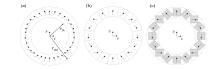
Fig. 1
Schematic diagram of (a) ideal Halbach magnet, (b) compact Halbach magnet and (c) discrete Halbach magnet structure
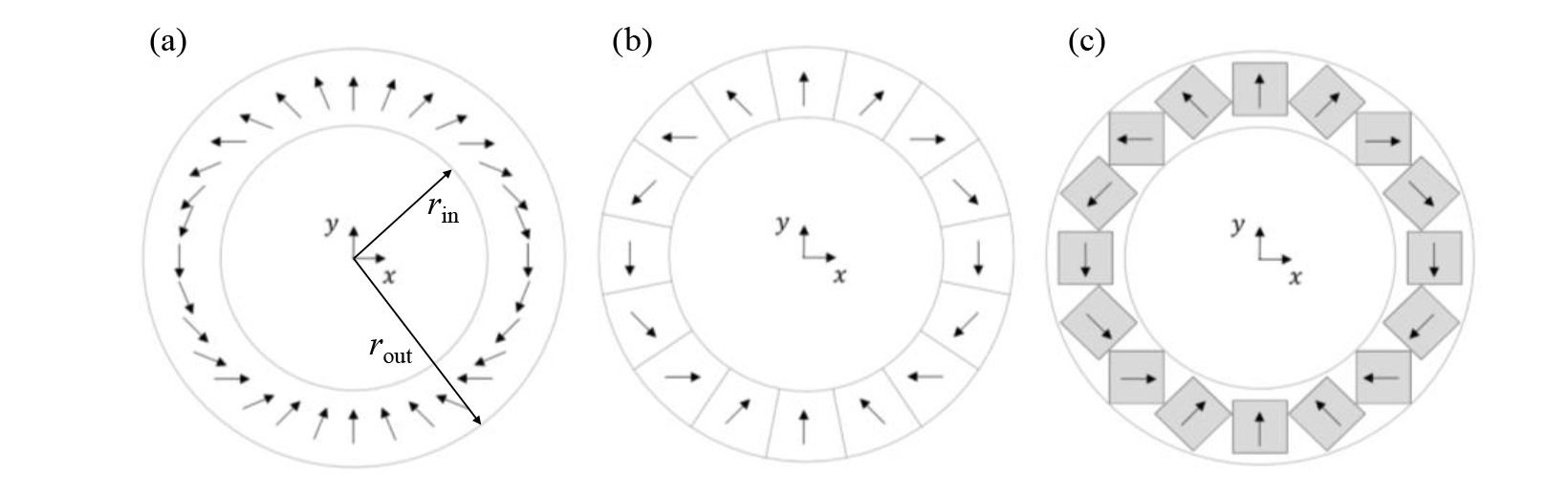
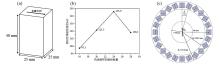
Fig. 2
(a) Schematic diagram of magnetic block with dimensions of 40 × 25 × 25 mm3; (b) The influence of the number of magnetic blocks on the magnetic field strength; (c) Schematic diagram of a single-loop magnetic ring arrangement
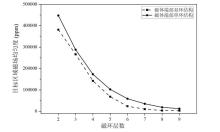
Fig. 3
Effects of the number of magnet ring layers and the end ring structure on the magnetic field homogeneity in the ROI
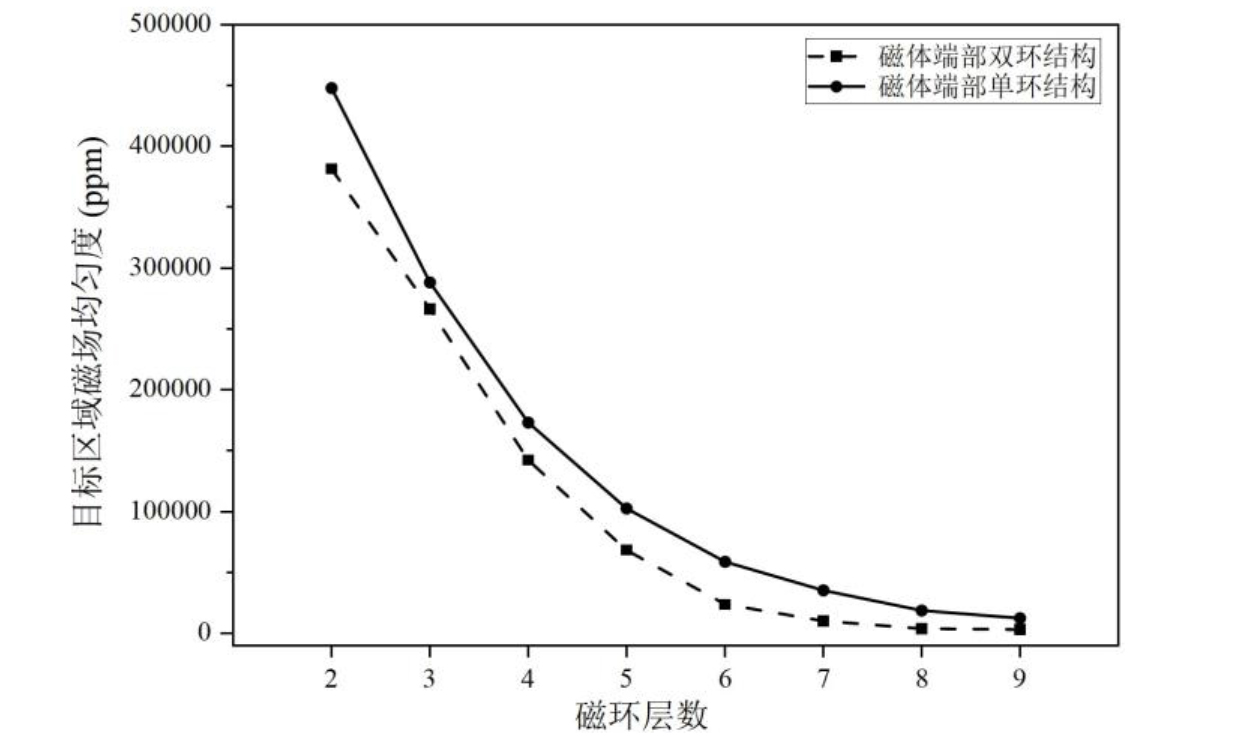
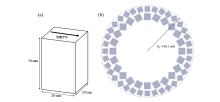
Fig. 4
(a) Schematic diagram of magnetic block with dimensions of 30 × 20 × 20 mm3; (b) Schematic diagram of the double loop magnetic rings at the top and bottom ends of the magnet
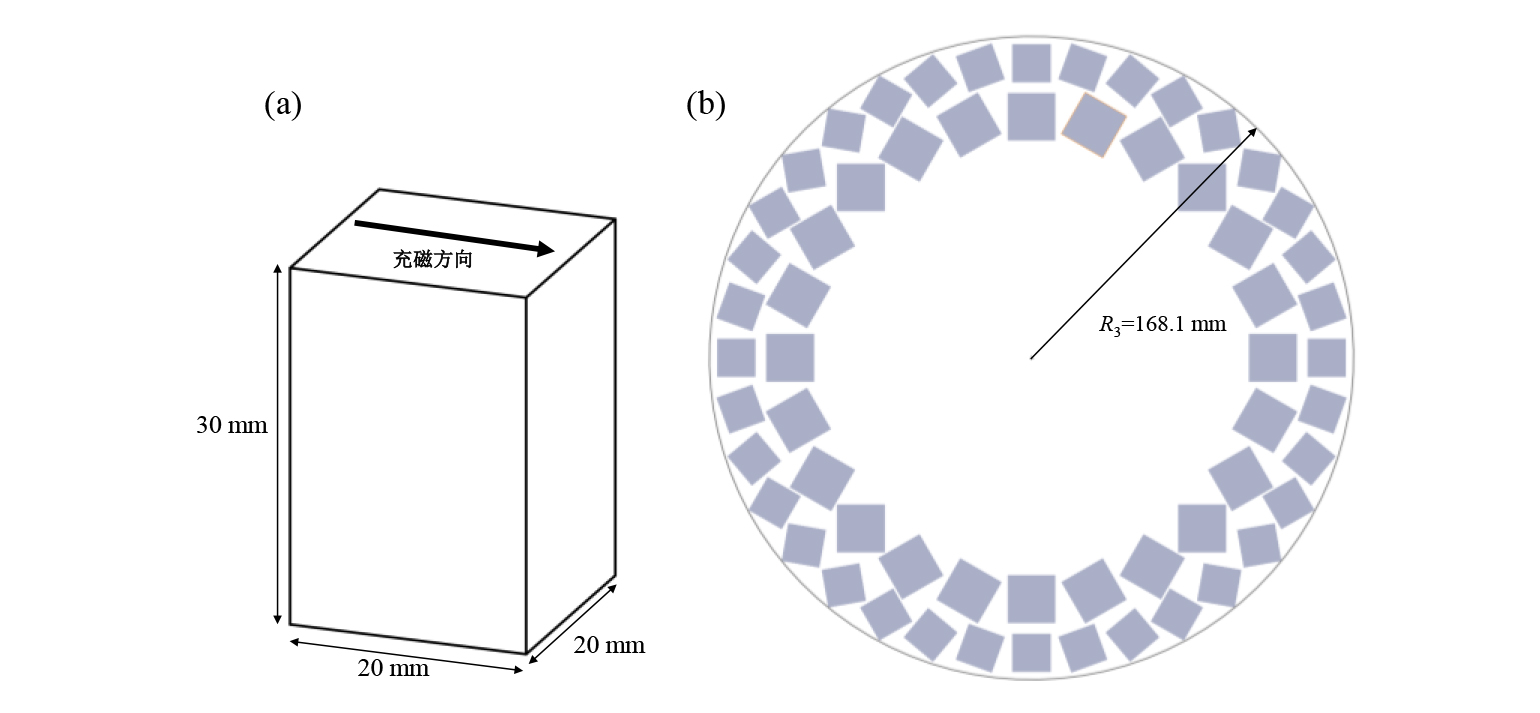
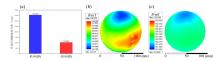
Fig. 5
(a) The effect of adding magnetic rings at both ends of the magnet on the homogeneity of the ROI (seven magnet ring layers in total); (b) Simulation result of magnetic field distribution in the ROI when no magnetic rings are added at the top and bottom ends of the magnet; (c) Simulation result of magnetic field distribution in the ROI after adding magnetic rings at both ends of the magnet
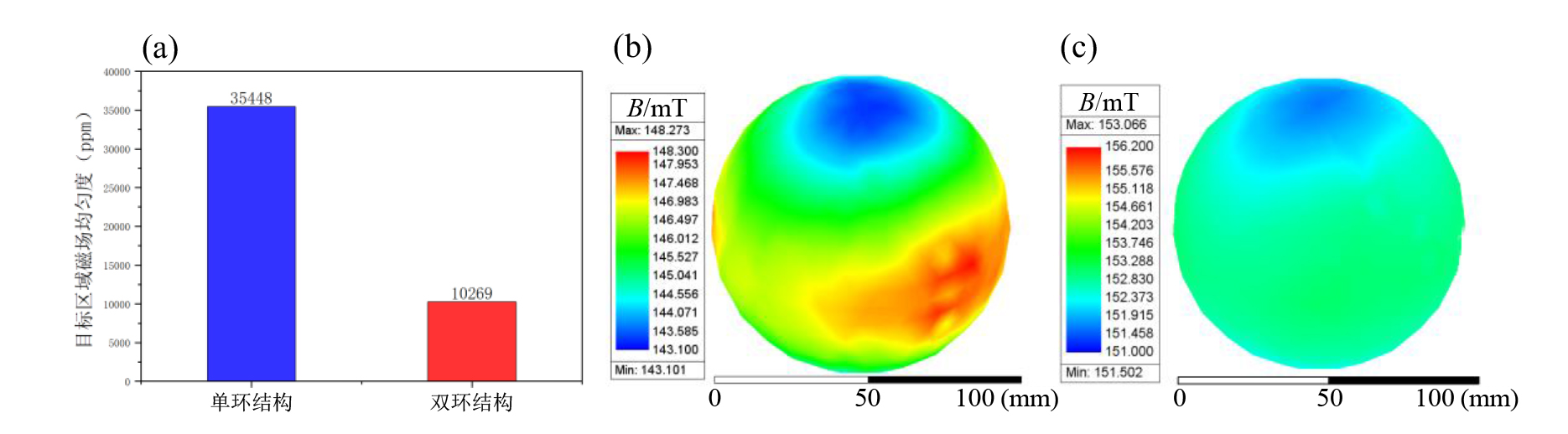
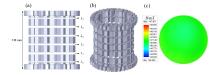
Fig. 6
(a) Front view of the magnet; (b) Schematic of the final magnet structure; (c) Effect of the number of magnet layers on the magnetic-field homogeneity within the ROI
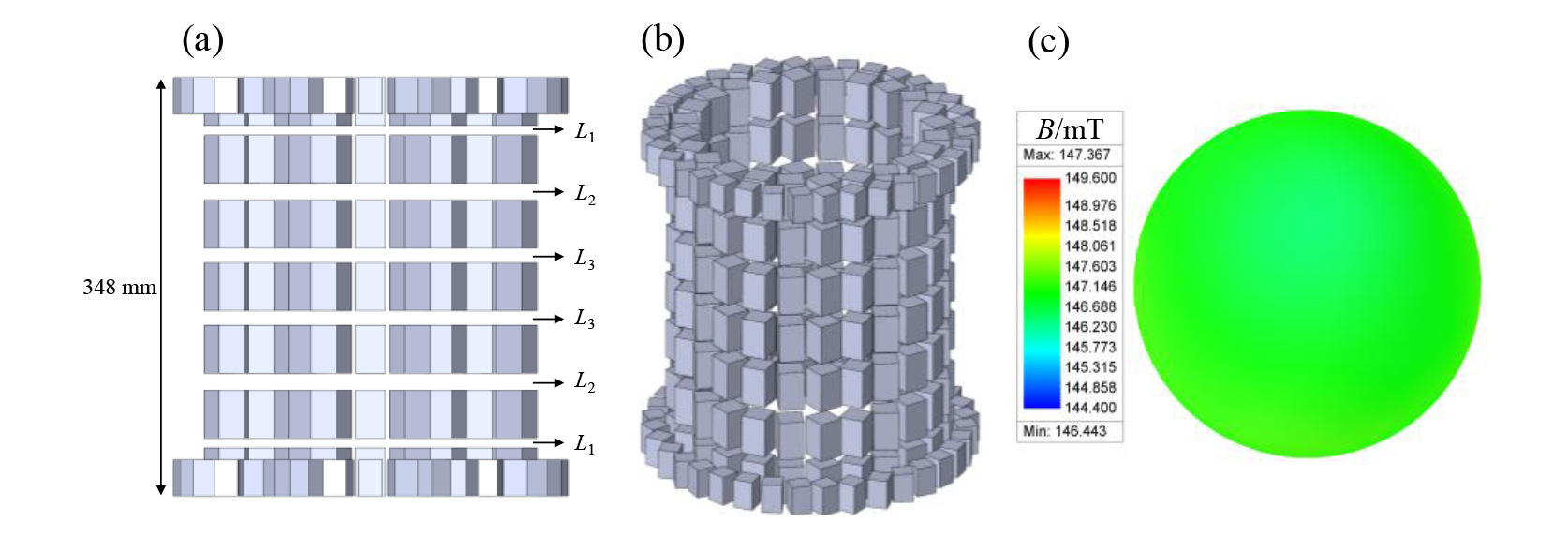
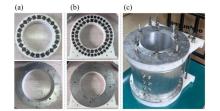
Fig. 7
Photographs of (a) single magnet ring, (b) double ring assembly, and (c) fully assembled Halbach magnet
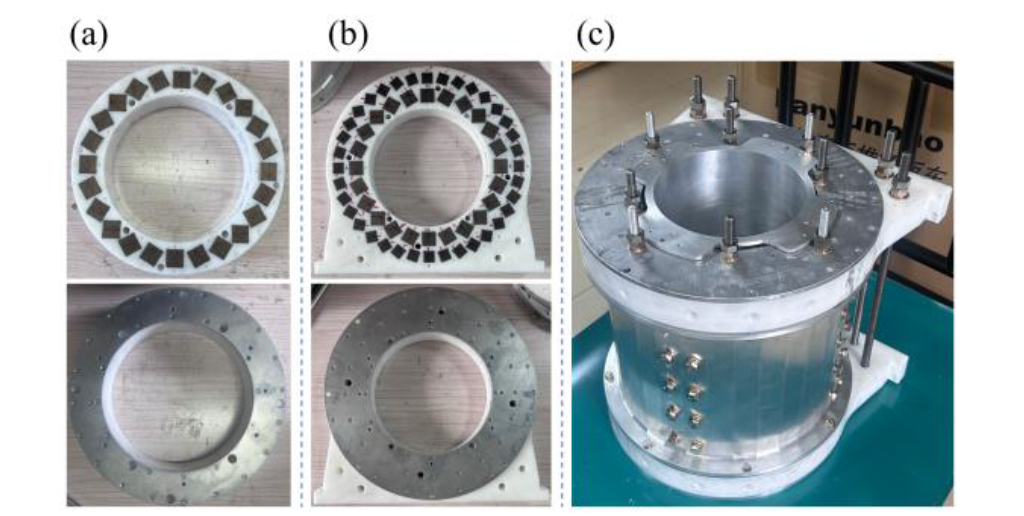
Fig. 8
(a) ROI and the 100 mm field mapping lines along the X, Y, and Z axes; (b) Initial magnetic field profiles within a 100 mm range along the X, Y, and Z axes
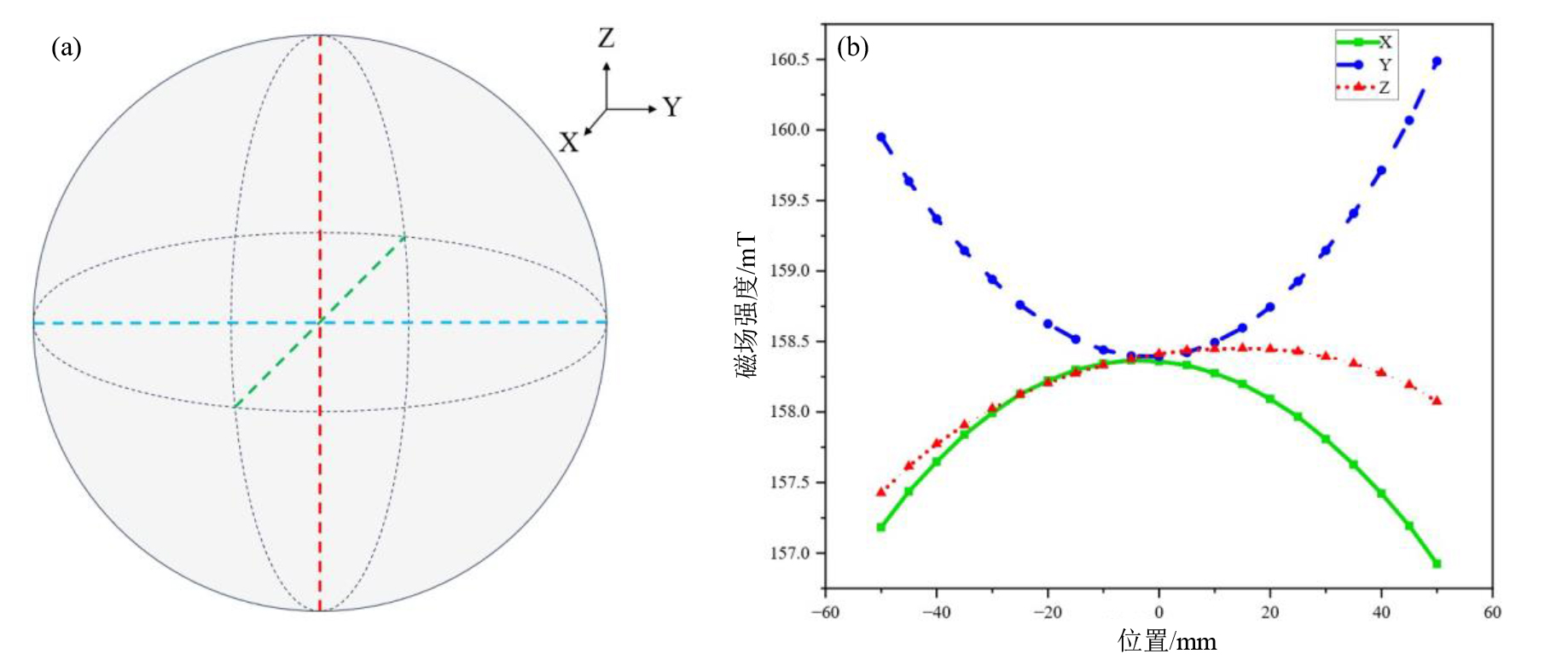
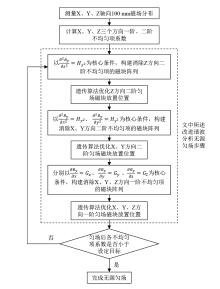
Fig. 9
Flowchart of the passive shimming procedure
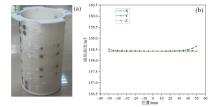
Fig. 10
(a) Photograph of the passive shimming cylinder; (b) Magnetic-field profiles along the X, Y, and Z axes within a 100 mm range after passive shimming

Table 1
Performance parameters for each component of the test platform
| 测试系统部件 | 部件核心指标 | 性能参数 |
|---|---|---|
| 谱仪控制子系统 | 激发频率范围 | 1~100 MHz |
| 最小脉冲宽度 | 150 ns | |
| 最大接收带宽 | 1 MHz | |
| 射频功率放大器 | 工作频段 | 6~220 MHz |
| 最大输出功率 | 300 W | |
| 前置放大器 | 工作频段 | 5~100 MHz |
| 6.79 MHz频点放大倍数 | 25 dB | |
| 25 mm内径射频线圈 | 调谐频率 | 6.791 MHz |
| 回波损耗(S11) | -26.73 dB | |
| 品质因子(Q值) | 75.3 | |
| 100 mm内径射频线圈 | 调谐频率 | 6.792 MHz |
| 回波损耗(S11) | -40.01 dB | |
| 品质因子(Q值) | 26.3 |
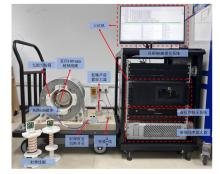
Fig. 11
NMR experimental system
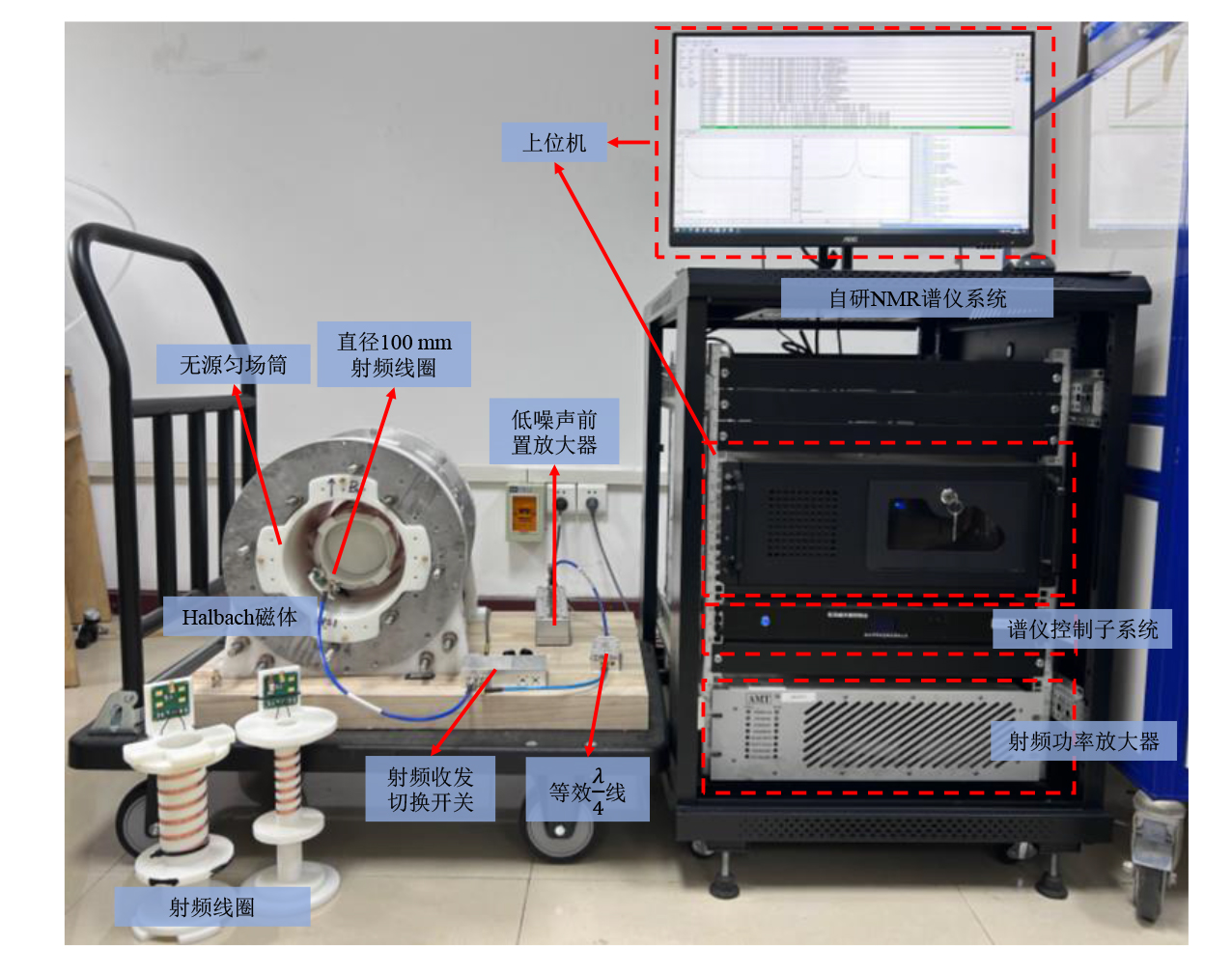
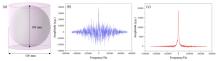
Fig. 12
(a) Schematic illustrating the relationship between the ROI and the Φ 100 mm × H 100 mm test region; (b) NMR signal of a Φ 100 mm × H 100 mm CuSO4 aqueous solution before shimming (10 signal averages); (c) NMR signal of the same sample after shimming (single acquisition, no averaging)
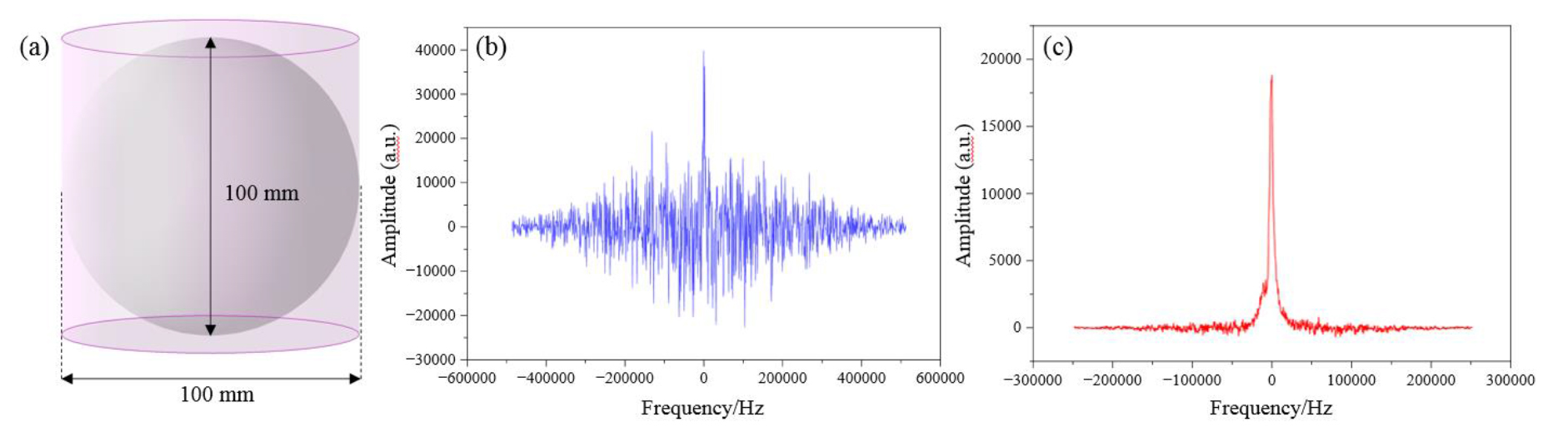
Fig. 13
(a) Schematic illustrating the relationship between the ROI and the Φ 25 mm × H 25 mm test region; (b) Comparison of the NMR signals from a Φ 25 mm × H 25 mm CuSO₄ aqueous solution before and after shimming (normalized); (c) Zoomed-in view of the peak region in (b)
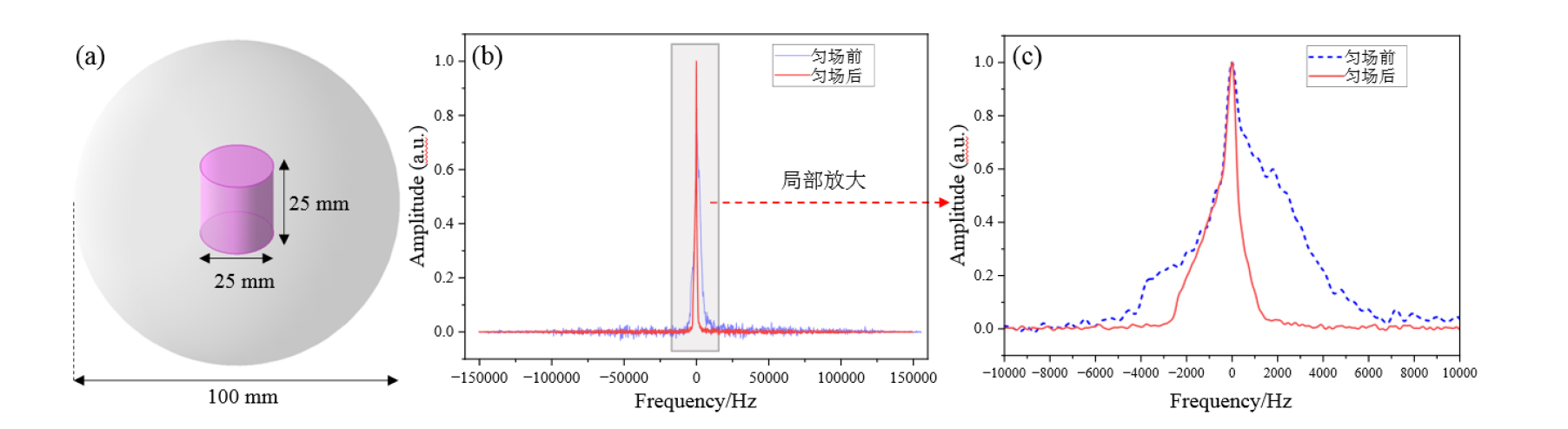
Fig. 14
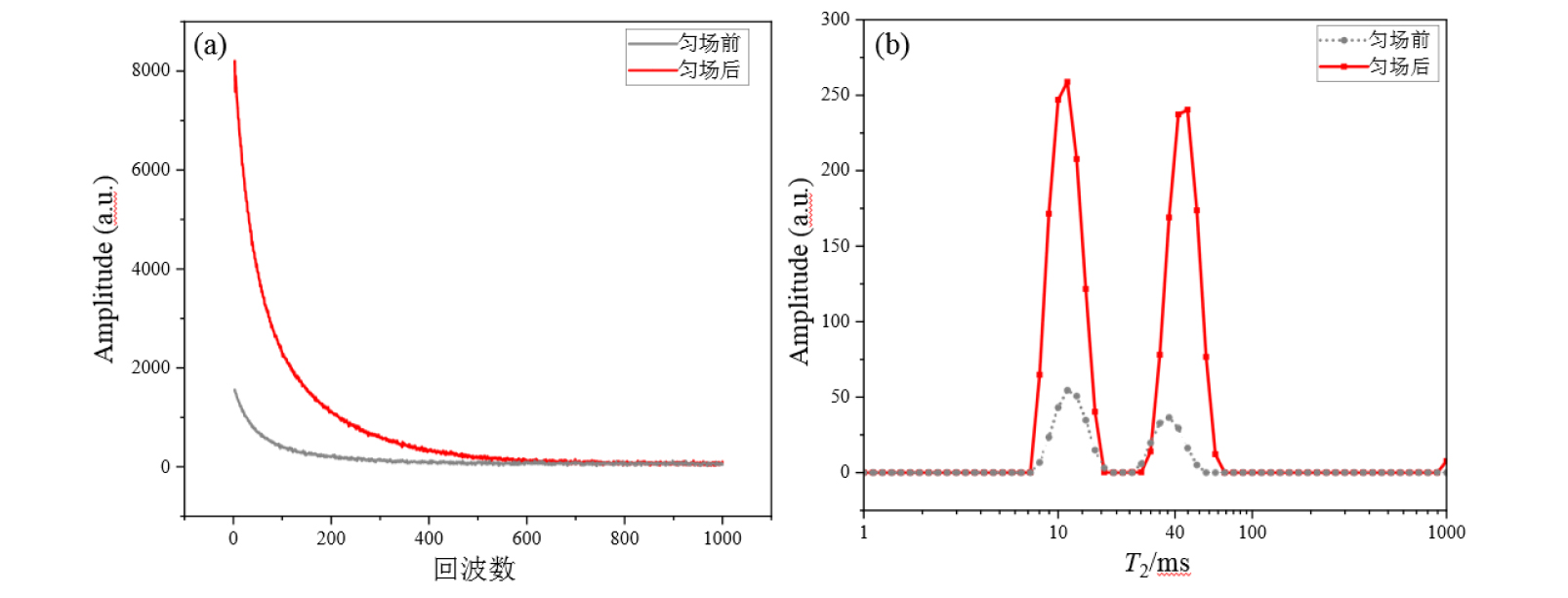
(a) CPMG echo envelope decay curve of a two component CuSO4 aqueous solution (TE = 0.3 ms); (b) T2 distribution spectrum of the two component CuSO4 aqueous solution
| [1] |
BLÜMICH B, CASANOVA F, APPELT S. NMR at low magnetic fields[J]. Chem Phys Lett, 2009, 477(4-6): 231-240.
doi: 10.1016/j.cplett.2009.06.096 |
| [2] |
LUO G, XIAO L, LUO S, et al. A study on multi-exponential inversion of nuclear magnetic resonance relaxation data using deep learning[J]. J Magn Reson, 2023, 346: 107358.
doi: 10.1016/j.jmr.2022.107358 |
| [3] |
CHEN Y A, MATHUR S, LIN A, et al. Tips and challenges for clinical use and interpretation of low field portable MRI in neuroimaging[J]. Emerg Radiol, 2025, 32(2): 279-289.
doi: 10.1007/s10140-025-02323-8 |
| [4] |
MITCHELL J, FORDHAM E J. Contributed review: nuclear magnetic resonance core analysis at 0.3 T[J]. Rev Sci Instrum, 2014, 85(11): 111502.
doi: 10.1063/1.4902093 |
| [5] | DERNAIKA M, SERAG S, KALAM M Z. The impact of heterogeneity and multi-scale measurements on reservoir characterization and STOOIP estimations[C]// International Symposium of the Society of Core Analysts. Austin: SCA, 2011: 1-6. |
| [6] |
JONES M, APTAKER P S, COX J, et al. A transportable magnetic resonance imaging system for in situ measurements of living trees: the Tree Hugger[J]. J Magn Reson, 2012, 218: 133-140.
doi: 10.1016/j.jmr.2012.02.019 pmid: 22445351 |
| [7] | SUN Z, XIAO L Z, LIAO G Z, et al. Design of magnets for in situ NMR detection devices intended for preservation of ancient architectures[J]. Chinese J Magn Reson, 2017, 34(3): 372-382. |
| 孙哲, 肖立志, 廖广志, 等. 用于长城等古建筑探测的NMR探测器的磁体设计[J]. 波谱学杂志, 2017, 34(3): 372-382. | |
| [8] | YU D J, GUO P, WU J M, et al. A unilateral nuclear magnetic resonance sensor for nondestructive wood moisture measurements[J]. Chinese J Magn Reson, 2017, 34(4): 508-518. |
|
余登洁, 郭盼, 吴嘉敏, 等. 用于木材水分检测的单边核磁共振传感器设计[J]. 波谱学杂志, 2017, 34(4): 508-518.
doi: 10.11938/cjmr20172561 |
|
| [9] |
VAN BEEK T A. Low-field benchtop NMR spectroscopy: status and prospects in natural product analysis (dagger)[J]. Phytochem Anal, 2021, 32(1): 24-37.
doi: 10.1002/pca.v32.1 |
| [10] | LIU M, QIU W Q, SUN H J, et al. Research progress of portable NMR spectrometers[J]. Chinese J Magn Reson, 2014, 31(4): 504-514. |
|
刘敏, 邱雯绮, 孙惠军, 等. 便携式核磁共振谱仪的研究进展[J]. 波谱学杂志, 2014, 31(4): 504-514.
doi: 10.11938/cjmr20140405 |
|
| [11] |
YU P, XU Y, WU Z, et al. A low-cost home-built NMR using Halbach magnet[J]. J Magn Reson, 2018, 294: 162-168.
doi: S1090-7807(18)30191-5 pmid: 30055440 |
| [12] | ASTAING-CORDIER T, BOUILLAUD D, FARJON J, et al. Recent advances in benchtop NMR spectroscopy and its applications[M]//WEBB G A.Annual Reports on NMR Spectroscopy. London: Academic Press, 2021, 103: 191-258. |
| [13] | YE Y, SHEN S, GUO P, et al. A portable Halbach NMR sensor for detecting the moisture content of soybeans[J]. IEEE Trans Instrum Meas, 2022, 71: 1-11. |
| [14] |
PURCHASE A R, VIDARSSON L, WACHOWICZ K, et al. A short and light, sparse dipolar Halbach magnet for MRI[J]. IEEE Access, 2021, 9: 95294-95303.
doi: 10.1109/ACCESS.2021.3093530 |
| [15] |
GAO M, LUO S, ZHU L, et al. Easy-to-implement passive shimming approach of Halbach magnet for low-field NMR measurement[J]. J Magn Reson, 2025, 376: 107887.
doi: 10.1016/j.jmr.2025.107887 |
| [16] |
YANG L, CHEN F, CHEN L, et al. An easy-built Halbach magnet for LF-NMR with high homogeneity using optimized target-field passive shimming method[J]. J Magn Reson, 2023, 357: 107582.
doi: 10.1016/j.jmr.2023.107582 |
| [17] |
O'REILLY T, TEEUWISSE W M, WEBB A G. Three-dimensional MRI in a homogenous 27 cm diameter bore Halbach array magnet[J]. J Magn Reson, 2019, 307: 106578.
doi: 10.1016/j.jmr.2019.106578 |
| [18] |
HALBACH K. Perturbation effects in segmented rare earth cobalt multipole magnets[J]. Nucl Instrum Methods Phys Res, 1982, 198(2): 213-215.
doi: 10.1016/0167-5087(82)90258-7 |
| [19] | HALBACH K. Design of permanent multipole magnets with oriented rare earth cobalt material[J]. Nucl Instrum Methods Phys Res, 1980, 169(1): 1-10. |
| [20] |
TUREK K, LISZKOWSKI P. Magnetic field homogeneity perturbations in finite Halbach dipole magnets[J]. J Magn Reson, 2014, 238: 52-62.
doi: 10.1016/j.jmr.2013.10.026 pmid: 24316186 |
| [21] | WANG J, JIANG X, HU Z, et al. Design and shimming method of low length-to-interdiameter ratio Halbach magnet[J]. IEEE Trans Instrum Meas, 2022, 71: 1-10. |
| [22] |
WINDT C W, SOLTNER H, VAN DUSSCHOTEN D, et al. A portable Halbach magnet that can be opened and closed without force: the NMR-CUFF[J]. J Magn Reson, 2011, 208(1): 27-33.
doi: 10.1016/j.jmr.2010.09.020 pmid: 21036637 |
| [23] |
ANFEROVA S, ANFEROV V, ARNOLD J, et al. Improved Halbach sensor for NMR scanning of drill cores[J]. Magn Reson Imaging, 2007, 25(4): 474-480.
pmid: 17466767 |
| [24] |
YU P, WANG Y, XU Y, et al. Theoretical foundation for designing multilayer Halbach array magnets for benchtop NMR and MRI[J]. J Magn Reson, 2022, 344: 107322.
doi: 10.1016/j.jmr.2022.107322 |
| [25] |
WANG Y, XU Y, WANG F, et al. A passive shimming method for Halbach magnet based on magnetic sheet arrays[J]. J Magn Reson, 2022, 339: 107210.
doi: 10.1016/j.jmr.2022.107210 |
| [26] |
JACHMANN R C, TREASE D R, BOUCHARD L S, et al. Multipole shimming of permanent magnets using harmonic corrector rings[J]. Rev Sci Instrum, 2007, 78(3): 035115.
doi: 10.1063/1.2713438 |
| [1] | LU Xingyun, YAO Shouquan, XU Juncheng, JIANG Yu. A High-stability Shimming Current Amplifier Design for Low-field Permanent Magnet NMR Systems [J]. Chinese Journal of Magnetic Resonance, 2026, 43(3): 268-278. |
| [2] | LIU Kewen, JIANG Yukang, CHEN Fang, CHEN Junfei, LU Yuan, CHEN Li, LIU Chaoyang. A Deep Learning-based Method for LF-NMR Relaxation Time Spectrum Inversion [J]. Chinese Journal of Magnetic Resonance, 2026, 43(3): 307-320. |
| [3] | PAN Meihong, QIN Nan, ZHAO Chuan, WEN Liujing. Detailed NMR Assignment of Ensifentrine [J]. Chinese Journal of Magnetic Resonance, 2026, 43(3): 339-349. |
| [4] | ZHAO Jing, BAO Qingjia, ZHANG Zhi, CHEN Gang, WU Zhaobo, HUANG Zhen, LIU Chaoyang. NMR Environmental Noise Suppression Method Based on Multi-channel Transformer Reconstruction [J]. Chinese Journal of Magnetic Resonance, 2026, 43(2): 115-124. |
| [5] | WANG Jing, XIAO Yao, YU Xin, YI Xianfeng, ZHENG Anmin. Influence Mechanism of NH4F Etching on the Structure and Acidity of ZSM-5 Zeolite [J]. Chinese Journal of Magnetic Resonance, 2026, 43(2): 136-145. |
| [6] | LIU Jia, WANG Yingxiong, ZHAO Jiancheng. NMR Study of Tautomeric Distribution of Monosaccharides in Imidazolyl Ionic Liquids/DMSO-d6 [J]. Chinese Journal of Magnetic Resonance, 2026, 43(2): 146-163. |
| [7] | GAO Yuan, LIU Xinyue, WANG Sihong, HU Wei. Structure Elucidation of cis- and trans-1,2,4-Oxadiazol Derivatives [J]. Chinese Journal of Magnetic Resonance, 2026, 43(2): 164-174. |
| [8] | WU Zhaobo, WANG Jiaxin, LIU Wanzhen, CHENG Xin, WEI Wei, HUANG Zhen, CHEN Fang, ZHANG Zhi, LIU Chaoyang. Design and Development of Key Components for a Low-field Solid-state NMR Magic Angle Spinning (MAS) Probe [J]. Chinese Journal of Magnetic Resonance, 2026, 43(1): 1-15. |
| [9] | LIU Ying, LU Zhihao, LV Hailong, ZHANG Haowei. A Design of CORDIC-based Magnetic Resonance RF Pulse Generator [J]. Chinese Journal of Magnetic Resonance, 2026, 43(1): 16-26. |
| [10] | HE Fengcheng, LI Mingdao, LV Xinglong, YAO Shouquan, JIANG Yu. Software Design of the Handheld NMR Spectrometer Console [J]. Chinese Journal of Magnetic Resonance, 2026, 43(1): 27-36. |
| [11] | ZHANG Guangqing, ZHAN Jianhua, XIAO Xiong, ZHU Qinjun, JIANG Bin, LIU Maili, ZHANG Xu. Investigating the Factors Influencing Oxidative Modification of Human Cytochrome c Using Girard's Reagent T as an NMR Probe [J]. Chinese Journal of Magnetic Resonance, 2026, 43(1): 37-45. |
| [12] | GUAN Yao, FENG Jin, WANG Qinghui, ZHOU Kaijin, LIU Weinan, SHI Lei. A Method for Correcting T2 Spectrum in Low-permeability Light Oil Sandstone Reservoirs to Improve the Accuracy of NMR-derived Permeability [J]. Chinese Journal of Magnetic Resonance, 2026, 43(1): 94-103. |
| [13] | YI Chunhai, LI Fang, YANG Xiaoyun. Spectroscopic Data of Fluopimomide and Interpretations [J]. Chinese Journal of Magnetic Resonance, 2025, 42(4): 429-436. |
| [14] | ZHENG Jiaqi, WANG Yinong, YUAN Siwen, YIN Tianpeng. Structural Identification and Complete NMR Spectral Assignments of 4-Isopropoxy-1-(trifluoroacetyl)naphthalene [J]. Chinese Journal of Magnetic Resonance, 2025, 42(4): 437-444. |
| [15] | LIU Yonghong, LIAO Qi, JIAO Ying, SUN Wei, XIAO Lei, JIA Wei, LIU Cuimei. Structural Elucidation of Phenylethyl Etonitazene in Seized Powders [J]. Chinese Journal of Magnetic Resonance, 2025, 42(4): 414-428. |
| Viewed | ||||||
|
Full text |
|
|||||
|
Abstract |
|
|||||
