
Chinese Journal of Magnetic Resonance ›› 2026, Vol. 43 ›› Issue (1): 1-15.doi: 10.11938/cjmr20253163cstr: 32225.14.cjmr20253163
• Magnetic Resonance Instrument & Technology • Previous Articles Next Articles
WU Zhaobo1,#, WANG Jiaxin2,#, LIU Wanzhen2,3, CHENG Xin2,3, WEI Wei1, HUANG Zhen1, CHEN Fang2,3, ZHANG Zhi2,3,*( ), LIU Chaoyang2,3,§()
Received:2025-04-27
Published:2026-03-05
Online:2025-05-20
Contact:
*Tel: 027-87199686, E-mail: zhangzhi@apm.ac.cn;§Tel: 027-87198790, E-mail: chyliu@apm.ac.cn.
CLC Number:
WU Zhaobo, WANG Jiaxin, LIU Wanzhen, CHENG Xin, WEI Wei, HUANG Zhen, CHEN Fang, ZHANG Zhi, LIU Chaoyang. Design and Development of Key Components for a Low-field Solid-state NMR Magic Angle Spinning (MAS) Probe[J]. Chinese Journal of Magnetic Resonance, 2026, 43(1): 1-15.
Add to citation manager EndNote|Reference Manager|ProCite|BibTeX|RefWorks
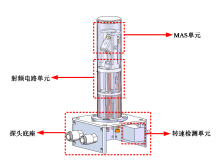
Fig. 1
Overall schematic diagram of low-field solid-state MAS probe structure
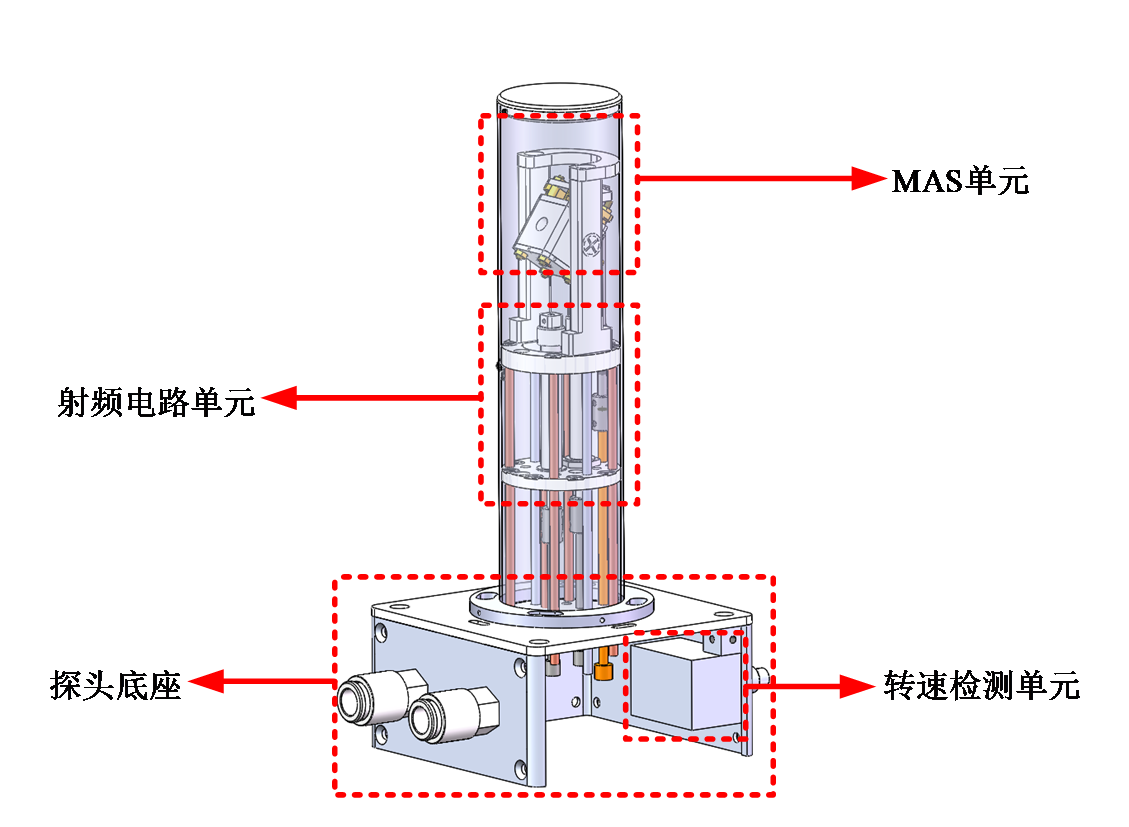
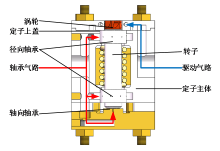
Fig. 2
Schematic diagram of the miniaturized MAS unit structure design
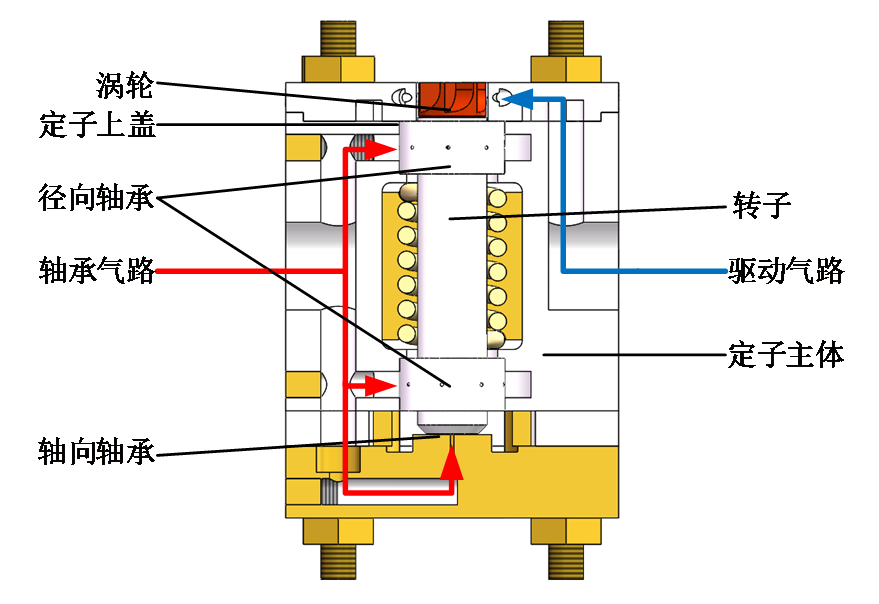
Fig. 3
3D exploded view of the miniaturized MAS unit
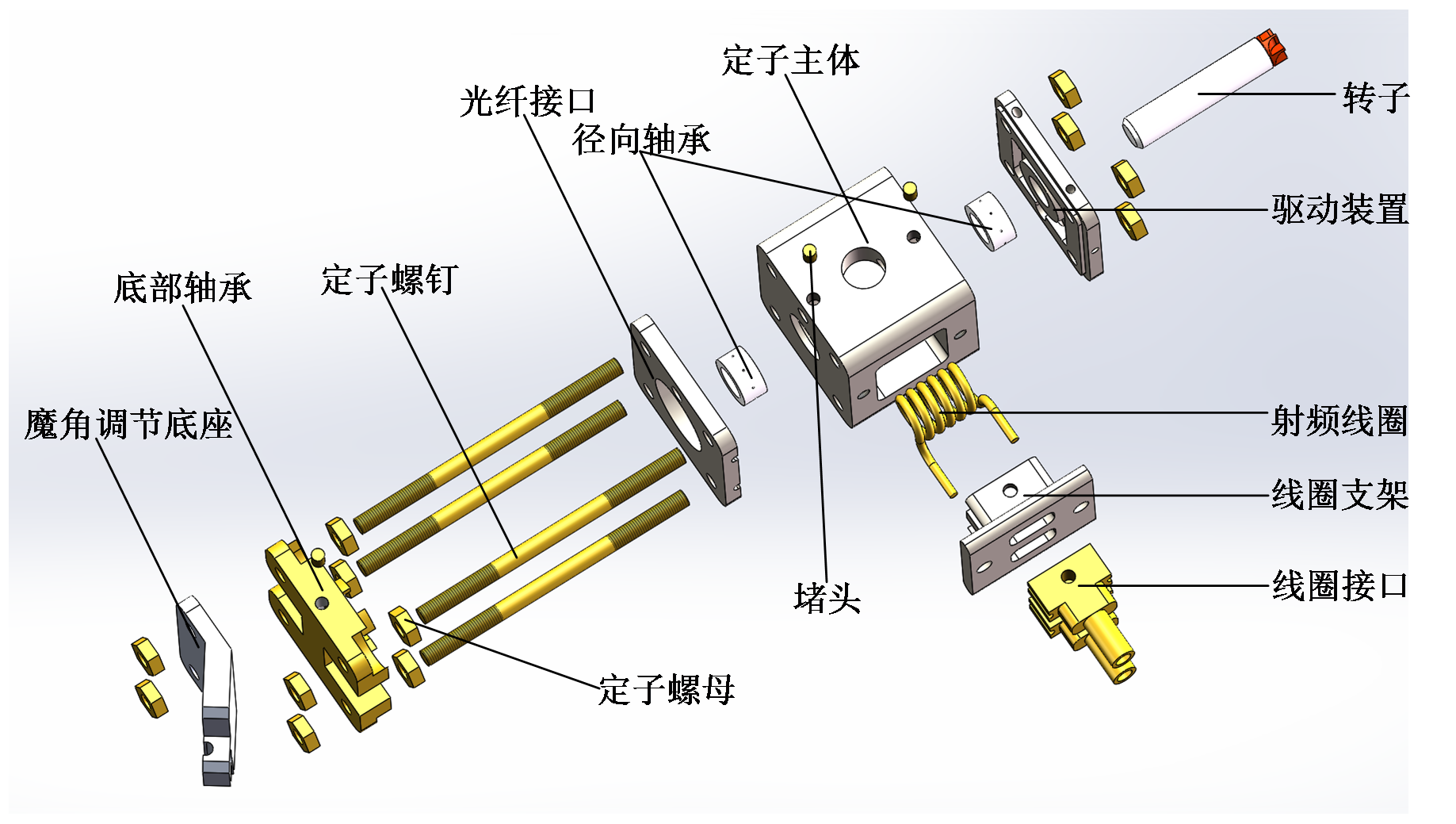
Fig. 4
Simulation diagram of the miniaturized MAS unit drive gas path. (a) Air pressure distribution diagram;(b) Flow velocity distribution diagram
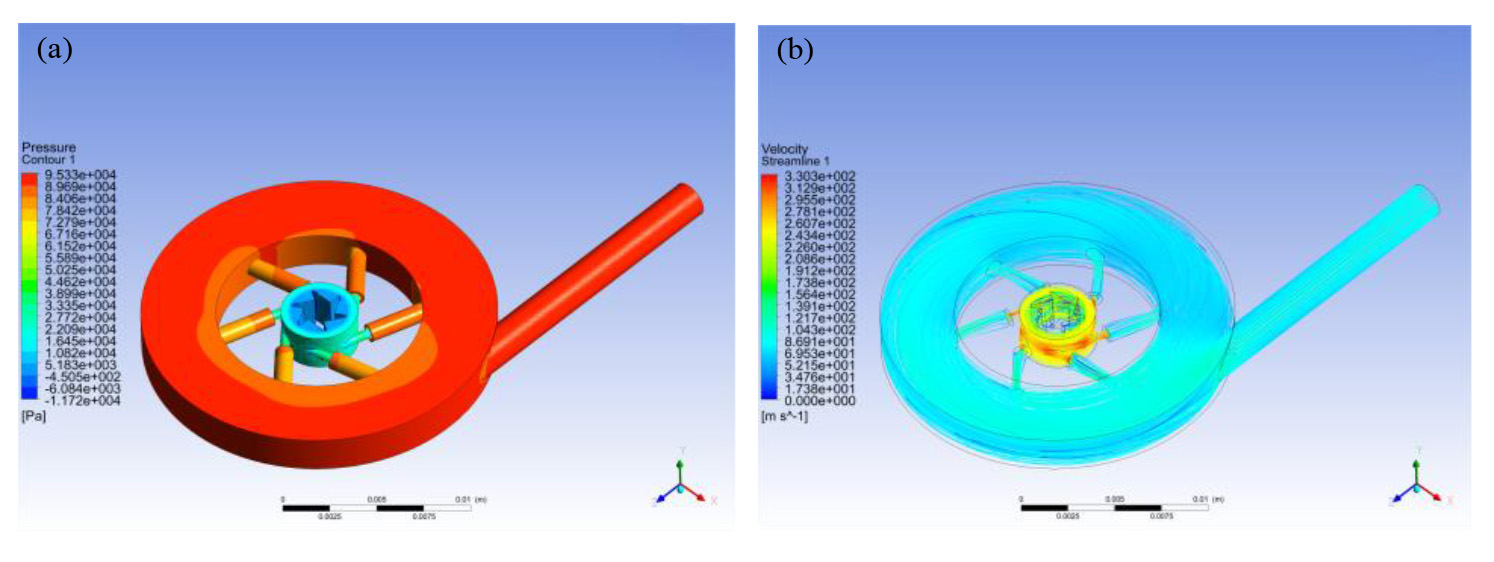
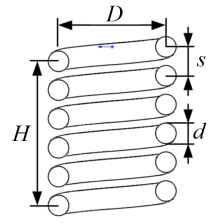
Fig. 5
Geometric structure diagram and key parameters of the solenoid coil
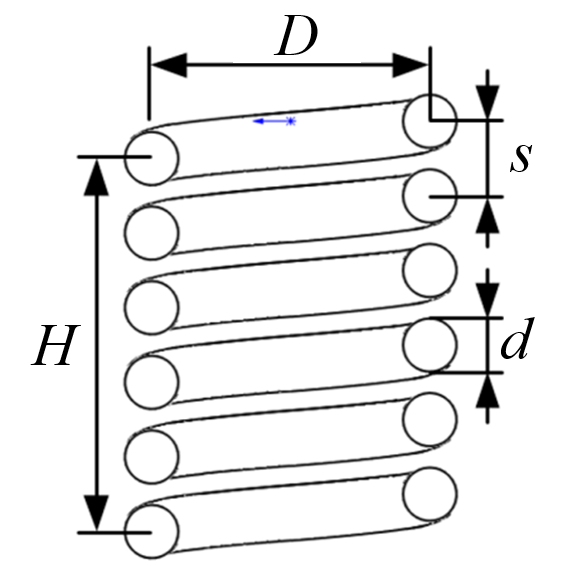

Table 1
Simulation optimization of solenoid coil turns
| 线圈匝数(N) | 相对信噪比(SNR) | 射频场均匀性(δ均匀) | 品质因数(Q) | 综合性能(P) |
|---|---|---|---|---|
| 4 | 3.43E-03 | 59% | 2.89E+02 | 0.586 |
| 5 | 3.68E-03 | 69% | 2.89E+02 | 0.732 |
| 6 | 3.80E-03 | 76% | 2.83E+02 | 0.819 |
| 7 | 3.79E-03 | 80% | 2.70E+02 | 0.815 |
| 8 | 3.65E-03 | 84% | 2.48E+02 | 0.761 |
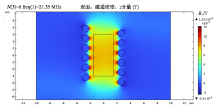
Fig. 6
Simulation results of the B1 field distribution of the solenoid coil, where magnetic flux density refers to the magnetic induction intensity of the radio frequency field, and the color from blue to red indicates the magnetic induction intensity from weak to strong
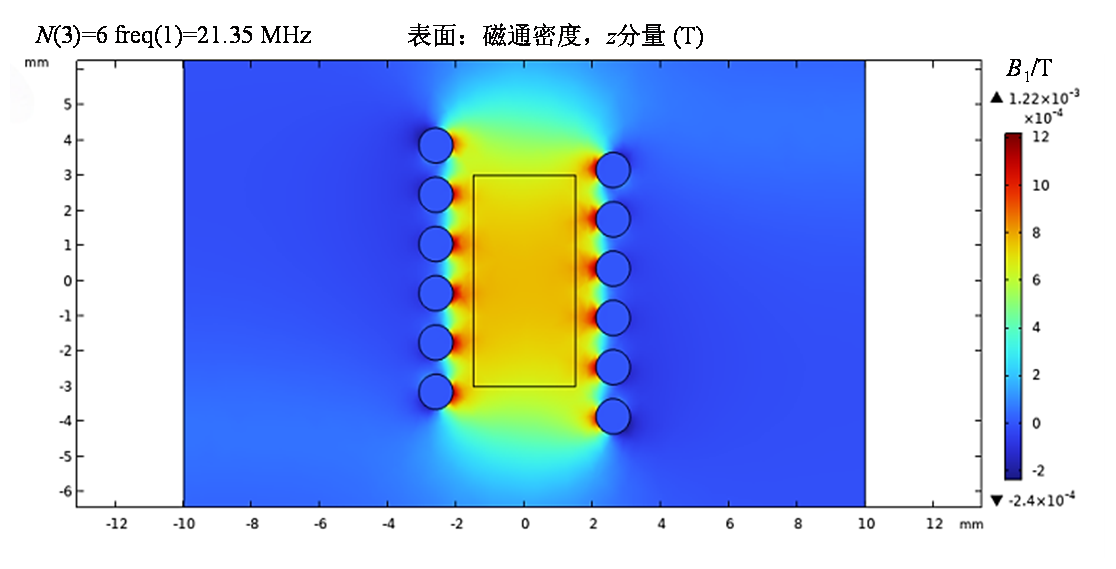
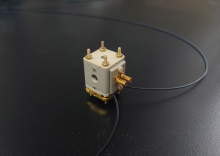
Fig. 7
Physical picture of the miniaturized MAS unit
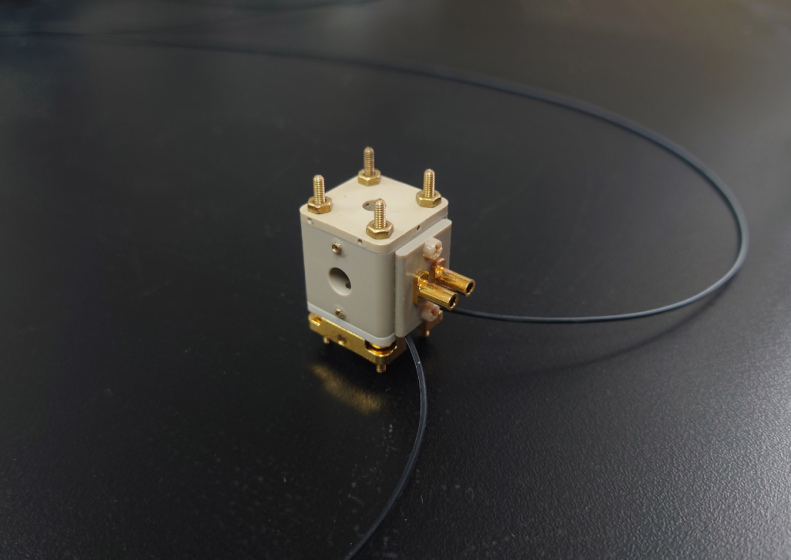
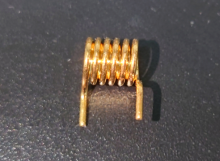
Fig. 8
Physical picture of the solenoid coil
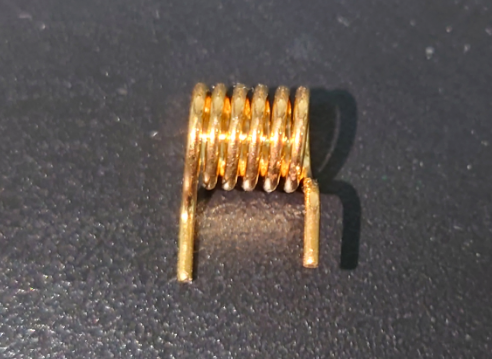
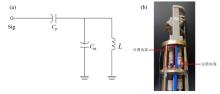
Fig. 9
Matching network of the radio frequency circuit and the physical picture. (a) LC parallel resonant network; (b) Photograph of the RF circuit
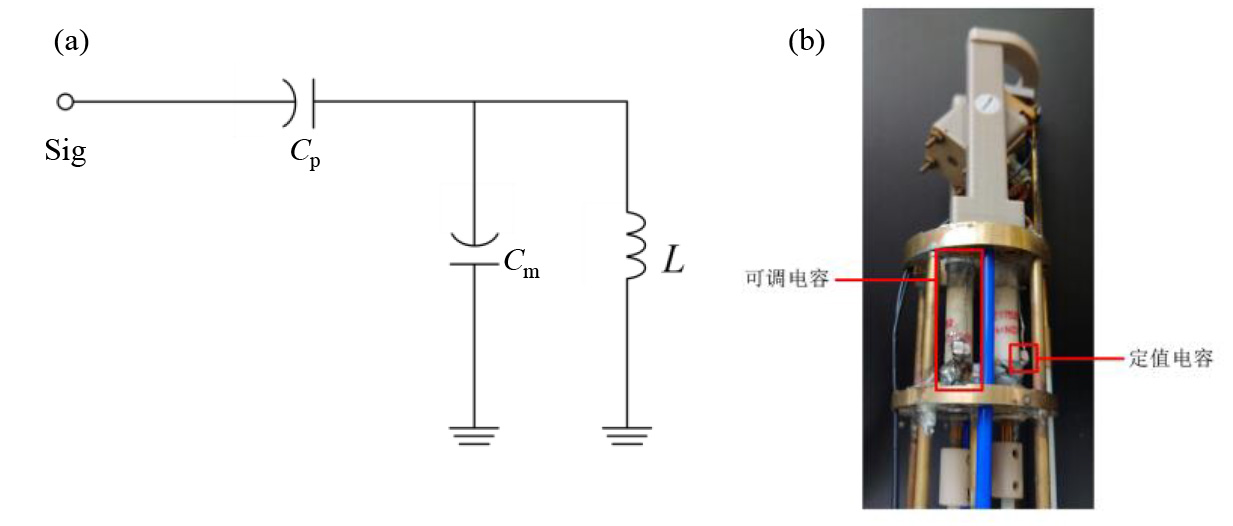
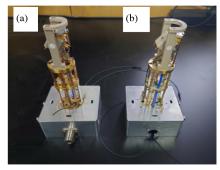
Fig. 10
Physical picture of the low-field solid-state MAS probe. (a) Probe for 7Li NMR signals; (b) Probe for 1H NMR signals
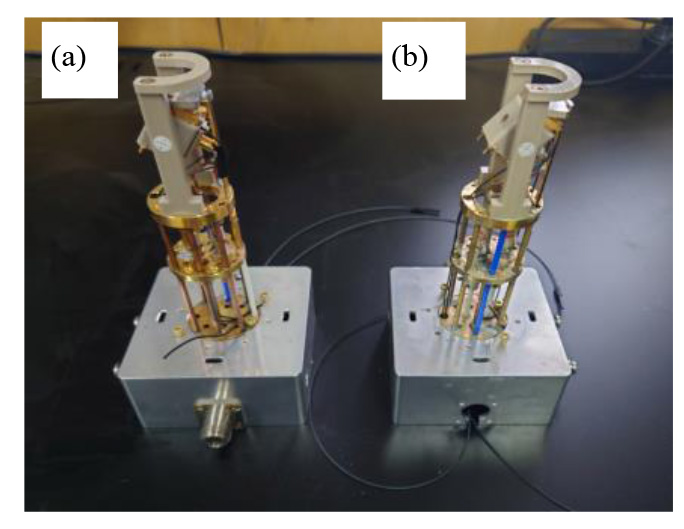
Fig. 11
Test results of the probe S11 parameters. (a) Test results of the S11 parameter for the 1H probe; (b) Test results of the S11 parameter for the 7Li probe
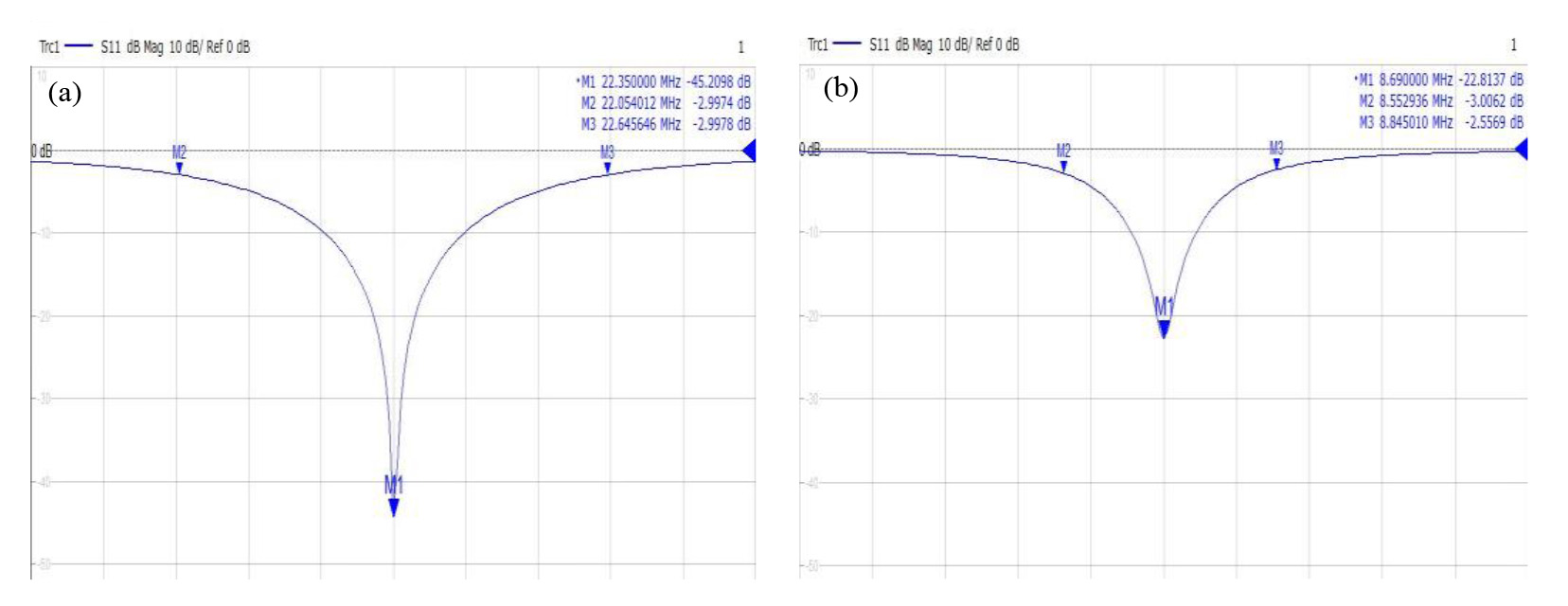
Fig. 12
Rotate speed test diagram of the MAS unit. (a) Low-field solid-state MAS probe; (b) Pneumatic control console
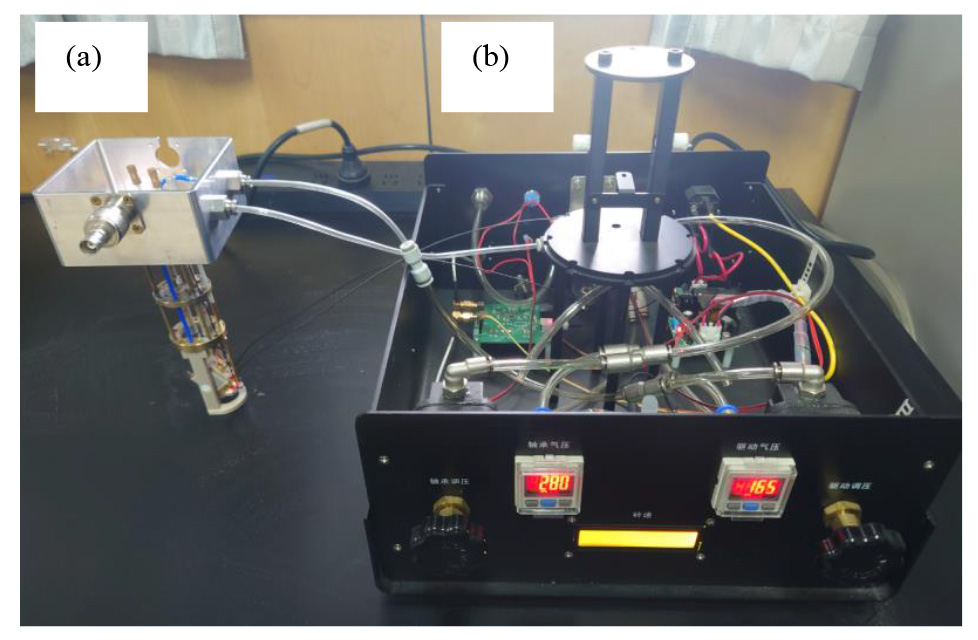
Table 2
Correspondence table of no-load rotor speed and air pressure
| 实验次数 | 轴承气压/kPa | 驱动气压/kPa | 转速/kHz |
|---|---|---|---|
| 1 | 105 | 35 | 4 |
| 2 | 120 | 45 | 5 |
| 3 | 140 | 55 | 6 |
| 4 | 170 | 70 | 7 |
| 5 | 190 | 85 | 8 |
| 6 | 205 | 100 | 9 |
| 7 | 220 | 120 | 10 |
| 8 | 245 | 145 | 11 |
| 9 | 270 | 165 | 12 |
| 10 | 290 | 190 | 13 |
| 11 | 310 | 215 | 14 |
Fig. 13
Block diagram of the low-field nuclear magnetic resonance testing platform composition
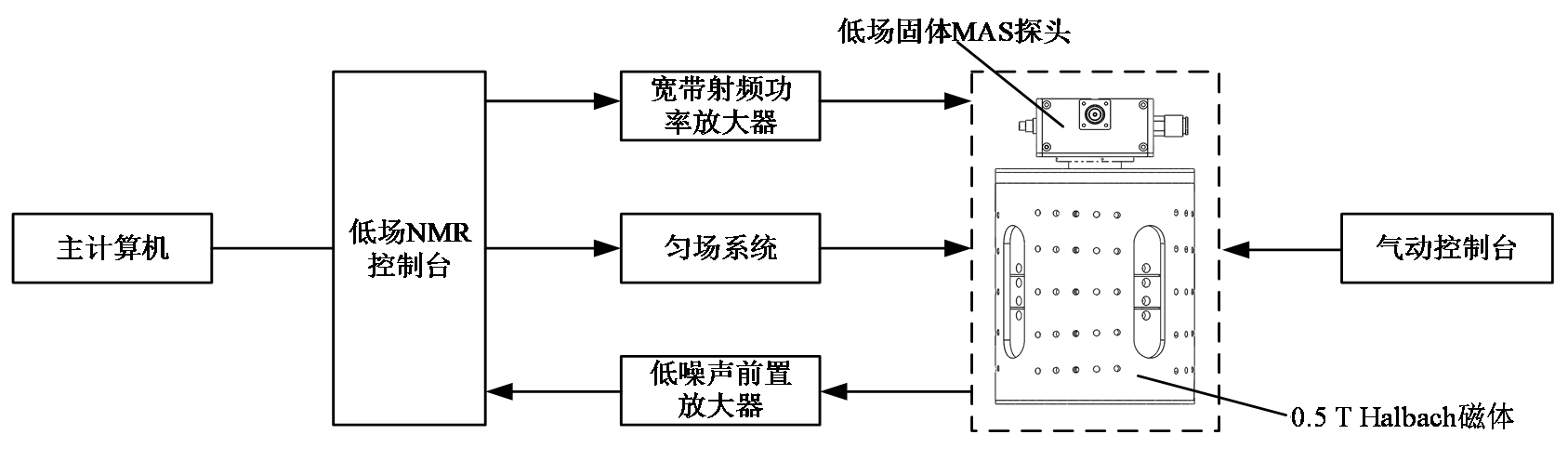
Fig. 14
Probe and magnet combination diagram. (a) Combined physical diagram; (b) Physical image of a bare magnet; (c) Combination schematic diagram
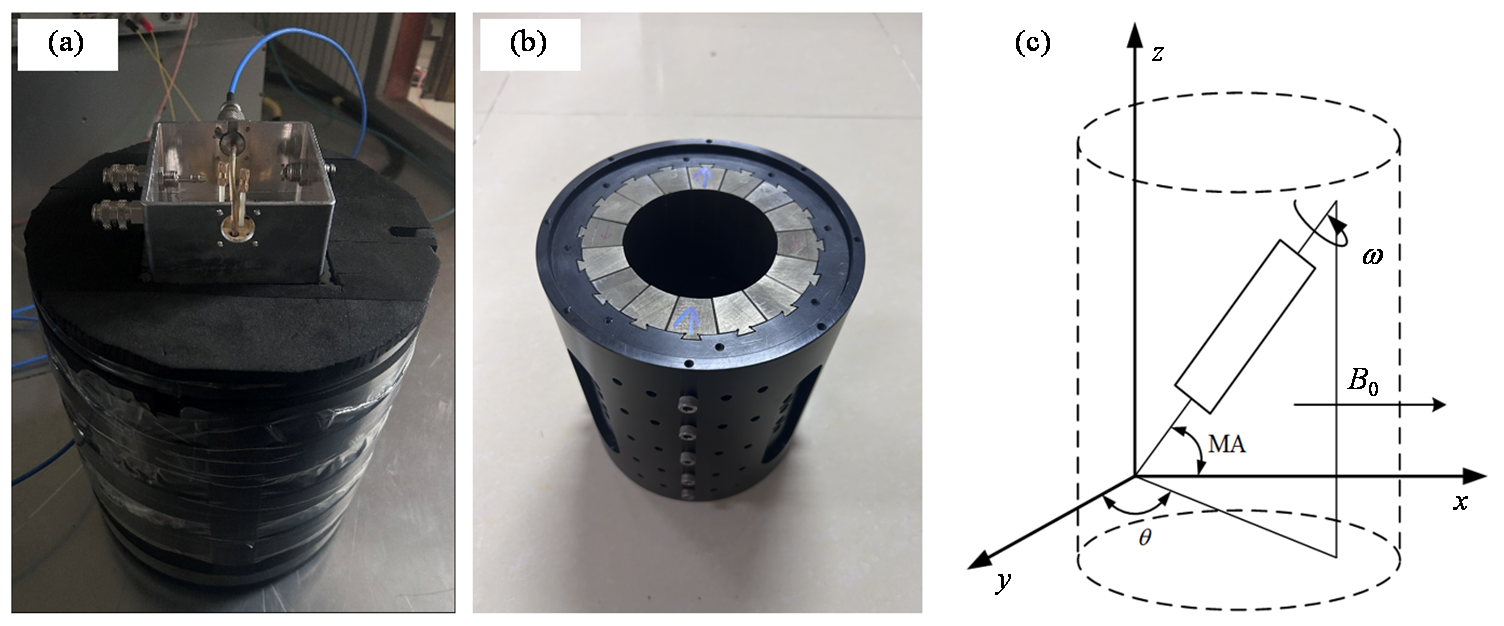
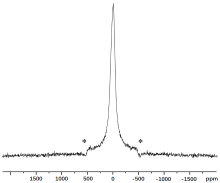
Fig. 15
1H NMR spectra of the adamantane sample. * the rotating sideband
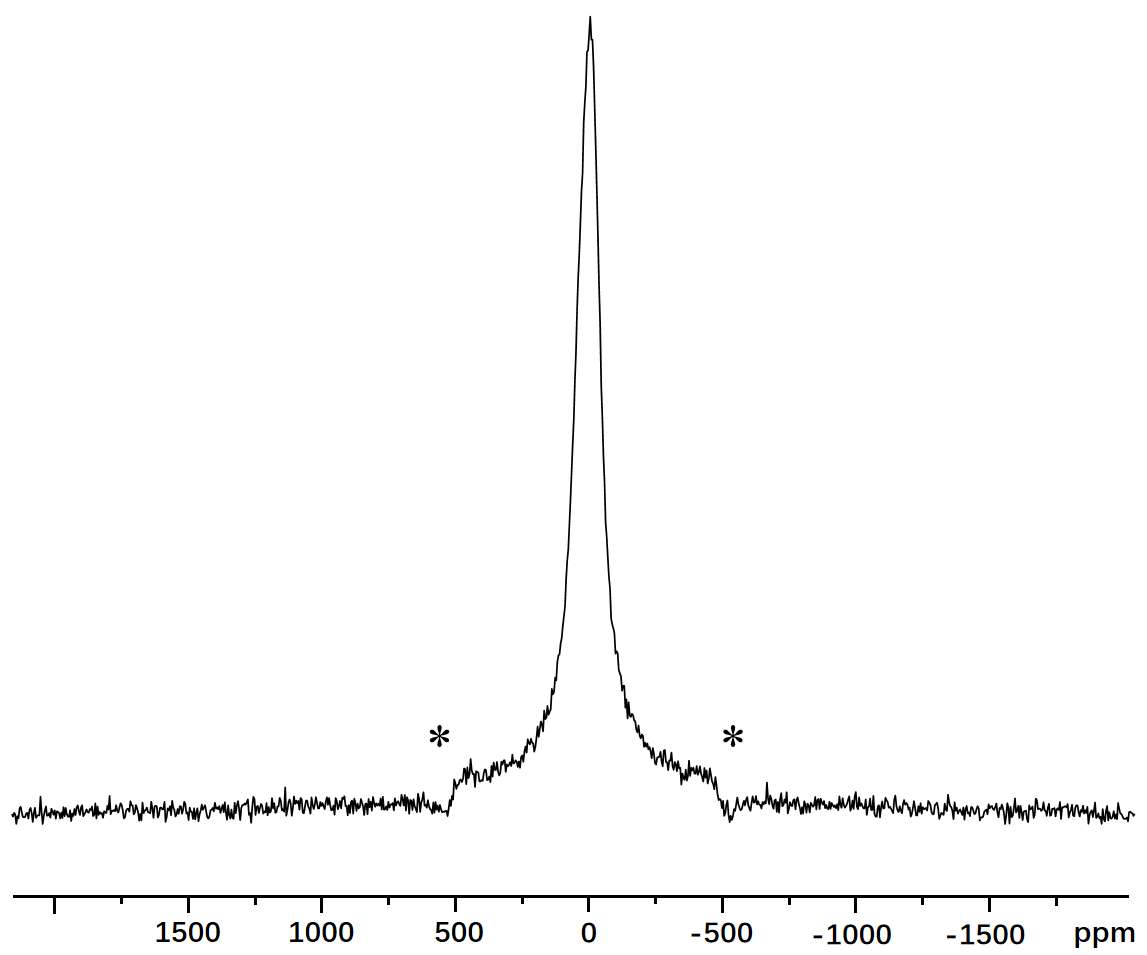

Fig. 16
Test results of 7Li NMR spectra. (a) 7Li NMR spectrum under high field reported in the literature[10]; 7Li NMR spectrum of LiFePO4 (b), Li3PO4 (c), LiCoO2 (d) and LiMn2O4 (e) under low field

| [1] | 杨勇. 固态电化学[M]. 北京: 化学工业出版社, 2017. |
| [2] |
PECHER O. Materials' methods: NMR in battery research[J]. Chem Mater, 2017, 29(1): 213-242.
doi: 10.1021/acs.chemmater.6b03183 |
| [3] |
LOWE I J. Free induction decays of rotating solids[J]. Phys Rev Lett, 1959, 2(7): 285-287.
doi: 10.1103/PhysRevLett.2.285 |
| [4] |
ANDREW E R, BRADBURY A, Eades R G. Removal of dipolar broadening of nuclear magnetic resonance spectra of solids by specimen rotation[J]. Nature, 1959, 183: 1802-1803.
doi: 10.1038/1831802a0 |
| [5] |
Yu P, Xu Y J, WU Z Y, et al. A low-cost home-built NMR using Halbach magnet[J]. J Magn Reson, 2018, 294: 162-168.
doi: S1090-7807(18)30191-5 pmid: 30055440 |
| [6] | HALBACH K. Strong rare earth cobalt quadrupoles[J]. Bull APS, 1979, 24(2): 183-183. |
| [7] |
LEE J N, ALDERMAN D W, JIN J Y. Cylindrical spinner and speed controller for magicangle spinning nuclear magnetic resonance[J]. Rev Sci Instrum, 1984, 55(4): 516-520.
doi: 10.1063/1.1137783 |
| [8] |
SORENSEN M K, BAKHAREV O, JENSEN O, et al. Magic-angle spinning solid-state multinuclear NMR on low-field instrumentation[J]. J Magn Reson, 2014, 238: 20-25.
doi: 10.1016/j.jmr.2013.10.015 pmid: 24291330 |
| [9] |
KLUG C A, SWIFT M W, MILLER J B, et al. High resolution solid state NMR in paramagnetic metal-organic frameworks[J]. Solid State Nucl Magn Reson, 2022, 120: 101811.
doi: 10.1016/j.ssnmr.2022.101811 |
| [10] |
XU K, ALDUDAK F, PECHER O, et al. High resolution solid-state NMR on the desktop[J]. Solid State Nucl Magn Reson, 2023, 126: 101884.
doi: 10.1016/j.ssnmr.2023.101884 |
| [11] | YE C H, LI L Y, SUN B Q. High resolution mas NMR of solids by a routine spectrometer for liquids[J]. Chinese J Magn Reson, 1985, 2(3): 227-236. |
| [12] | YANG Y, SUN X Q, GU L L, et al. Advances in the application of high-resolution magic-angle spinning NMR spectroscopy[J]. Chemical World, 2009, 50(5): 308-311. |
| [13] | 王佳鑫. 固体核磁共振探头魔角旋转单元的研制[D]. 北京: 中国科学院大学, 2019. |
| [14] |
ZBOROWSKI M, SUN L, MOORE L R, et al. Continuous cell separation using novel magnetic quadrupole flow sorter[J]. J Magn Magn Mater, 1999, 194(1): 224-230.
doi: 10.1016/S0304-8853(98)00581-2 |
| [15] |
LEONG S S, AHMAD Z, LOW S C, et al. Unified view of magnetic nanoparticle separation under magnetophoresis[J]. Langmuir, 2020, 36(28): 8033-8055.
doi: 10.1021/acs.langmuir.0c00839 pmid: 32551702 |
| [16] |
SUN B Q, YE Z H. Inhomogeneous interactions of solids under MAS[J]. Acta Physica Sinica, 1986, 35(3): 329-337.
doi: 10.7498/aps |
| 孙伯勤, 叶朝辉. 魔角旋转情形下固体的非均匀相互作用[J]. 物理学报, 1986, 35(3): 329-337. | |
| [17] | ILOTT A J, JERSCHOW A. Aspects of NMR reciprocity and applications in highly conductive media[J]. Concepts Magn Reson Part A, 2019, 1(2): 21466. |
| [18] | YANG B L, HU H B, ZHOU J W, et al. DNP CP/MAS probe design and discussion of DNP experimental technique[J]. Chinese J Magn Reson, 1996, 13(2): 183-190. |
| 杨保联, 胡红兵, 周建威, 等. 固体高分辨DNP CP/MAS探头的研制及DNP实验技术的探讨[J]. 波谱学杂志, 1996, 13(2): 183-190. | |
| [19] |
HENNEL J W, KLINOWSKI J. Magic-angle spinning: a historical perspective[J]. Top Curr Chem, 2005, 246: 1-14.
doi: 10.1007/b98646 pmid: 22160286 |
| [20] | KENDRICK R D, WIND R A, YANNONI C S. A method of orienting the rotation axis of a spinning sample used in a nuclear magnetic resonance experiment, its synthesis and use: EP, 0051124B1[P]. 1984-12-05. |
| [21] | HILL H D W, HUBER U. Device and method for spinning a sample for NMR probes, its synthesis and use: EP, 0020085A1[P]. 1980-12-10. |
| [22] | DAUGAARD P, JAKOBSEN H J, LANGER V. High speed spinner for NMR spectrometer, its synthesis and use: EP, 0249383B1[P]. 1991-01-16. |
| [23] |
GAO C, JUDGE P T, SESTI E L, et al. Four millimeter spherical rotors spinning at 28 kHz with double-saddle coils for cross polarization NMR[J]. J Magn Reson, 2019, 303: 1-6.
doi: 10.1016/j.jmr.2019.03.006 |
| [24] | BUSCHOW K H J, CAHN R, FLEMINGS M C, et al. Encyclopedia of materials: science and technology[M]. Amsterdam: Elsevier, 2001. |
| [25] | 吴利杰. 超高速空气静压电主轴动态性能流固耦合分析[D]. 广州: 广东工业大学, 2014. |
| [26] | WANG F, LIU T W, XU Y J, et al. A miniaturised NMR RF probe design with external field-locking channel[J]. Chinese J Magn Reson, 2023, 40(3): 332-340. |
|
王峰, 刘庭伟, 徐雅洁, 等. 一种带外部锁场通道的小型化核磁共振射频探头设计[J]. 波谱学杂志, 2023, 40(3): 332-340.
doi: 10.11938/cjmr20223044 |
|
| [27] | 袁毅. 面向10 MHz低场核磁共振仪器射频探头的研制[D]. 南京: 东南大学, 2022. |
| [28] |
JIANG Y J, WOOLFENDEN W R, ALDERMAN D W, et al. Efficient stator/rotor assembly for magic-angle spinning NMR[J]. Rev Sci Instrum, 1987, 58(5): 755-758.
doi: 10.1063/1.1139626 |
| [29] | BERNSTEIN M A, KING K F, ZHOU X J. Handbook of MRI pulse sequences[M]. Amsterdam: Elsevier, 2004. |
| [1] | LI Keyan, CHENG Xin, CHEN Junfei, CAO Li, HUANG Zhen, LIU Chaoyang. Development of Low-noise Preamplifier for Low-field NMR [J]. Chinese Journal of Magnetic Resonance, 2025, 42(3): 321-333. |
| [2] | SHEN Xueyuan, WANG Ruichen, QI Guodong, XU Jun, DENG Feng. Design of in situ Solid-State NMR Rotor Inserts and Their Application to Catalytic Reactions [J]. Chinese Journal of Magnetic Resonance, 2025, 42(1): 13-21. |
| [3] | CHEN Yang, ZHOU Meng, LI Yong, YANG Haijun. Independent Development of Sample Preparation Tools for Solid-state NMR [J]. Chinese Journal of Magnetic Resonance, 2024, 41(1): 77-86. |
| [4] | HE Caiyan,XIAO Yuqing,LI Shenhui,XU Jun,DENG Feng. Solid-state NMR Investigation of the Host-guest Interactions in Gas Adsorption and Chemical Separation Using MOFs as Adsorbents [J]. Chinese Journal of Magnetic Resonance, 2023, 40(2): 192-206. |
| [5] | SHI Guanghui,XIAO Lizhi,LIAO Guangzhi,LUO Sihui,HOU Xueli,LU Yapu. A New Method and Circuit of Ringing Suppression for Low-field NMR Instruments [J]. Chinese Journal of Magnetic Resonance, 2023, 40(1): 68-78. |
| [6] | Chao-wei SHI,Pan SHI,Chang-lin TIAN. NMR Studies of Large Protein Dynamics Using Unnatural Amino Acids [J]. Chinese Journal of Magnetic Resonance, 2021, 38(4): 523-532. |
| [7] | FENG Tao, CHEN Jun-fei, ZHANG Zhen, YANG Chun-sheng, ZHANG Zhi, LIU Chao-yang. A Design of Short Dead-Time RF Coil and RF Switch for Low-Field NMR [J]. Chinese Journal of Magnetic Resonance, 2021, 38(1): 1-11. |
| [8] | MA Cong-wei, YANG Hong-yi, ZHONG Kai. Research Progresses of High-Field MRI 1H/31P Dual-Tuned Radio Frequency Coil [J]. Chinese Journal of Magnetic Resonance, 2021, 38(1): 118-139. |
| [9] | ZHANG Shi-mao, GE Xiang, WANG Xin, HOU Ke-jun. A Two-Dimensional NMR Logging Method for Gas-Water Identification in Dolomite Reservoir of the Western Sichuan Gas Field [J]. Chinese Journal of Magnetic Resonance, 2020, 37(3): 360-369. |
| [10] | ZHANG Zhi-jie, LI Duan-xiu, LUO Chun, QIU Ru-chen, DENG Zong-wu, ZHANG Hai-lu. 13C Chemical Shift Assignment of Solid 2-Picolinic Acid by DFT/Crystallography Integrated Approach [J]. Chinese Journal of Magnetic Resonance, 2020, 37(1): 67-75. |
| [11] | GAO Xiu-zhi, ZHANG Yi, WANG Xiu-mei, ZHANG Zhi-hua, XU Guang-tong. Structure and Acidity Changes in Ultra-Stable Y Zeolites During Hydrothermal Aging: A Solid-State NMR Spectroscopy Study [J]. Chinese Journal of Magnetic Resonance, 2020, 37(1): 95-103. |
| [12] | FENG Zong-jing, DU Ya-ping, LUO Feng, XU Jun. An Ultrawide-Line 139La Solid-State NMR Investigation of Layered La(OH)2NO3 [J]. Chinese Journal of Magnetic Resonance, 2020, 37(1): 76-85. |
| [13] | WANG Yang, YANG Chang-ju, WEN Yu-jie, CHEN Jun-chao, DU Jia-huan, PENG Lu-ming. Analysis of the Concentrations of Surface Ni Ions in Ni/CeO2 With 17O Solid-State NMR Spectroscopy [J]. Chinese Journal of Magnetic Resonance, 2020, 37(1): 52-60. |
| [14] | XU Guang-yong, DONG Man-yuan, MA Jian-feng, ZHANG Li-min. Molecular Dynamics of Semi-Crystalline Poly(3-Hydroxybutyrate) and Poly(3-Hydroxybutyrate-Co-3-Hydroxyvalerate) Studies by Solid-State NMR Spectroscopy [J]. Chinese Journal of Magnetic Resonance, 2019, 36(4): 544-554. |
| [15] | XU Xiao-jun, WANG Shen-lin. Probing Membrane Protein Interactions by 19F Solid-State NMR [J]. Chinese Journal of Magnetic Resonance, 2019, 36(2): 238-251. |
| Viewed | ||||||
|
Full text |
|
|||||
|
Abstract |
|
|||||
